


Topic portal
Child Labour
What is child labour?
Not all work performed by children is child labour. International standards define child labour as work that is hazardous to a child’s health and development, demands too many hours and/or is performed by children who are too young. Usually, child labour interferes with a child’s right to education and to play. This issue is at the core of the ILO mission.
Explore the causes and different forms of child labour
Explore the causes
Root causes of child labour
Explore the worst forms
Worst forms of child labour
Explore hazardous work
Hazardous child labour
ILO action to end child labour

International Programme on the Elimination of Child Labour and Forced Labour (IPEC+)

6th Global Conference on the Elimination of Child Labour - The Marrakech Global Framework
Our impact, their voices

Video playlist
Our impact, their voices - A selection of videos on the reality of child labour
Projects
Project
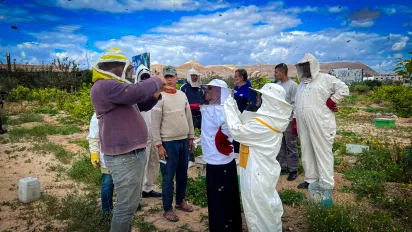
Economic empowerment and resilience for at-risk families in Jericho and the Jordan Valley

ESDC-Funded Project
Expanding Action on Forced Labour and Child Labour to Advance Fundamental Principles and Rights at Work (FPRW) in Malaysia

Strengthening resilience to climate change for the elimination of child labour in cocoa producing areas in Ghana
Partnerships and initiatives

Alliance 8.7 Global Partnership

8.7 Accelerator Lab Initiative

Child Labour Platform (CLP)

Regional Initiative Latin America and the Caribbean Free of Child Labour
International Labour Standards on child labour
One of the most effective ways to ensure that children do not start working too young is to establish the minimum age at which they can legally be employed or otherwise work.
ILO Convention No. 138 on the minimum age for admission to employment or work aims to achieve the effective abolition of child labour by requiring countries to (1) establish a minimum age for entry into employment or work; and (2) establish national policies for the elimination of child labour.
Recommendation No. 146, which accompanies ILO Convention No. 138, stresses that national policies and plans should provide for poverty alleviation and the promotion of decent jobs for adults, so that parents do not need to resort to child labour; free and compulsory education and the provision of vocational training; the extension of social security and birth registration systems; and appropriate facilities for the protection of children and adolescents who work.
To achieve the elimination of child labour, laws setting minimum ages for work should be embedded in such comprehensive policy responses.
The Recommendation is non-binding and does not require ratification.
ILO Convention No. 182 on the worst forms of child labour helped draw international attention to the urgent need to eliminate these forms as a priority, while maintaining the long-term goal of the effective elimination of all child labour. The Convention requires countries to take immediate, effective and time-bound measures to eliminate the worst forms of child labour as a matter of urgency.
ILO Convention No. 182 is the first ILO Convention to achieve universal ratification. It was also the most rapidly ratified Convention in the history of the ILO, with the majority of ratifications occurring within the first three years after its adoption in 1999.
ILO Recommendation No. 190, which accompanies Convention No. 182, recommends that any definition of “hazardous work” should include: (i) Work that exposes children to physical, psychological or sexual abuse; (ii) Work underground, underwater, at dangerous heights or in confined spaces; (iii) Work with dangerous machinery, equipment and tools, or work involving heavy loads; (iv) Exposure to hazardous substances, agents or processes, or to temperatures, noise levels or vibrations damaging to health; (v) Long working hours, night work or unreasonable confinement to the employer's premises.
The Recommendation is non-binding and does not require ratification.
Campaigns: Get involved!

World Day Against Child Labour - 12 June

Red Card to Child Labour!

Music against Child Labour Initiative
News and stories

ACCEL Africa Gender LABb: Turning gender equality commitments into action to address the root causes of child labour

Nigeria strengthens national action to end child labour and promotes child’s participation
Most recent publications
Combating child labour in Egypt
Code of conduct for the training and employment of children: Guidance for companies and enterprises in Egypt

Report
Situation analysis study on the worst forms of child labour and education status in agriculture and rural areas of Myanmar
2026 edition
International Programme on the Elimination of Child Labour and Forced Labour (IPEC+) - A snapshot of action around the world
Training and learning resources on child labour


General and sector-specific courses

Country-specific training
Practical tools and resources

For teachers
SCREAM: Supporting Children's Rights through Education, the Arts and the Media

For companies
Checkpoints for eliminating and preventing child labour: A mobile application against child labour