

Joint ILO / FAO publication
Policy guidance on the elimination of child labour in fisheries and aquaculture
This policy guidance offers a framework for governments, industry, employers’ and workers’ organizations, communities and international partners to translate international commitments into practical measures. By acting together, stakeholders can support sustainable fisheries and aquaculture, as part of efforts to build resilient and equitable agrifood systems, while upholding children’s rights and well-being.
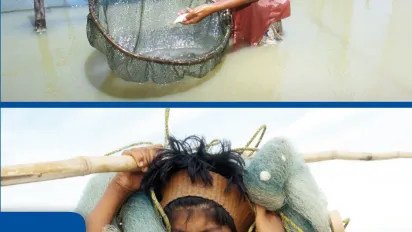
Child labour persists in fisheries and aquaculture, in contexts ranging from coastal villages and inland fish farms to seafood processing plants. Children may face hazardous conditions, long hours, exposure to chemicals, and risks of exploitation and trafficking, often at the expense of their education, health and development. The continued presence of child labour undermines children’s rights and well-being, perpetuates cycles of poverty, and poses challenges to the sustainability of fisheries and aquaculture as sources of livelihoods and food security.
Eliminating child labour in fisheries and aquaculture requires integrated strategies that combine prevention, protection and sustainable alternatives. It is important to recognize that the underlying drivers are multidimensional and interconnected and include poverty, lack of decent work for adults, insufficient access to quality and inclusive education, limited social protection, weak governance, and sociocultural norms that normalize child labour. Effective responses therefore need to be holistic, gender-sensitive and adapted to local realities.
Additional details
References
- DOI: https://doi.org/10.54394/WLLR4354
- ISBN Print: ILO: 9789220428351
- ISBN Web PDF: ILO: 9789220423097 / FAO: 9789251401682
Related content
Guidance on addressing child labour in fisheries and aquaculture

Sector portal
Agriculture, aquaculture, plantations, other rural sectors