


Productivity Ecosystems for Decent Work Programme Viet Nam
Duration
1 January 2021 - 30 April 2026
Development partner(s)
Swiss State Secretariat for Economic Affairs (SECO) and the Norwegian Agency for Development Cooperation (NORAD)
Location
Vietnam
Contact
Gulmira Asanbaeva, Project Manager (Email: [email protected])
Additional details


Background
Over the past thirty years Viet Nam has achieved unprecedented rapid economic development. Per capita GDP has increased almost five times at constant prices from 732 USD in 1992 to 3,694 USD in 2021. Living standards have increased accordingly and millions of Vietnamese have escaped material poverty. These achievements are the result of a rapid growth in productivity that has been sustained for a long time – in the past decade alone labour productivity has grown 4.9 percent per year on average, albeit from a much lower base than neighbouring countries.
Structural transformation has been a key driver of productivity. The transfer of labour from agriculture, characterized by overemployment and low productivity, to the non-agricultural sectors with higher productivity levels became a forceful driver of overall productivity and economic growth. However, the contribution of structural transformation to productivity growth is slowing – within-sector productivity growth is becoming a more important driver of productivity. The economic model based on cheap, abundant rural labour going into low skill, labour-intensive manufacturing is slowly eroding and new vectors of productivity and growth need to be found for Vietnam to pursue its impressive development course.
A key challenge for Viet Nam is to ensure that growth in productivity and decent work is not limited to a few industries. It needs to be generated across all enterprise segments to create more productive jobs for all. However, the large segment of unproductive micro- and small enterprises in the domestic private sector is growing rather than shrinking, implying that structural transformation is not sufficient to absorb the surplus labour via reallocation to higher productivity sectors. Rather, Viet Nam must improve productivity and working conditions of this enterprise segment to overcome its productivity challenge and create decent and productive work for everyone.
Latest updates

Productivity ecosystems for decent work
How strategic approaches to productivity can drive environmental sustainability and long-term economic growth

Productivity ecosystems for decent work
Leading with purpose: Hanh champions women’s voice in Viet Nam’s manufacturing future
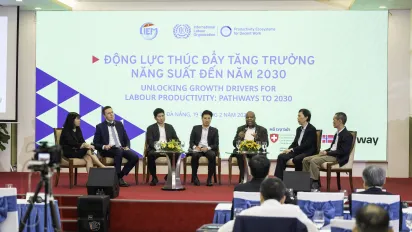
A collaborative approach to unlocking growth drivers for sustainable productivity in Viet Nam

Productivity ecosystems for decent work
Women breaking barriers: Nhung rises as consultant in male-dominated manufacturing
Drivers of productivity growth in Viet Nam

Research report: Gender diagnostics in support of transforming employment frameworks in Viet Nam

Measuring change: Productivity ecosystems and decent work in practice

Decarbonisation is a new priority for Viet Nam's wood processing industry
Key resources

Employment policies
Enhancing the gender responsiveness of the proposed revisions to the Employment Law in Viet Nam (Policy brief)

Employment policies
Labour Market Information Systems: International experiences and considerations for the revision of the Viet Nam Employment Law (Policy...

Viet Nam
Viet Nam's machinery and equipment industry - A systemic sector assessment

Viet Nam
Viet Nam’s wood and furniture industry - A systemic sector assessment
More information

Research report: Gender diagnostics in support of transforming employment frameworks in Viet Nam
Productivity ecosystems for decent work
How strategic approaches to productivity can drive environmental sustainability and long-term economic growth
Productivity ecosystems for decent work
Leading with purpose: Hanh champions women’s voice in Viet Nam’s manufacturing future
A collaborative approach to unlocking growth drivers for sustainable productivity in Viet Nam
Productivity ecosystems for decent work
Women breaking barriers: Nhung rises as consultant in male-dominated manufacturing

Decarbonisation is a new priority for Viet Nam's wood processing industry