

Productivity ecosystems for decent work
How strategic approaches to productivity can drive environmental sustainability and long-term economic growth
Integrating productivity and environmental stewardship in Viet Nam
10 October 2025
HA NOI (ILO News) - As Viet Nam rapidly industrializes and targets an annual productivity growth rate of at least 6.5%, managing the environmental impact of this progress has become a pressing challenge. Balancing productivity with sustainability is not only possible - it is essential for the country’s long-term prosperity.
Aligning productivity and sustainability
In recent years, Viet Nam has made significant advances in boosting productivity across key sectors. However, the link between productivity and environmental sustainability has not always been fully addressed. The two goals are often seen as competing priorities. Yet, when approached strategically, they can reinforce each other.
Enhancing productivity typically involves optimizing resource use, reducing waste, and improving operational efficiency - all of which contribute to environmental sustainability. By adopting greener practices, enterprises can ensure the long-term availability of resources, reduce costs associated with waste and energy use, and achieve sustained productivity gains.
Transforming the wood processing sector
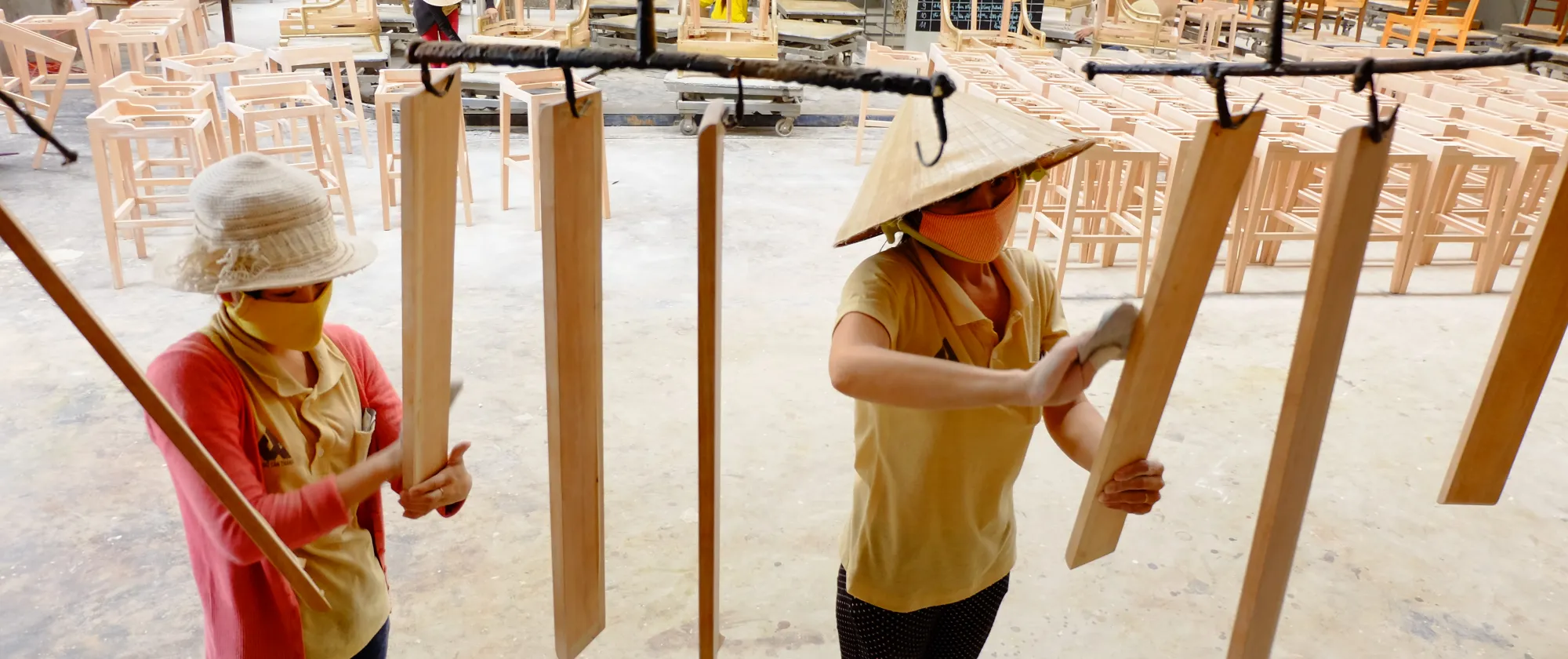
The wood processing industry - one of the key sectors supported under the ILO’s Productivity Ecosystems for Decent Work programme - illustrates how Viet Nam is putting this approach into practice. Despite growing awareness, many enterprises in this sector still face challenges such as limited resources, outdated technologies, and regulatory uncertainty.
The programme launched 10 pilot greenhouse gas (GHG) inventories. Six are in collaboration with all four key sector associations, and four are with private and government partners. Pioneering enterprises participated in the pilots, such as Lam Viet Furniture, Thanh Tam Wood Furniture, Happy Furniture, Tran Duc Home, Vitana Wood, and Imiti Wood played a pivotal role, as they are widely respected in the sector for their production capacity and adaptability to new technologies and development trends. All pilots revealed:
- A clear and feasible potential reduction of 25% in GHG emissions, including 10% achievable through improved management practices (e.g., enhanced monitoring and staff engagement without major financial costs) and an additional 15% through renewable energy investments, despite existing policy constraints on grid connection and electricity trading.
- The roadmap for a phased approach to net zero by investing in renewable energy was both realistic and financially sound.
These pilots showed that emission reductions were not abstract development goals but practical, achievable outcomes. They provided the credibility needed to convince other firms that the green transition could strengthen competitiveness and result in both short-term, practical benefits and long-term, strategic change toward more sustainable development.
Building partnerships for a green transition
By 2025, all four major wood processing associations - Binh Duong Furniture Association, Handicarft and Wood Industry Association of Ho Chi Minh City, Dong Nai Wood and Handicraft Association, and Forest Products Association of Binh Dinh - will have made decarbonization a strategic priority, with formal cooperation agreements signed with the ILO’s Productivity Ecosystems for Decent Work programme to advance GHG reduction training, consultancy, and best practice sharing. These efforts are preparing the industry for stricter global market requirements on transparency and accountability. Over 50 enterprises in the sector have benefited from these initiatives.
The programme also supports the Viet Nam Productivity Institute (VNPI) in developing Green Productivity services for small and medium-sized enterprises. Through a 2023 Training of Trainers initiative, VNPI is building national capacity in GHG accounting, waste reduction, and cleaner production - targeting at least 40 enterprises and 15 public agencies by 2025. VNPI has since embedded green productivity in its core services and will reflect these outcomes in the 2024 Viet Nam Productivity Report to inform policy and scale good practices.
Project results have also gained national and international recognition, showcased by the Swiss Embassy at EuroCham’s Green Economy Forum 2024 and by Ministry of Industry and Trade at the National Export Promotion Forum on Green Export.
Towards a sustainable future
The Productivity Ecosystems for Decent Work programme in Viet Nam shows how productivity and sustainability reinforce each other. By addressing challenges at policy, sectoral, and enterprise levels, it drives competitiveness, protects the environment, and improves working lives.
As Viet Nam moves toward upper-middle-income status by 2045, integrating environmental goals into productivity strategies is essential for lasting resilience. Through green technologies, stronger institutions, and responsible business practices, Viet Nam demonstrates that productivity and sustainability can advance together, building a resilient and inclusive future.
Related content

Productivity Ecosystems for Decent Work Programme Viet Nam

Viet Nam
Viet Nam’s wood and furniture industry - A systemic sector assessment

Decarbonisation is a new priority for Viet Nam's wood processing industry
Relevant projects
Productivity
Productivity Ecosystems for Decent Work Project

Productivity ecosystems for decent work
Productivity Ecosystems for Decent Work Programme Ghana