


Sector portal
Construction
The construction industry produces a wide range of products, and the enterprises are equally diverse. However, the vast majority of enterprises involved in on-site construction are small and local. Despite globalization and the existence of an international construction industry, the majority of construction activity is still undertaken by local firms. There is a tendency among enterprises in construction (as in other industries) to outsource the supply of goods and services required in the production process. Building materials, plant and equipment are generally purchased or hired from other enterprises. Specialized services are supplied by subcontractors, and labour by labour agents. Design and engineering services are also provided by separate professional entities.
There have been technological changes in the industry, notably the increasing use of environment-friendly technologies. There is a need for skills training for workers and managerial training for enterprises to adapt to such changes. The decentralization of government activities related to construction bring new demands for local authorities, involved on a large amount of construction activities through direct administration and/or contracting private enterprises. Following, there is a need to build the capacity of local authorities regarding labour issues in construction.
The construction industry generates jobs for large numbers of people. Labour conditions vary widely throughout the world. The Sectoral Policies Department (SECTOR) has undertaken research on emerging labour issues in the construction industry, facilitated social dialogue among the ILO’s tripartite constituents, provided technical advice, and developed practical tools, policy recommendations, and training modules used by the headquarters and field offices.
Key resources
- Safety and Health in Construction Convention, 1988 (No. 167)
- Safety and Health in Construction Recommendation, 1988 (No. 175)
- Occupational Safety and Health Convention, 1981 (No. 155)
- Occupational Safety and Health Recommendation, 1981 (No. 164)
- Protocol of 2002 to the Occupational Safety and Health Convention, 1981
- Occupational Health Services Convention, 1985 (No. 161)
- Occupational Health Services Recommendation, 1985 (No. 171)
- Promotional Framework for Occupational Safety and Health Convention, 2006 (No. 187)
- Promotional Framework for Occupational Safety and Health Recommendation, 2006 (No. 197)
- Asbestos Convention, 1986 (No. 162)
- Asbestos Recommendation, 1986 (No. 172)
Safety and health in construction

Safety and health in construction
ILO Code of practice
This code promotes a preventative safety and health culture in which the right to a safe and healthy working environment is respected throughout the construction project life cycle.

Safety and health in construction
Training package
This training package draws on the ILO Code of Practice and is designed to support national implementation of the code and to promote the rights to a safe and healthy working environment in the sector
Data and statistics
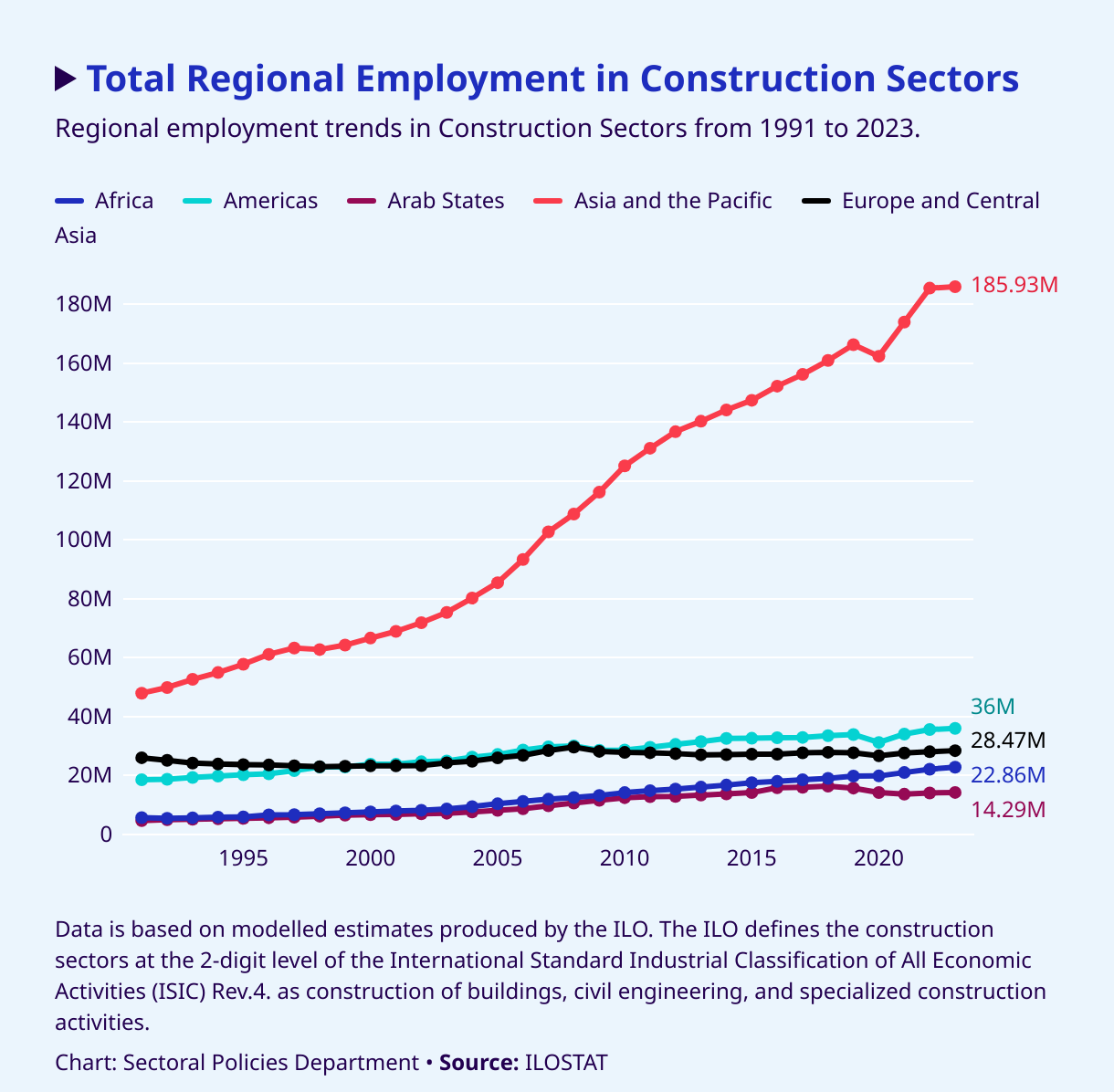
The line graphs show a time series of modelled global and regional employment estimates at the sectoral level. The ILO modelled estimates generally cover 189 countries, offering a comprehensive set of internationally comparable labour statistics. These include both reported data and imputed figures for countries with missing information. The imputations are generated using econometric models developed by the ILO.
For more detailed labour market indicators and country-level data, visit the Sectoral Employment Statistics page of the ILOSTAT database.
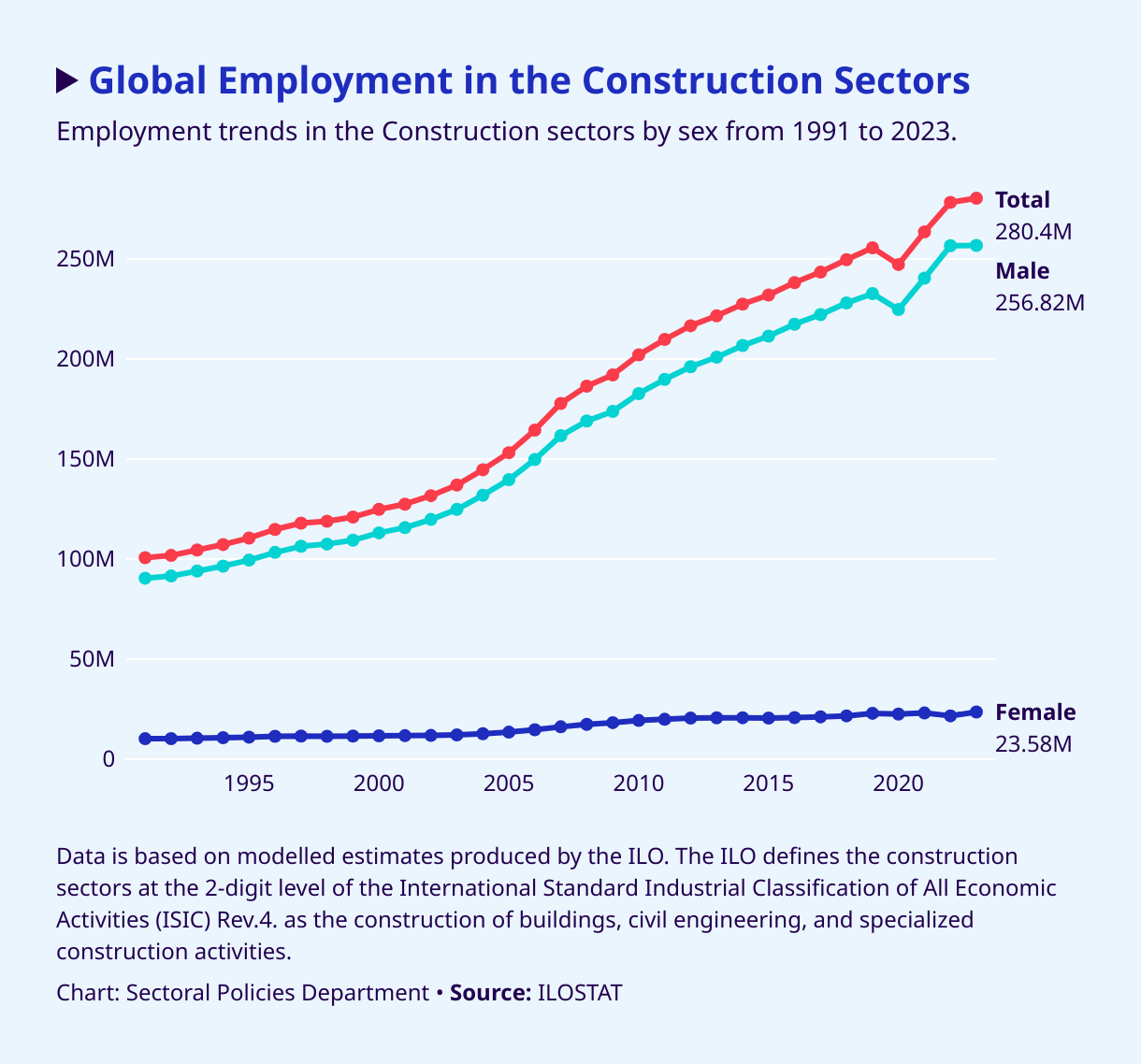
The line graphs show a time series of modelled global and regional employment estimates at the sectoral level. The ILO modelled estimates generally cover 189 countries, offering a comprehensive set of internationally comparable labour statistics. These include both reported data and imputed figures for countries with missing information. The imputations are generated using econometric models developed by the ILO.
For more detailed labour market indicators and country-level data, visit the Sectoral Employment Statistics page of the ILOSTAT database.
News

Building Information Modeling
Digital construction skills training opens pathways for Filipino youth

Green skills
Philippines pilots new green skills construction training

Digital skills
Philippines advances digital construction skills
Publications and documents
Brief
Informality in Nepal’s Construction Sector: Promoting enterprise formalization and extending social protection to construction workers
Build it right: Policy, procurement and decent work in Mozambique
Press release
Pakistan approves Occupational Safety and Health Code of Practice for the construction sector
Projects
Just transition through skills for employment
Just Transitions for Men, Women and Youth through Skills Training and Jobs Creation in Sustainable Construction and Eco-Tourism in Flood...
Labour migration
Ensuring Decent Work and Reducing Vulnerabilities for Women and Children in the Context of Labour Migration in South-East Asia (PROTECT)
HIMO Bâtiments in Madagascar
RECYCLING
Recycling is key to the circular economy, employing at least 6.9 million workers worldwide, many in the informal sector. Expanding recycling could create 7 million more jobs by 2030, but current roles often lack decent work standards.
Contact information
Sectoral Codes of Practice and Guidelines
Sectoral meetings
Conclusions and recommendations of sectoral meetings
Sign up to our newsletter!
Receive ILO news about sectoral work