

Supporting young people’s employability and job creation through the EII approach in Cameroon’s transport sector
Youth employability and the strengthening of agricultural value chains through employment-intensive investments in Cameroon.
Duration
27 December 2021 - 31 December 2026
Development partner(s)
African Development Bank (AfDB)
Reference
CMR/20/02/BAD
Location
Bamenda, Cameroun
Contact
Ramiarintsoa Holiarivony, EIIP Specialist
Previous phase CMR/20/01/CMR
Summary
Due to the lack of economic opportunities in the North West and South West regions of Cameroon, these populations are overcome by discouragement and idleness. The consequence of this generalized malaise leads not only to addictive behaviour and the negation of civic and moral values, but also favours violent extremism, one of the corollaries of which is enrolment in the armed groups that currently exist in the region. Thus, there is an urgent need to act and provide economic opportunities to the youth of the region in order to keep them away from these armed groups.
To this end, the ILO has been solicited to provide technical assistance that will focus on:
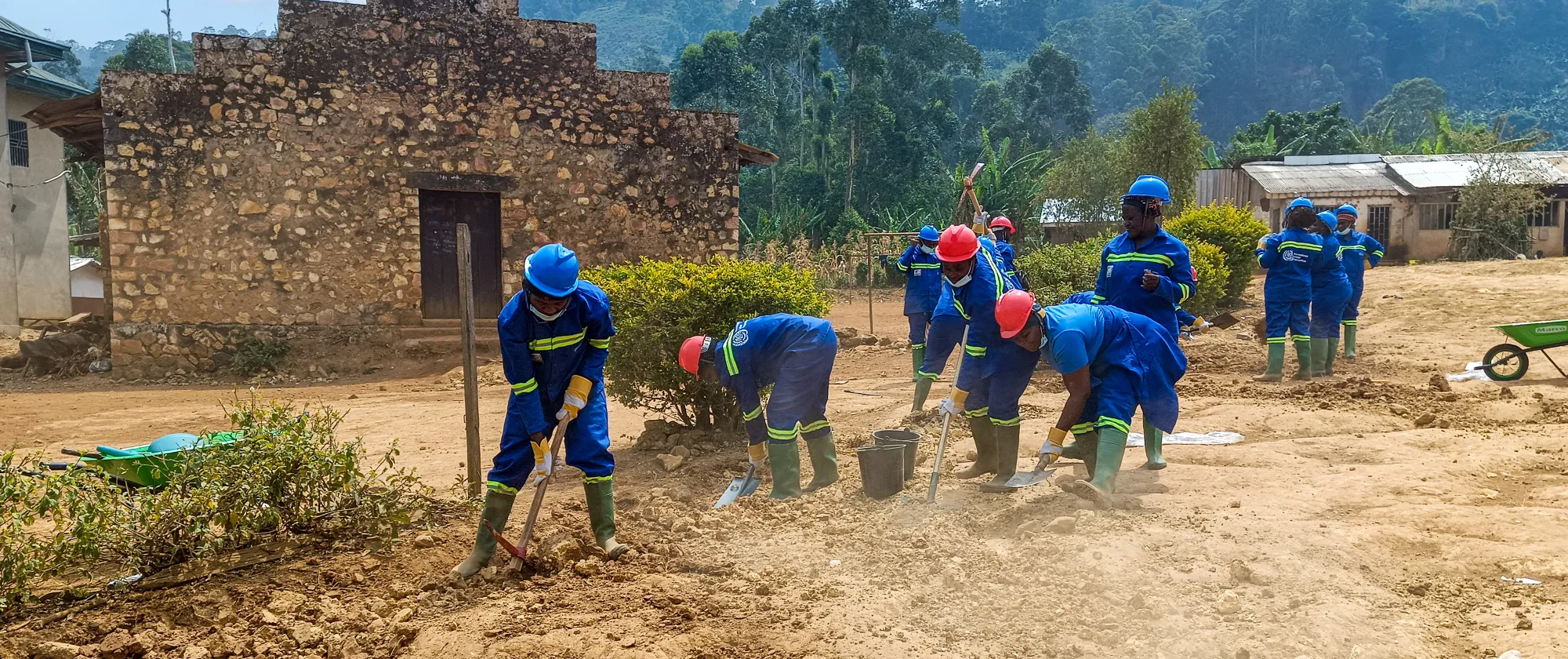
- Training of young people in the PIZ in labour-based techniques and road maintenance with a view to their integration into existing or future Communal Road Committees (CRCs).
- Diagnosis of the situation of the CRCs, their capacity to take on road maintenance or rehabilitation and capacity building in labour-based approaches with a view to their effective participation in public contracts for road maintenance.
- Sensitisation of local administrations to the problem of post-rehabilitation maintenance and strengthening their capacity to manage road maintenance contracts.
- Analyses of the agricultural value chain in the PIZ in order to boost agricultural production so as to create more jobs for young people.
- Structuring young people into CRCs, economic interest groups and/or cooperatives with a view to integrating them into the links in the identified value chain.
- Development and implementation of a strategy and action plan for the development of the identified value chain.
- Strengthening of the skills of local institutions for the supervision of farmers, CRCs, EIGs (Economic Interest Groups) and youth cooperatives in order to improve the services offered to the value chain actors.
More information about the previous phase of the project can be found here.
Objectives
Outcome 1:
Young people, members of the Communal Road Committees, SMEs and managers of public administrations are trained in mastering labour-based techniques for the maintenance of roads.
Outcome 2:
The potential of job creation for youth and the rehabilitation of rural infrastructure using labour-based approaches is demonstrated with the implementation of school construction projects.
Outcome 2.1:
A sustainable value chain with potential for creating employment opportunities for youth in the intervention area is analysed and the economic opportunities identified.
Outcome 2.2:
The capacity of support structures and service providers to cooperatives and Economic Interest Groups (EIGs) are strengthened.
Outcome 2.3:
Training and supervision tools for members of cooperatives and Economic Interest Groups (EIGs) in the identified sector are identified are developed.
Activities
- Carry out a baseline assessment of the project’s implementation zone (PIZ).
- Development of a training program based on the identification of training needs, in coordination with the local construction and Public Works Vocational Centers in the region
- Support for strengthening the organizational structure and capacity-building of the Communal Roads Committees (CRCs).
- Supply of suitable equipment and a technical manual to the CRCs to support road maintenance activities carried out through labour-intensive (EII) methods
- Feasibility study for the establishment of a public works vocational training center on the site of the Divisional Delegation of Public Works in Donga Mantung
- Organization of a field training site (‘chantier‑école’) to apply the theoretical modules in practice
- Identification and selection of a high‑potential value chain, with an assessment of its capacity to generate employment opportunities for youth in the PIZ
- Carrying out an analysis of the selected value chain and its economic and youth employment opportunities within the PIZ.
- Develop capacity‑building and training tools for managers and members of cooperatives and Economic Interest Groups (EIGs) operating in the identified value chain
- Capacity‑building for young people in the PIZ on establishing and managing cooperatives, Economic Interest Groups (EIGs), and CRCs.
- Supply of appropriate equipment and small‑scale tools to agricultural cooperatives and Economic Interest Groups (EIGs) to support their productive activities.
News and articles
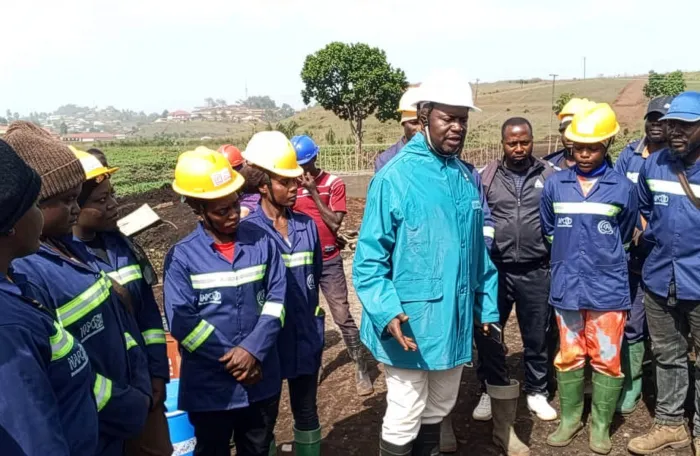
In Cameroon, road rehabilitation is opening pathways to work and services

In Cameroon, decent work in construction is rebuilding lives