


Topic portal
Care economy
What is the care economy?
The care economy encompasses care work — paid and unpaid, direct and indirect — delivered through the public and private sectors, including MSMEs, non-profit organizations, the social and solidarity economy, and households. It includes care providers and recipients, as well as the employers and institutions offering care services.
Care work involves activities and relationships that sustain quality of life, nurture human capabilities, foster agency, autonomy, and dignity, and develop the opportunities and resilience of both caregivers and care recipients. It meets a range of physical, psychological, cognitive, mental health, and developmental needs across all life stages — including for children, youth, adults, older persons, persons with disabilities, and caregivers.
Paid care work comprises diverse occupations and sectors. The care economy includes the activities of workers in education, early childhood care and education, the health and social sectors, domestic workers and individuals who perform unpaid care work. Unpaid care work, often provided by the family and by social networks of care recipients, is of great value for care recipients, care providers and society.
News and stories
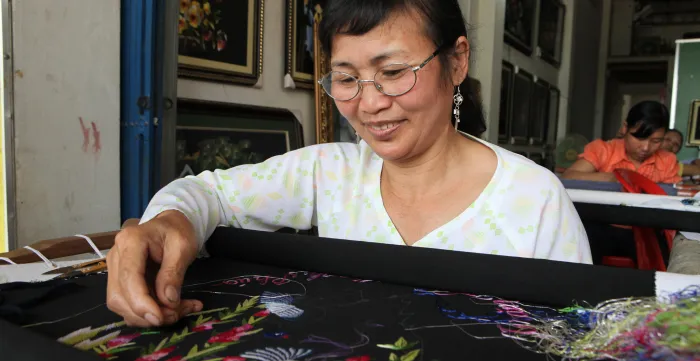
Viet Nam readies itself to support an ageing society, with decent work, skills, and social protection at its core

Care economy
Asturias and the ILO launch project to improve working conditions for women caregivers in Colombia
2 billion
potential parents without adequate maternity protection, parental leave, and quality childcare
24 %
gender pay gap in the health and care sector
Key resources

ILO Care Economy Brief series
This new ILO brief series delivers rigorous research and insights on care economy challenges, policies and decent-work solutions to improve quality care and advance gender equality.
Report to the International Labour Conference
Decent work and the care economy
Report
Care at work: Investing in care leave and services for a more gender equal world of work
Report
Care Work and Care Jobs for the Future of Decent Work
Statistical Brief
The impact of care responsibilities on women’s labour force participation
ILO Working paper
Costs and benefits of investing in transformative care policy packages: A macrosimulation study in 82 countries
ILO/UN Women
A Guide to Public Investments in the Care Economy
Policy and Statistical Tools

ILO Global Care Policy Portal
ILO Care Policy Investment Simulator
Standards and legal frameworks
ILO Resolution concerning decent work and the care economy
The resolution provides a common understanding of the care economy, guiding principles and policy recommendations and reinforces ILO’s global leadership role in advancing the care agenda at the global, regional and national levels. It underscores the urgent need for action to ensure decent work within the care economy and to promote access to high-quality care and support for all.
- ILO Resolution concerning decent work and the care economy
- Follow-up to the resolution concerning decent work and the care economy (Plan of action)
Conventions
Latest publications and documents
Factsheet
Innovative care policies in Bolivia, Brazil and Mexico
Jordan annual report 2025
Narrative recap of the development cooperation implementation of the ILO programme in the Hashemite Kingdom of Jordan
Advancing care through SSE models
Assessment of the care cooperative and social and solidarity economy (SSE) ecosystem in Sri Lanka
Training
-
Explore our latest training modules on care economy on the ILO International Training Centre (ITCILO)
Contact
-
 ILO Care economy task force