

Social and solidarity economy: Strengthening jobs and local services in the Republic of Korea
ILO–KLRI research workshop explores how the social and solidarity economy can expand decent work and essential services, particularly in the care economy and in rural areas.
18 December 2025
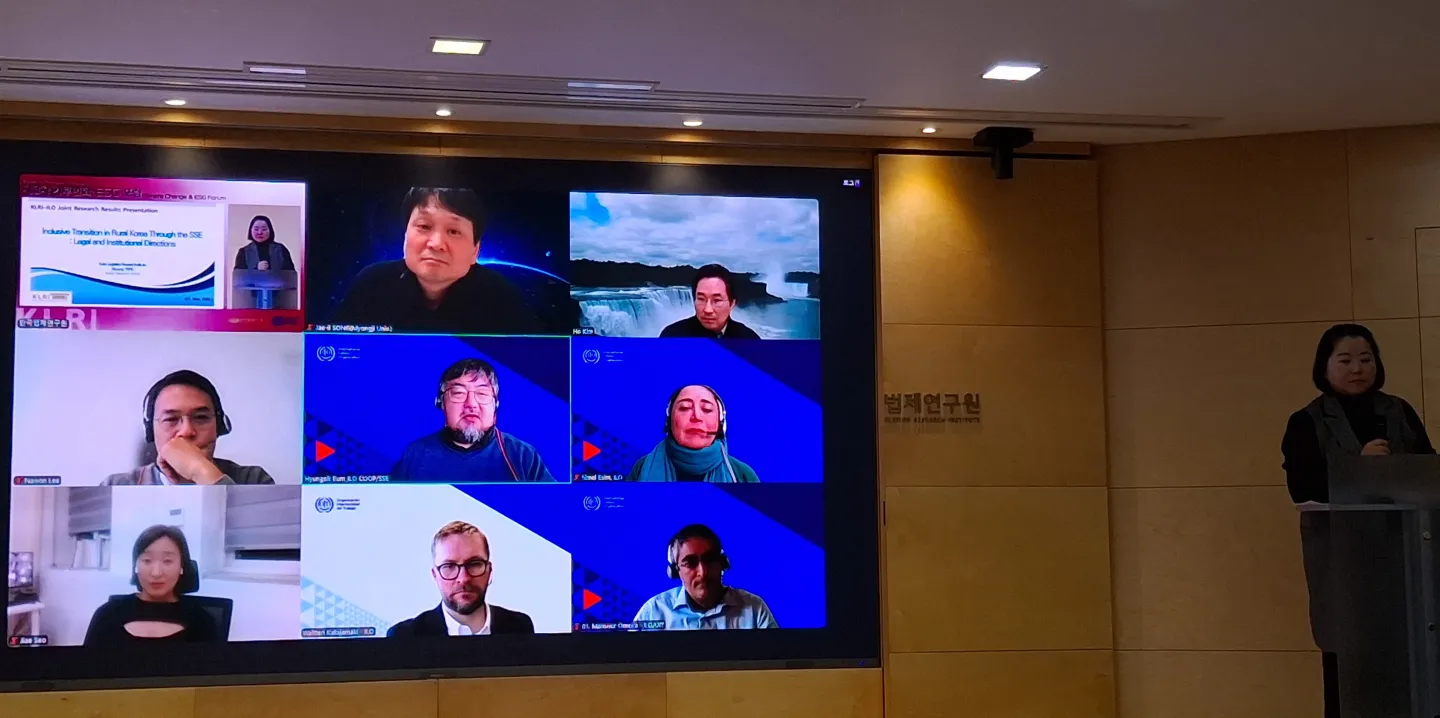
GENEVA, SEOUL (ILO News) – The social and solidarity economy (SSE) is increasingly shaping how the Republic of Korea advances decent work, especially in the care economy and in rural areas marked by rapid ageing, out-migration and widening care gaps. A joint hybrid research workshop held by the International Labour Organization (ILO) and the Korea Legislation Research Institute (KLRI) on November 27, 2025 explored how the SSE can respond to these challenges and what policy measures could further strengthen its impact.
Aligning global frameworks with national priorities
The SSE has gained international momentum, including with the adoption in 2022 of the ILO's resolution on decent work and the SSE, which provides the first globally agreed definition of the SSE, grounded in values, social purpose and governance principles—including democratic decision-making and prioritizing people over profit.
Legislation in the Republic of Korea already supports cooperatives, social enterprises and community-based initiatives. These measures have generated employment and expanded essential services across many regions. Building on these achievements, workshop participants highlighted that developing comparable and harmonized SSE statistics in line with international definitions could enable better policy evaluation and planning.
Research presented during the workshop helped to reconnect the Resolution to ILO's constitutional mandate by reaffirming that the SSE aligns with the ILO’s longstanding commitment to social justice and democratic participation in the world of work.
Care services and rural development: Practical contributions of the SSE
Many rural areas in Korea face rapid ageing, population decline and service gaps, including in relation to the care economy. The workshop examined how the SSE initiatives are addressing these challenges with flexible, community-driven solutions adaptable to diverse local needs.
Korean case studies illustrated how social farms, village enterprises and cooperatives are bridging gaps in eldercare, childcare and daily-life services, while creating stable employment, particularly for women, young people and rural returnees. By circulating economic resources locally, they contribute to strengthening community resilience and to rural revitalization.
Republic of Korea's 2023 Rural Economic and Social Services Act was highlighted as a strong example of policy integration and multistakeholder dialogue. Its inclusion of social farms as recognized providers of social and care services was noted as an innovative and promising concept linking rural development to community-based employment creation.
Moving forward through partnership
The workshop emphasized that meaningful progress depends on effective collaboration across institutions and levels of governance. The ILO–KLRI partnership illustrates how international standards and good practices and national expertise can complement each other, identifying strengths, gaps, and opportunities for innovation. By examining Korea's experience through a global lens, the joint research supports informed policy dialogue and provides insights that may guide future reforms.
The workshop concluded with recognition that the SSE provides practical tools for addressing Korea's evolving social and economic priorities—from improving job quality to expanding essential services and revitalizing rural areas. As countries around the world seek pathways to more inclusive and sustainable development, Korea's engagement with international SSE frameworks offers valuable insights for translating global principles into context-specific solutions.
Related content

Thematic page on the cooperative, social and solidarity economy
SSE: Rural economy

Thematic page
The social and solidarity economy and the care economy