Advancing social justice, promoting decent work
ILO is a specialized agency of the United Nations
English
Policy dialogue
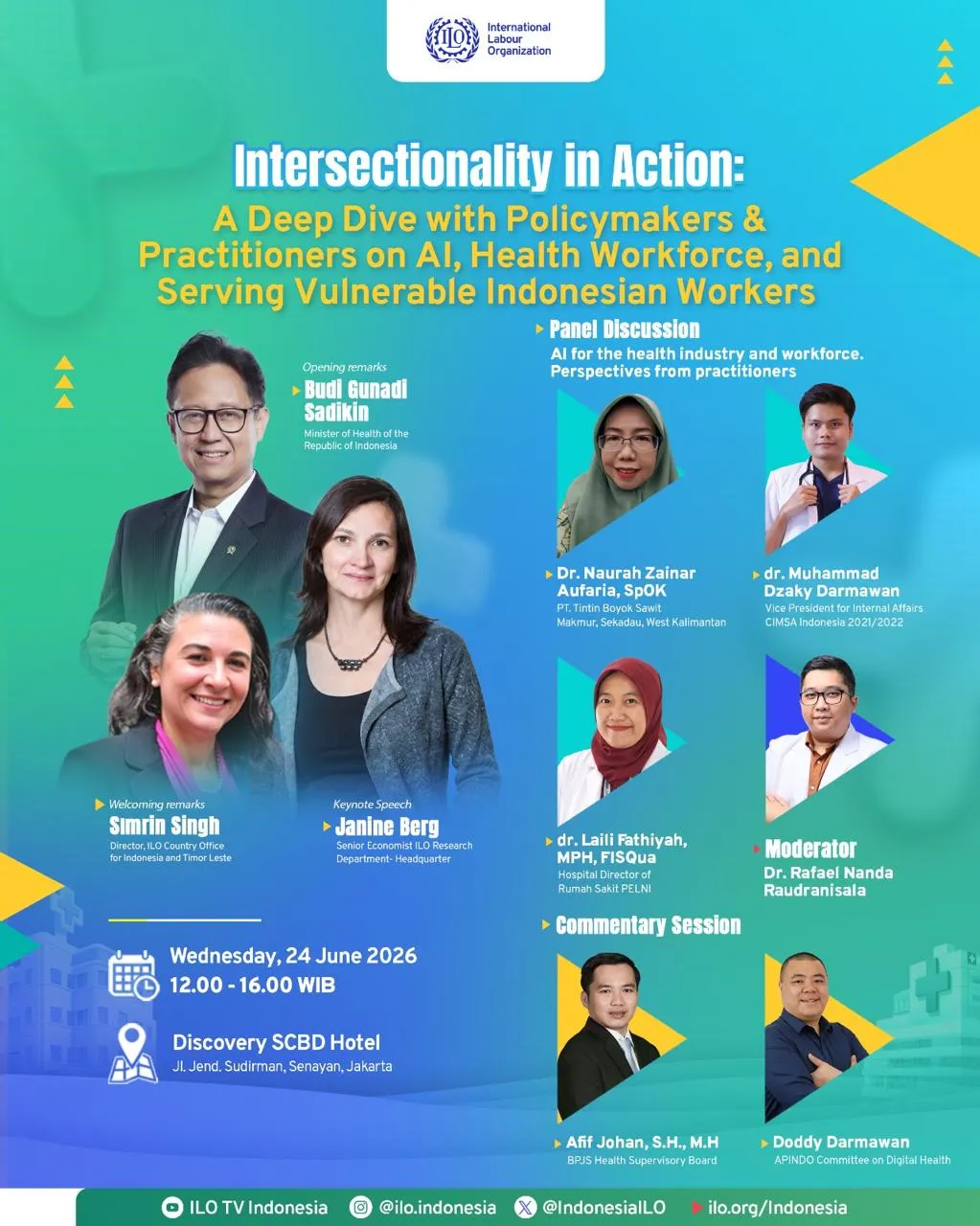
Intersectionality in action: A deep dive with policymakers & practitioners on AI, health workforce, and serving vulnerable Indonesian workers
Artificial Intelligence (AI) is rapidly transforming health systems worldwide. From clinical decision-support tools and diagnostics to workforce planning, administrative automation, disease surveillance, pharmaceutical research, and digital health platforms, AI is increasingly influencing how health services are delivered and managed.
Artificial Intelligence (AI) is rapidly transforming health systems worldwide. From clinical decision-support tools and diagnostics to workforce planning, administrative automation, disease surveillance, pharmaceutical research, and digital health platforms, AI is increasingly influencing how health services are delivered and managed.
From a world of work perspective, AI-powered diagnostic systems have the potential to improve efficiency and expand access to healthcare. AI can also support occupational safety and health by helping identify workplace risks, reduce administrative burdens, improve scheduling, and support health workers in managing growing workloads. However, the deployment of AI also raises important questions for the future of work. AI may transform tasks performed by health professionals. Concerns have emerged regarding algorithmic bias, data privacy, worker autonomy, occupational stress, surveillance, accountability for clinical decisions, and unequal access to technology and skills. Overall, while the health sector remains highly labour-intensive, and AI presents significant opportunities to improve productivity, quality of care, occupational safety and health, and access to services for the vulnerable, the ultimate impact on the health workforce, its working conditions and possibly the scope of its service delivery, remains to be determined.
Against such a framework, Indonesia is currently implementing an ambitious health transformation agenda focused on strengthening primary health care, referral services, health resilience, health financing, human resources for health, and health technology. At the same time, the country continues to face challenges related to shortages and unequal distribution of health workers, increasing demand for health services driven by demographic change and population ageing, and persistent gaps in access to quality healthcare between urban and rural areas.
The development of AI in Indonesia is supported by several national policy frameworks. The National Strategy for Artificial Intelligence (Stranas KA) 2020–2045 identifies health services as one of the priority sectors for AI development and application. The strategy highlights the potential of AI to improve diagnostics, healthcare accessibility, disease prevention, health system management, and medical research. More recently, Indonesia has taken steps to promote responsible AI development through the Circular Letter on Artificial Intelligence Ethics issued by the Ministry of Communication and Digital Affairs and through participation in regional initiatives such as the ASEAN Guide on AI Governance and Ethics.
Examine how AI transforms jobs, tasks, services delivery and skills in the health workforce and health industry.
Discuss opportunities to enhance productivity and supply to otherwise underserved population while balancing the risks related to job quality, privacy, algorithmic bias, worker autonomy, and inequality.
Identify strategies for reskilling and upskilling health workers to effectively interact with AI systems.
Promote social dialogue and human-centred governance approaches for responsible AI adoption in the health sector.
The event will include keynote presentations, panel discussions, commentary sessions, and interactive Q&A to facilitate dialogue among policymakers, industry leaders, health professionals, and social partners.