

ILO Reform
The ILO reform seeks to strengthen the Organization’s capacity to deliver on its mandate of promoting decent work for social justice. It aims to make the ILO more streamlined, agile and resilient, with improved operational efficiency and a balanced strategic focus. The process also provides an opportunity to align organizational structures and operations more effectively and to reinforce technical capacity in the regions.
In a period of profound transformation in the world of work and heightened expectations of multilateral institutions, the reform reflects a forward-looking response to global change, while reaffirming the enduring relevance of the ILO’s founding purpose, values and comparative advantages.
The reform is structured around three pillars and is being implemented progressively, taking into account the Organization's financial situation and developments under the UN80 initiative. A governance and change-management framework supports coherence, accountability and effective implementation of the reform’s work packages.
Strategic framework for reform monitoring
The strategic framework for reform monitoring sets out metrics and indicators for monitoring the implementation and results of the ILO reform over the period 2026–2029. The monitoring results will inform any necessary adjustments and, where appropriate, may serve as a basis for reporting to the Governing Body.
Member States' contributions
Contributions received are, in the first instance, applied against outstanding arrears of contribution (unless a financial arrangement has been approved by the International Labour Conference).
Reference documents
Risk register
This section provides an overview of the key uncertainties associated with the reform process. It is based on current assumptions and the best available information highlighting the most relevant risks at this stage.
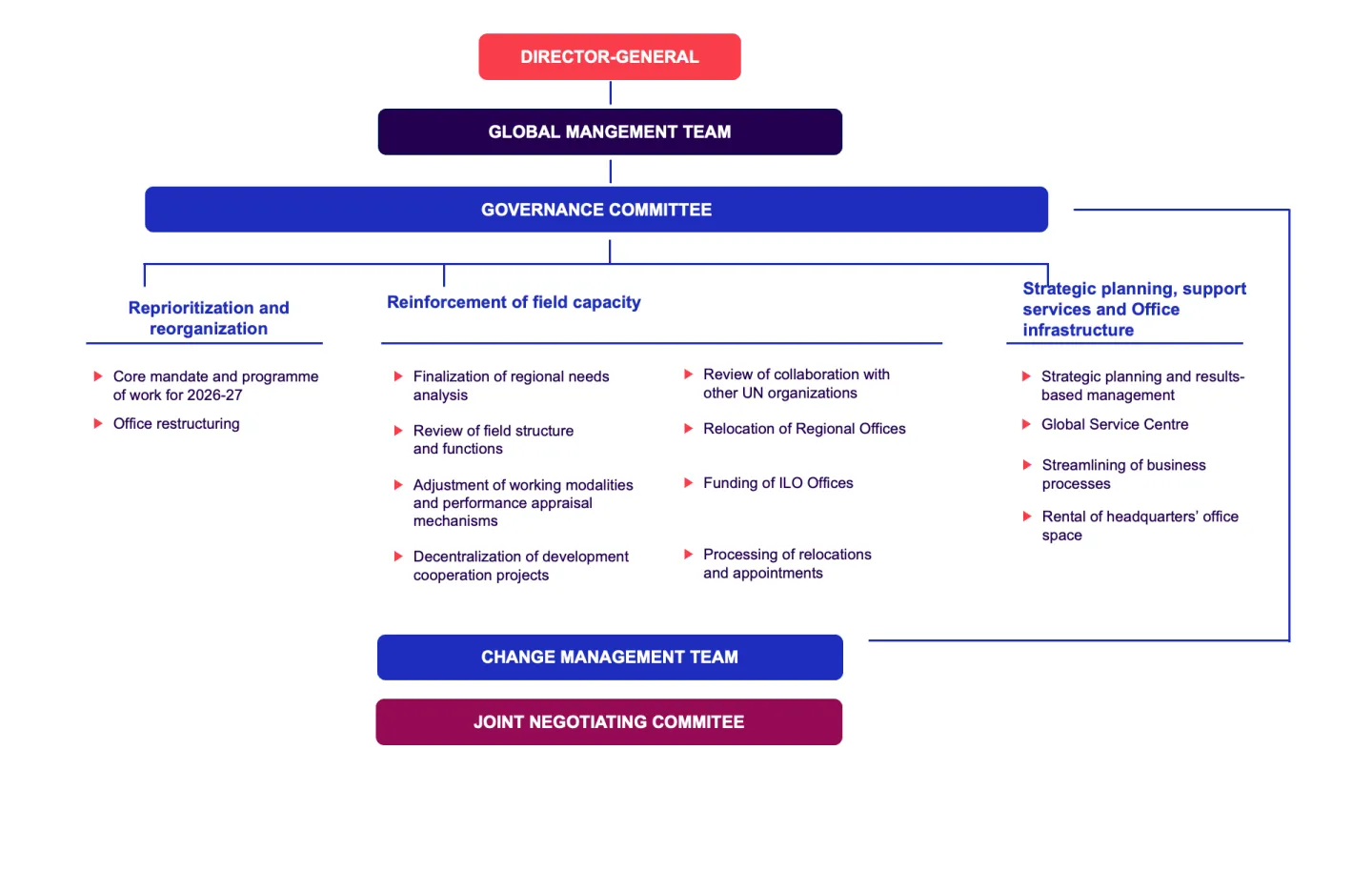
Governance organigram
Global Service Centre
As part of its reform efforts to improve efficiency and service delivery, the ILO is exploring the establishment of a Global Service Centre to consolidate selected administrative and support functions. Drawing on experiences across the UN system, a new report examines the potential benefits, challenges and lessons learned to inform the development of a model adapted to the ILO's needs.
Reform timeline
The reform will ensure a more efficient, resilient and impactful ILO, focused on strengthening the delivery of our core mandate for our constituents, and positioned at the heart of the global social architecture.
ILO Director-General Gilbert F. Houngbo
Social dialogue
Social dialogue is a foundational principle of the International Labour Organization. It is central to the ILO's mandate and to its approach to addressing challenges in the world of work. It is equally important within the Organization itself, particularly at a time of significant institutional change.
In line with the recognition and procedural agreement signed in March 2000, the Administration and the Staff Union agree on the importance of promoting and supporting constructive and effective good-faith social dialogue. At the ILO, social dialogue entails information-sharing, consultation and negotiation through the Joint Negotiating Committee.
As the ILO advances its reform process and responds to the financial challenges affecting its operations, the Administration has maintained regular engagement with the Staff Union, which initiated several proposals, to mitigate the impact of the financial situation on staff.
In March 2026, the Administration and the Staff Union signed a memorandum of understanding on the applicable framework for social dialogue in the context of the ILO Reform.
In June 2026, upon the initiative of the Staff Union, the Administration and the Staff Union negotiated and signed the Framework Agreement on Workforce Adjustment, establishing an agreed basis for managing workforce adjustment measures resulting from the ILO Reform and the contingency measures introduced to address the immediate shortfall in the Organization's regular budget.
From June to the end of October 2026, the Administration and the Staff Union have negotiated five annexes (see below) to the Framework Agreement on Workforce Adjustment, covering the successive stages of the process regarding specifically the need to avert or minimize terminations in particular in the context of contingency measures: mapping, matching, individual consultation and communication, redeployment, involuntary separation and support measures to staff members, such as training grants, transition leave days, reskilling and development and information and administrative support.
The reform process and workforce adjustments involve difficult decisions, and dialogue does not necessarily eliminate differences of views between the Administration and staff representatives (more information on Staff Union position about the reform).
Nevertheless, sustained engagement, including negotiations where required, remains essential to ensuring that decisions are implemented through clear, transparent and fair procedures, with a human-centred approach that places attention on the well-being of affected staff and the Organization’s duty of care.
As the ILO moves into the next stages of reform, the Administration will continue to engage with the Staff Union through the Joint Negotiating Committee and is committed to meaningful and good-faith social dialogue in the ILO.