

Productivity Ecosystems for Decent Work in Egypt: Improving productivity and strengthening working conditions in key industrial sectors
Duration
5 June 2024 - 4 June 2027
Development partner(s)
Italy, Ministry of Foreign Affairs and International Cooperation
Reference
EGY/23/02/ITA
Location
Cairo
Background
Micro, small, and medium-sized enterprises (MSMEs) represent 98 per cent of all enterprises in Egypt, contributing to 43 per cent of the gross domestic product (GDP) and employing over 75 per cent of the workforce. They face significant challenges to productivity growth, further aggravated by informality, poor working conditions, and limited access to resources and services. These create critical constraints to inclusive growth and decent work.
While productivity gap is declining between large enterprises and MSMEs, this is due to reduced productivity in the former. This means MSMEs continue to face internal and external constraints to productivity growth and formalization, with poor working conditions, low wages, inflexible working hours, and inadequate social protection prevalent among MSME workers.
ILO’s Productivity Ecosystems for Decent Work in Egypt project is funded by the Italian Ministry of Foreign Affairs and International Cooperation, and implemented in partnership with the Egyptian Ministry of Industry.
Rooted in ILO’s Productivity Ecosystems for Decent Work approach, this project aims to address productivity drivers and decent work deficits at the sector (meso) and enterprise (micro) levels. It works to mobilize, stimulate, and strengthen the capacities of sector-level actors and stakeholders to promote productivity and improve working conditions. At the same time, it works at the micro level with participating enterprises in two industrial districts.
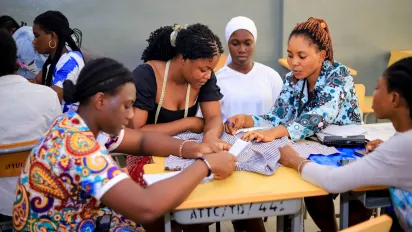
In these industrial districts, the project implements the ILO’s Sustaining Competitive and Responsible Enterprises (SCORE) Programme, which improves productivity and working conditions in small and medium-sized enterprises (SMEs). The programme's key intervention is SCORE Training, which combines practical classroom training with in-factory consulting. The training package covers a wide range of topics including workplace cooperation, quality management, resource efficiency and occupational safety and health.
SCORE Training focuses on developing cooperative working relations resulting in shared benefits for enterprise owners and those who work there. Through demonstrating best international practice in the manufacturing and service sectors, it helps SMEs participate in global supply chains.
Target sectors
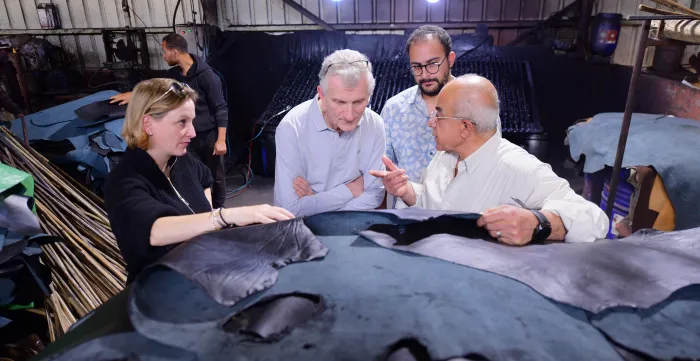
1. Leather tanning in the Robbiki cluster: In 2004, the Government of Egypt decided to establish a leather processing industrial zone in the Robbiki area, moving all tanning production from the centre of Cairo (Magra El Eyoun), which used outdated and polluting techniques. This move aims to improve production linkages, trade, and increase the country’s leather exports. Through a cluster approach, the government will develop better infrastructure and services to support the industry, enhance technology and knowledge transfer, and facilitate collective action.
2. Marble in Shaq Al-Tho'ban: The Shaq Al-Tho'ban industrial cluster in East Cairo is the largest marble and granite industrial agglomeration in Egypt, and the fourth largest in the world. However, the cluster poses significant environmental hazards due to the large amounts of waste generated during the processing of marble and granite.
3. Furniture: The furniture industry has significant potential but faces barriers to growth, including industry fragmentation with few large companies. Most enterprises are small, family-run workshops in Damietta and other areas, characterized by low labour productivity and informality. Other constraints include outdated processes and technology, a lack of skilled labour, and a high prevalence of low-quality products, which limits export capacity.
Beneficiaries
Workers: Women and men in selected sectors and targeted SMEs will benefit from increased productivity, improved working conditions, wages, and social protection.
- SMEs: SMEs in the marble and leather sectors, particularly in Shaq Al-Tho'ban and Robbiki Leather City, including microenterprises, will benefit from strengthened stakeholder capacity to improve productivity and working conditions, with special attention to the informal economy.
Implementing partners
- Ministry of Industry (and its affiliated bodies and institutions)
- Ministry of Labour
- Ministry of Planning and International Cooperation
- Federation of Egyptian Industries
- Workers' Organizations
- Sector support organizations and service providers
Project objectives, outcomes, and outputs
Internal factors affecting productivity are management practices. There is a strong positive correlation between better management and higher total factor productivity, leading to improved decent work. External factors such as business climate affect sales growth, productivity and profitability. The project will address both internal and external constraints, with impacts expected at both enterprise and sector levels.
- Outcome 1: Sectoral constraints to productivity growth and decent work are addressed by stakeholders.
- Output 1.1: Sector systemic analysis and intervention design are developed and endorsed by key stakeholders.
- Output 1.2: Sector support organizations in the leather and marble sectors are capacitated to address sector constraints.
- Output 1.3: Technical assistance strengthens the efforts of sector support organizations.
- Outcome 2: 200 micro, small and medium-sized enterprises implement measures to improve productivity and working conditions.
- Output 2.1: 100 enterprises in the leather sector have improved access to business development support services.
- Output 2.2: 100 enterprises in the marble sector have enhanced access to business development support services.
Publications and documents
Productivity Ecosystems for Decent Work in Egypt
Enhancing productivity and improving working conditions in Egypt's leather tanning sector
Productivity Ecosystems for Decent Work in Egypt
Enhancing productivity and improving working conditions in Egypt's marble sector
Productivity Ecosystems for Decent Work in Egypt
SCORE brochure in Egypt
News and stories
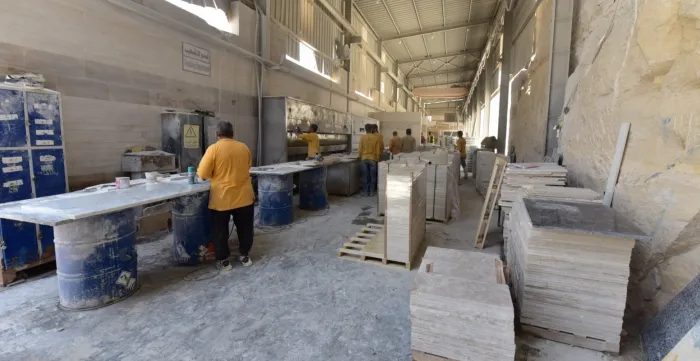
Productivity Ecosystems for Decent Work in Egypt
ILO supports workplace safety and productivity in Egypt’s marble and leather tanning clusters
Productivity Ecosystems for Decent Work in Egypt
Enterprise upgrading gains momentum in Egypt’s leather tanning and marble clusters

Spotlight interview
From coordination to impact: Insights from Egypt’s productivity ecosystems for decent work project
Related content
Productivity Ecosystems for Decent Work

Topic portal
Productivity and decent work

Sustaining Competitive and Responsible Enterprises (SCORE) Programme

SCORE Programme Brochure