

Indonesia's North Kalimantan promotes safer working conditions for fishers
ILO-led training empowers labour and fishing inspectors in North Kalimantan, Indonesia to improve occupational safety and health in the fisheries sector.
18 September 2025
TARAKAN, North Kalimantan, Indonesia (ILO News) - During the ILO’s Work Improvement in the Fishing Industry (WIFI) training held in Tarakan Island City on 10 September, labour and fishing inspectors from the Provincial Offices of Manpower and the Marine Affairs and Fisheries of North Kalimantan identified several priority action plans. These included the dissemination of the Governor’s Decree on the Joint Inspection Team for Labour Norms onboard Fishing Vessels, harmonization of relevant regulations between the two offices and the expansion and promotion of good practices in occupational safety and health (OSH) across the fisheries sector.
“We are truly committed to implementing the Governor’s Decree as a tool to drive positive interventions that promote labour standards for fishers, including OSH-related issues,” stated Dewi Parasamya Wijayanti, Head of the Unit for Labour Norms Inspection and OSH at the North Kalimantan Provincial Office of Manpower and Transmigration. “In addition to strengthening collaboration among inspectors, we hope to expand OSH good practices already present in North Kalimantan as a way to show ship owners and fishers that improvements need not be burdensome.”
The training programme took place under the ILO’s Ship to Shore Rights South-East Asia: Safe Migration for Decent Work in the Blue Economy Programme, a regional effort funded by the European Union (EU) and implemented in collaboration with the International Organization for Migration (IOM) and the Food and Agriculture Organization of the United Nations (FAO). The programme promotes safe labour migration and decent work across Southeast Asia’s fish and seafood supply chains.

The training was conducted using the ILO’s Participatory Action-Oriented Training (PAOT) methodology for OSH and facilitated by Yuka Ujita, ILO Senior OSH Specialist and Albert Bonasahat, the National Project Coordinator of the Ship to Shore Rights. The PAOT approach emphasizes practical, low-cost solutions to improve safety, health, productivity and overall working conditions in fishing workplaces.
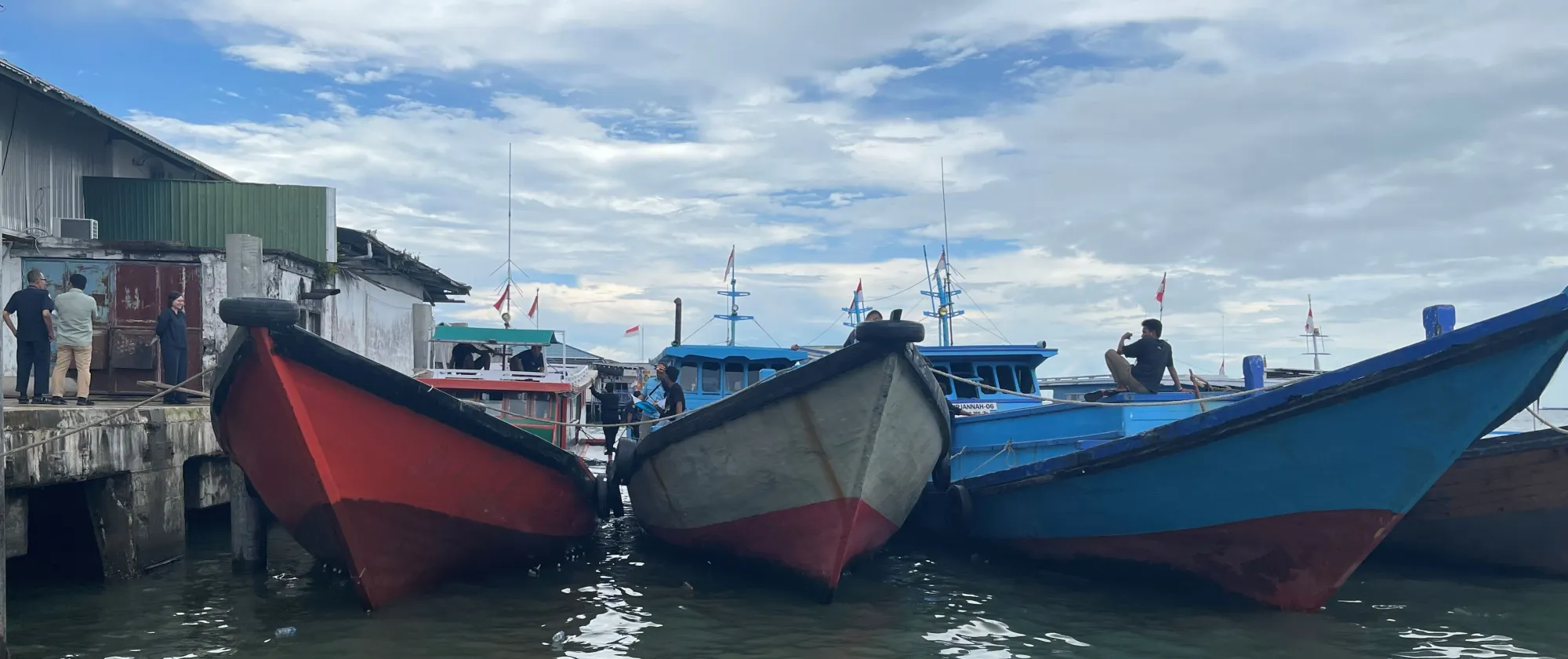
As part of the programme, 32 labour and fishing inspectors, four of them were women, carried out field inspections on four fishing vessels docked at Tangkayu II Port. While onboard, using provided handouts and learning to apply the ILO’s OSH checklist, they assessed key aspects of workplace safety, such as safe materials handling, housekeeping, hazard and risk control, as well as health, welfare and work organization at the fishing ports and onboard the vessels, to determine whether improvements were needed.
We are truly committed to implementing the Governor’s Decree as a tool to drive positive interventions that promote labour standards for fishers, including OSH-related issues.
Dewi Parasamya Wijayanti, Head of the Unit for Labour Norms Inspection and OSH at the North Kalimantan Provincial Office of Manpower and Transmigration
Inspectors examined transportation routes and vessel access, multi-level shelving and tool storage; evaluated slip-resistant surfaces, clear decks with guard rails, visible emergency buttons and adjustable sunshades; and reviewed the availability of resting areas, drinking water, waste management systems and essential first-aid materials.
They also learned about practical, locally adapted OSH practices implemented by fishers in Tarakan City. Notable examples included transportation routes free from obstacles, holes or sudden height changes; safe access to vessels; designated tool storage areas; and fish carts designed to suit the local fishing environment.
“Starting today, I need you to shift your perspective. It doesn’t have to be perfect or expensive right away. What matters is having a good example of progressive OSH implementation, a practical, low-cost solution that improves safety and fosters connection between workers and employers to spark meaningful dialogue,” said Yuka during the interactive discussions. She also encouraged inspectors to use OSH as an entry point to engage in broader conversations about fishers’ labour rights and to empower community leaders as key agents of change.

To help inspectors become familiar with practical OSH interventions, they were invited to select one priority action they would commit to implementing and promoting within the fishing community. Among the 39 actions identified during the training, one stood out: creating designated "homes for tools."
“This simple yet effective solution is a great example of how to encourage ship owners and fishers to install pegboards for hanging tools, making them both visible and easily accessible. Fishers can quickly locate the tools they need and return them to their proper place after use,” said Suparmoko, Head of the Fishing Port of Sebatik Island Post of the North Kalimantan Control and Border Service.
Related content

Labour migration
Ship to Shore Rights South-East Asia: Safe migration for decent work in the blue economy
Press release
North Kalimantan Province in Indonesia launches a Joint Inspection Team to strengthen labour standards in the fishing sector

Central Java shares good practices with North Kalimantan to strengthen labour standards in the Indonesia's fishing sector
Toward safer seas: Enhancing work conditions in North Kalimantan’s fishing sector in Indonesia
Relevant projects
Labour migration
Ship to Shore Rights South-East Asia: Safe migration for decent work in the blue economy