


Labour migration
Ship to Shore Rights South-East Asia: Safe migration for decent work in the blue economy
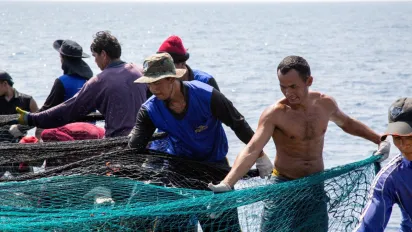
Promoting safe labour migration and decent work for a sustainable fish and seafood supply chain, including primary production (capture fishers and aquaculture) and post-harvest processing in South-East Asia.
Duration
1 January 2025 - 31 December 2028
Budget
EUR 11,000,000 (estimated USD 11,596,200)
Development partner(s)
European Union (EU)
Reference
RAS/24/07/EUR
Location
Cambodia, Indonesia, Malaysia, Myanmar, Philippines and Thailand
Contact
News and stories
Labour migration
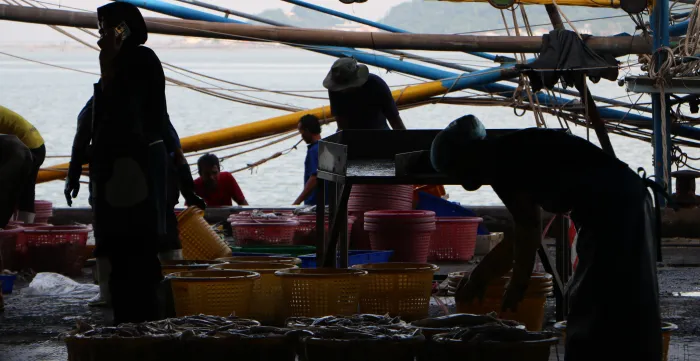
Thailand’s seafood sector strengthens supervisory skills to support decent work for migrant workers

Labour migration
New migrant worker resource centre supports decent work for migrant fishers in Malaysia
Labour migration
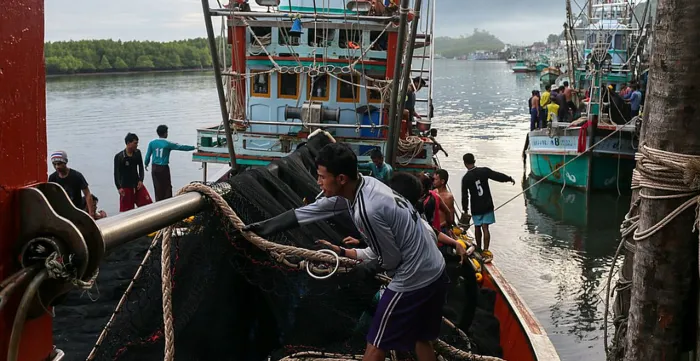
Turning commitments into systems: KP2MI study visit to the Philippine Department of Migrant Workers
Context and background

The blue economy is an important source of employment in South-East Asia. In 2020, Asia was home to more than 19 million fish farmers and 30 million fishers and accounted for 84% of all people employed in the fisheries and aquaculture sector worldwide.
The COVID-19 pandemic exacerbated pre-existing vulnerabilities, and in some cases, led to regression in working conditions in the blue economy. Fisheries and aquaculture production relying on export markets were particularly impacted. Domestic fresh fish and seafood supply was also severely impacted by the closure of the food service sector. The negative impacts of the pandemic were significantly worsened for migrant fishers due to substantial gaps in their realization of fundamental principles and rights at work and access to social protection. In the post-pandemic period, new contextual challenges and opportunities have emerged, highlighting the need for sustained intervention and support on labour standards and migration governance in the blue economy.
The project builds on the achievements of the Ship to Shore Rights Thailand (2016-2020); the South East Asia regional programme on labour migration on the fishing sector (Ship to Shore Rights South East Asia), and the extensive experience of ILO, IOM and FAO in the region. The new programme will consolidate and further advance positive achievements by deepening engagement with Cambodia, Myanmar, Indonesia, Philippines and Thailand on sectoral issues; include aquaculture to ensure a comprehensive coverage of fish and seafood production in the blue economy; and expand to Malaysia, a top marine capture fisheries producer country and a country of destination for migrant workers. Collaboration with ASEAN will also contribute in broader terms to strengthening labour migration governance in South-East Asia.
Programme objectives
- To increase ASEAN and sub-regional connectivity and cooperation on safe labour migration and decent work in the fish and seafood supply chain.
- To support national authorities to design, implement and enforce stronger legal and policy frameworks on labour migration, labour protection, and sustainable fisheries.
- To promote a culture of accountability, sustainable corporate practices, due diligence, and responsible fishing practices among employers and enterprises, including promoting promising practices and exchanging knowledge.
- To promote social dialogue, increase freedom of association and collective bargaining, and empower migrant workers, their families and communities to protect and assert their human and labour rights.




Publications and documents
Labour migration
Towards fair seas: Recruitment and working conditions for migrant workers in the fishing and seafood processing sectors in South-East Asia

Empowering Migrant Workers: Lessons Learned from ILO Migrant Worker Resource Centres in the ASEAN region
Lost in transit: Philippines migrant fishers in the United Kingdom fishing industry