


Skills development
Empowering Timor-Leste’s trainers: ILO and EU invest in future workforce development
The ILO’s Agroforestry Skills Programme, funded by the EU, supports certified training for local trainers in Timor-Leste to advance the standard of vocational education nationwide.
9 October 2025
COMORO, Timor-Leste (ILO News) - To address the shortage of qualified, certified trainers in Timor-Leste, the Agroforestry Skills Programme, implemented by the ILO and funded by the European Union (EU), facilitated a three-week Certificate III Training of Trainers (ToT) for 25 trainers. Held from 15 September to 3 October, the ToT was delivered by the Youth Vocational Training Center (STVJ) Comoro to equip local trainers with the knowledge and skills needed to deliver high-quality, standardized training curricula and programmes.

“Through this certification and ToT programme, we hope to contribute to the development of human capacity to drive sustainable change within Timor-Leste’s Technical and Vocational Education and Training (TVET) institutions,” explained Tendy Gunawan, ILO’s Rural Development and TVET Officer.
He also emphasized the importance of trainers being equipped not only with technical expertise but also with advanced skills in delivery and programme development. “Participating trainers learned to design comprehensive training modules, adapt their teaching methods to different learning styles and employ innovative techniques to engage participants, so they can deliver impactful sessions that inspire and help trainees achieve their goals,” Tendy added.
Through this certification and ToT programme, we hope to contribute to the development of human capacity to drive sustainable change within Timor-Leste’s Technical and Vocational Education and Training (TVET) institutions.
Tendy Gunawan, ILO’s Rural Development and TVET Officer
During the programme, trainers actively learned how to create a safe and healthy learning environment through the effective application of occupational safety and health (OSH) principles and risk assessments. They also explored how to plan, organize and deliver lessons to groups –from developing action and learning plans to preparing materials, facilitating sessions and conducting evaluations to improve learning outcomes.
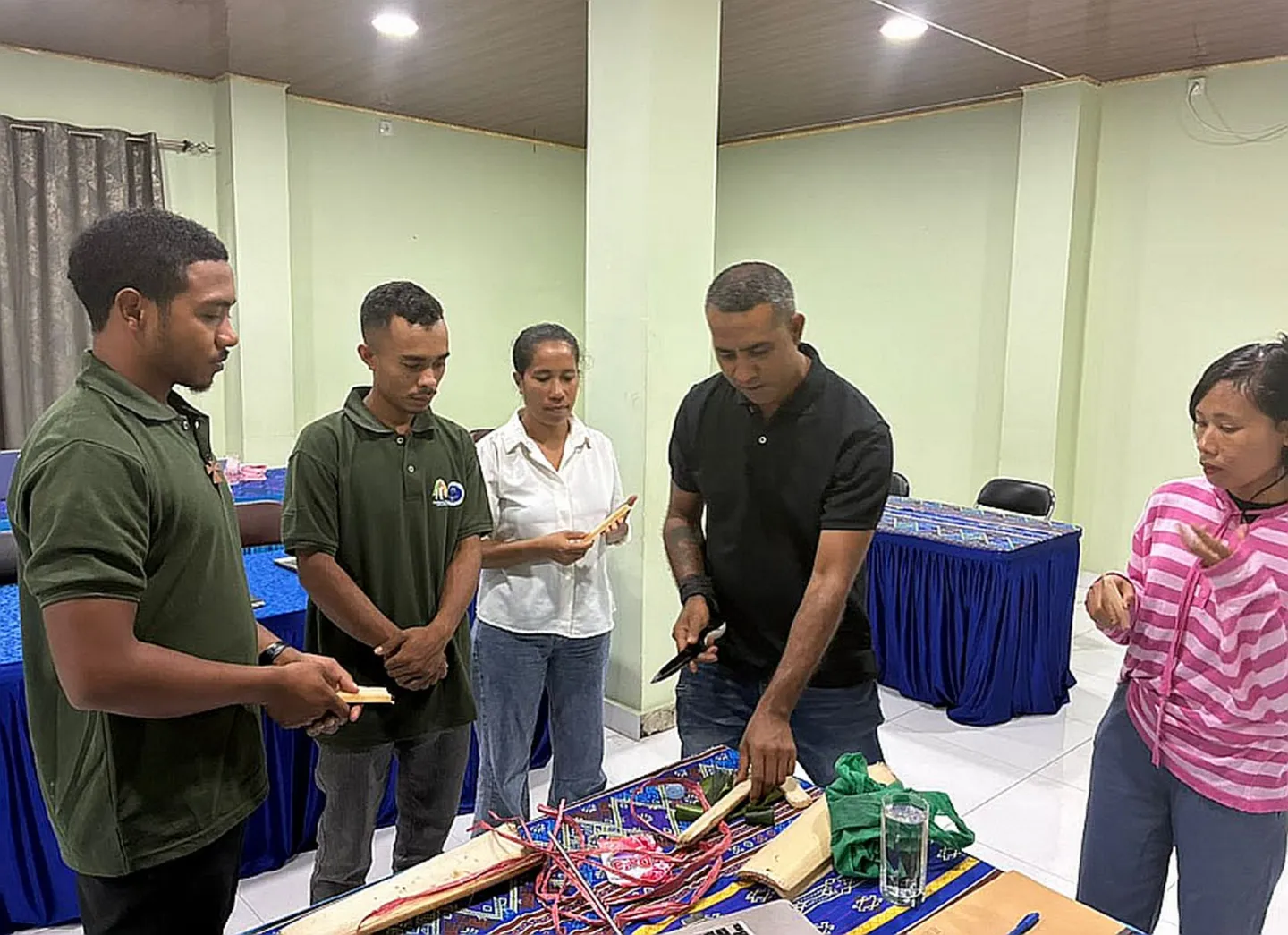
In hands-on practice sessions, participants further enhanced their instructional skills by organizing demonstrations, monitoring training performance, assessing learner progress and completing required documentation. They were also equipped with skills to maintain accurate and up-to-date training and assessment records, including managing learner data, providing feedback and counselling and fulfilling reporting obligations.
“The training programme motivates me to continue acquiring skills and enhancing my professional capacity,” said Canijio Afonso, a trainer from the Agricultural Vocational Training Center (CFPA) Corluli Bobonaro. “More trainers should receive this training because Certificates III and IV are essential for delivering effective instruction to students and trainees.”
Maria Eni Rosaria Alves, a trainer from Natarbora Vocational Technical Secondary School, shared her experience: “Becoming a qualified trainer makes me feel more confident and motivated to keep learning, help my trainees build their skills and support them in finding good jobs in the future.”
As a follow-up, the Certificate IV ToT and refresher training, along with continued coaching and mentoring, will be conducted. These upcoming activities will further strengthen trainer capacity and ensure continuous improvement across both accredited and non-formal vocational institutions nationwide.
Becoming a qualified trainer makes me feel more confident and motivated to keep learning, help my trainees build their skills and support them in finding good jobs in the future.
Maria Eni Rosaria Alves, a trainer from Natarbora Vocational Technical Secondary School
Related content
EU Programme
Agroforestry skills for employment and resilience in Timor-Leste
Relevant projects
EU Programme
Agroforestry skills for employment and resilience in Timor-Leste