

Impact story
Knitting through uncertainty: How an ILO grant boosted a hosiery business from Eastern Ukraine
When the war forced the Rubizhne Hosiery Manufactory team to flee the Luhansk region in Ukraine, they lost everything: equipment, premises, and raw materials. Yet through support from partners, and through grant assistance from the ILO and others, the company managed to restart operations in Lviv, create new jobs, and even expand its product range.
19 May 2025
Ukrainian businesses, especially those located near the frontline, risked losing everything they had built for years when war broke out. Companies had to relocate to safer regions and rebuild their operations from scratch, while countless Ukrainians were displaced and faced an urgent need to find employment.
To support relocated enterprises and stimulate job creation, the International Labour Organization (ILO), with its partner, the Government of Germany, launched a grant competition in 2023. 49 small and medium-sized enterprises, of which 17 were enterprises that were forced to relocate, received grants in Ukraine’s Lviv and Zakarpattia regions. This enabled them to sustain operations, purchase the equipment to restore and expand production, and create 227 new jobs.
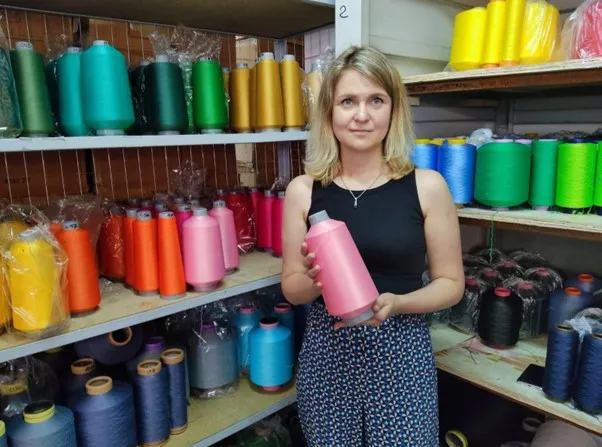
The Rubizhne Hosiery Manufactory was one of the enterprises that were forced to move. Olga Ushakova, the company’s Commercial Director, shares the challenging, yet inspiring, journey of rebuilding the business.
“Our factory ranked among Ukraine’s top five hosiery producers. We employed 162 people and operated 98 knitting machines and 40 pieces of sewing equipment, all modern and innovative. We even purchased 15 brand-new Italian machines, some of which we had not yet been put into operation.
In February 2022, we left the Luhansk region and never returned after receiving a call telling us that the war had started and Rubizhne was under fire. We immediately halted production to avoid risking our workers’ lives. All we had left was a black folder with our company documents.
We haven’t had reliable information about our factory for a long time. We know it was hit, the second floor caught fire, and looters ransacked our warehouses, stealing both finished products and raw materials. I don’t think there is anything left.
Our long-standing business partner from Lviv made a video about our company, describing how our facilities were destroyed. They shared it on Facebook, and it caught the attention of the Lviv City Council. They invited us to a meeting and asked: “How can we help?” We were so confused. We didn’t even know what kind of support to ask for.
We had lost everything, and we were left with a loan debt of 11 million hryvnias (approximately 263,000 USD) and three containers of raw materials stuck in a port somewhere.
In October 2022, after mustering all our strength, we resumed production in Lviv.
Today, we have 60 employees, including 14 former workers from our Rubizhne factory. In total, we employ 18 internally displaced persons (IDPs) and 42 (local) residents. Some of the new staff were trained from scratch, while others already had relevant experience in such production.
In 2023, our company was selected as one of 26 winners of an ILO grant competition organised by the Lviv Regional Employment Partnership. We received a USD 10,000 grant, which we used to restore and expand production, by purchasing specialised Italian sewing equipment for closing sock toes, the step that follows knitting in the production process.
Receiving this grant was incredibly important for us. We already had two similar sewing machines, and the purchase of a third allowed us to expand our knitting operations and increase sock production. But beyond the equipment, it was a crucial step in our overall recovery — not just in terms of production, but in the realisation that we are not alone. International partners are willing to stand with businesses, even in the most difficult circumstances.
The equipment normally costs about EUR 11,000, but the Italian supplier offered us a generous discount. We have worked with them for a long time. When they learned about our situation, they adjusted the delivery schedule to meet the grant requirements and even postponed their vacation plans to complete our order.
We managed to restore about 30–40% of the production capacity we had in Rubizhne so far. We have also resumed our full product range and even introduced items we hadn’t produced before.
We produce a wide range of men’s, women’s, and children’s hosiery: socks, knee-highs, tights, and leggings. We also work on custom orders. Each of our clients has unique designs and creative ideas. To meet this demand, we launch 20 new designs every week, reconfiguring our machines 5 to 10 times a day in order to accommodate the various styles.
Looking ahead, we plan to continue growing by expanding exports and increasing the production of our products. We also aim to enter the sportswear segment and begin manufacturing more technically advanced socks.
Like many Ukrainian businesses, we have faced immense challenges. It was scary, difficult, and at times, it felt impossible. But we survived. We kept producing socks, supporting our team and, most importantly, paying our taxes honestly.
We are deeply grateful to our incredible workers, who believed in us and in the possibility of rebuilding. Without the team, nothing would have happened.
The production we have restored in Lviv will stay here. We also hope to rebuild our factory in Rubizhne — when it is safe, and people can go back home.”
Relevant projects

Inclusive labour markets for job creation in Ukraine