

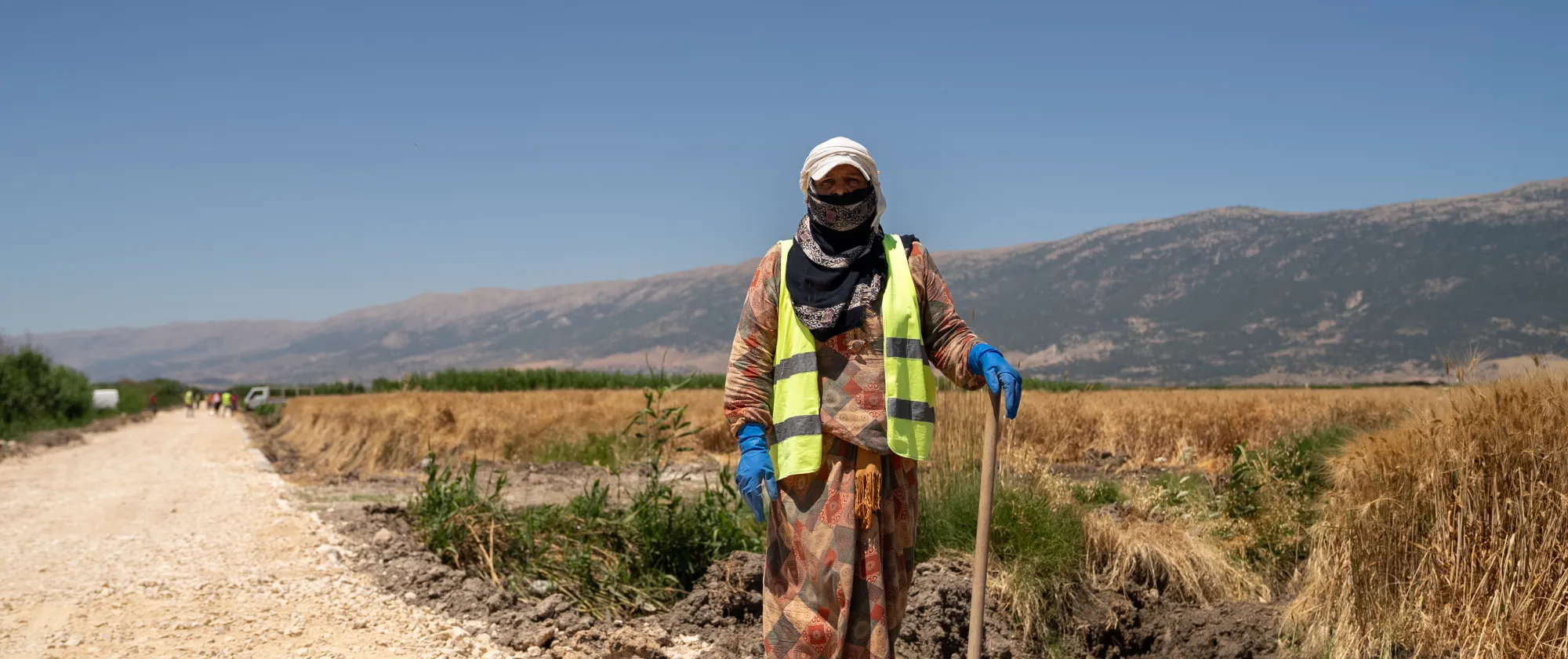
Building pathways to decent work for Lebanon's most vulnerable
With European Union support, the ILO has worked alongside Lebanon’s Ministry of Social Affairs to help transform social assistance into a gateway to jobs, livelihoods and economic inclusion.
28 July 2026
BEIRUT (ILO News) – For hundreds of thousands of families in Lebanon, social assistance has become an essential lifeline. But while cash support helps people weather crisis after crisis, it cannot by itself create jobs, restore livelihoods or provide a pathway towards long-term economic security.
This is the challenge that the Ministry of Social Affairs set out to address with the development of Lebanon's new Economic Inclusion Strategy, and one that the International Labour Organization (ILO), with funding from the European Union (EU), has supported from the outset.
The Strategy marks an important shift in how social protection is delivered. Rather than treating social assistance as the end point of support, it aims to connect vulnerable women and men with employment opportunities, skills development, entrepreneurship support and other services that can help them build sustainable livelihoods and transition towards social insurance.
The need has never been greater.
Lebanon continues to grapple with one of the deepest labour market crises in its history, compounded by events in recent months. An ILO assessment based on a survey conducted earlier this year found that one third of private-sector workers had lost their jobs since the escalation of hostilities between Hezbollah and the Israeli Military in March, displacement had affected more than one third of the workforce, and overall labour income had fallen by more than 40 per cent. The impact has fallen disproportionately on those already facing barriers to employment: 44 per cent of women, 42 per cent of youth and 71 per cent of persons with disabilities surveyed had lost work according to the survey, conducted in collaboration with the General Confederation of Lebanese Workers (CGTL) and National Federation of Workers and Employees Trade Unions in Lebanon (FENASOL).
Against this backdrop, economic inclusion is no longer simply a social policy objective. It has become an economic recovery priority.
At the request of the Ministry of Social Affairs, the ILO provided technical assistance throughout the development of the Strategy, drawing on its expertise in labour markets, social protection and international labour standards. Through the EU-funded ENABLE Programme, the ILO worked closely with the Ministry to design practical pathways from social assistance to wage employment, self-employment and entrepreneurship, while helping strengthen the institutional systems needed to deliver those pathways effectively.
Importantly, the Strategy does not focus on moving people off assistance. It focuses on expanding people's choices.
It proposes an integrated package of support tailored to individual needs, from career guidance and coaching to skills development, job placement, business support, transport assistance and childcare. It recognizes that different people face different barriers to entering or re-entering the labour market.
At the same time, it introduces a new results-oriented approach to service delivery, with specialized providers supported through performance-based contracts while the Ministry of Social Affairs leads the governance, coordination and oversight of the system.
"When many have lost their jobs, labour incomes have fallen sharply, and women, young people and persons with disabilities are bearing the heaviest burden, maintaining the status quo is simply not an option," said Ruba Jaradat, ILO Regional Director for Arab States. "The ILO has stood alongside the Ministry of Social Affairs in developing a Strategy that connects social assistance with decent work and sustainable livelihoods. Success will not be measured by the Strategy itself, but by the opportunities it creates, the jobs it helps generate and the lives it improves."
Beyond the Strategy itself, the European Union and the ILO have worked together to strengthen the Ministry of Social Affairs' institutional capacity to implement economic inclusion and integrate unemployed individuals into the labour market. This includes support for governance and coordination arrangements, monitoring and evaluation systems, registration and referral mechanisms and service provision, as well as partnerships with employers' and workers' organizations and the Ministry of Labour.
This work also forms part of the European Union and ILO's broader support to strengthen the Ministry's capacity to implement Lebanon's National Social Protection Strategy, of which Economic Inclusion and Labour Activation is one of five pillars.
"The European Union is proud to have supported the development of this Strategy and remains committed to supporting its implementation,” said EU Ambassador to Lebanon Sandra De Waele. “Turning this vision into reality will require strong coordination across government institutions, sustained reforms and close collaboration with the private sector to create more opportunities for inclusive and sustainable economic growth."
The Economic Inclusion Strategy was officially launched in Beirut during a national event. Held under the patronage of Lebanon's Minister of Social Affairs, H.E. Ms. Haneen Sayed, and hosted by the Economic, Social and Environmental Council (ECOSOC), the event brought together Minister Sayed, Minister of Labour Dr. Mohamad Haidar, Minister of Economy and Trade Dr. Amer Bisat, ILO Regional Director Jaradat, EU Ambassador De Waele, ECOSOC President Charles Arbid, members of Parliament, ambassadors and representatives of the United Nations, development partners, employer and business organizations, financial institutions and civil society organizations. The event also saw the signing of the Economic Inclusion Partnership Charter, signalling a shared commitment by the Government, the international community, and actors from Lebanon’s private and solidarity sectors to translating the Strategy into tangible results for people across Lebanon.
Video explaining Lebanon’s Economic Inclusion Strategy
Related content

Project
Empowering Networks and Activation for Building Long-term Employment (ENABLE)

Country Portal
Lebanon
Relevant projects
Project
Empowering Networks and Activation for Building Long-term Employment (ENABLE)