


Ethiopia
Critical infrastructure
Objective
The ILO's strategy on Critical Infrastructure, implemented through the Employment-Intensive Investment Programme (EIIP) within PROSPECTS, is to utilize public and private investments to simultaneously create decent jobs and deliver essential, resilient infrastructure for both forcibly displaced persons (FDPs) and host communities. By promoting labour-intensive methods and local resource-based approaches, the ILO maximizes employment impact, injects cash into local economies, and enhances community access to vital services like water, education, and healthcare, thereby operationalizing the humanitarian-development-peace nexus.
Key Activities
Infrastructure development
The ILO uses labor-based methods in public infrastructure projects. This approach aims to maximize local employment and income generation for vulnerable groups, including refugees, internally displaced persons (IDPs), women, and youth, while also creating vital community assets.
Jigjiga Polytechnic College Kebribeyah Vocational Training Satellite Center:
- The centre has workshops, a shed, well-equipped six classrooms, water and sanitation facilities, a cafeteria, a guardhouse, walking and parking lots, perimeter fence and green area.
- Created over 22,000 workdays of employment for refugees and host communities.
- Trained two local contractors who were selected for the construction of the Center as part of the contractor’s capacity development.
Water retention ponds
- To date, two geomembrane-lined water detention ponds, with the capacity to store over 5 million litres of water each, were constructed in Guyaw and Garbi Kebeles in Kebribeyah.
- The construction benefited 147 community members through Cash for Work initiatives and skills training, generating 6,344 person-days of employment.
- These ponds are serving 85 households with an estimated 8,900 herd of animals to have access to water as a result of this intervention.
Milk collection and cooling facility
- The ILO is also constructing milk collection and cooling facility in Guyaw Kebeles in Kebribeyah.
- This initiative is part of a broader effort to strengthen the dairy value chain and improve livelihoods in the area.
- The construction of the facility, built by local Somali contractors employing both refugees and host communities, is expected to be operational by 2025.
Feeder and cobblestone roads
- Rehabilitated 1.07km cobblestone road employing seven local contractors generating 1,765 working days to 437 youths from refugee and host communities.
- 25 youths trained in cobblestone works
Capacity building and skills development
The ILO, in partnership with public and private partners such as the Ethiopian Roads Administration (ERA), provided technical training and capacity building to various partners. Here are few:
- Labour-based road construction- for 18 supervisors in 22 competencies, including road design, material testing, and safety.
- TOT in road construction and maintenance- for 13 engineers from public sector.
- Road rehabilitation- 19 engineers from public and private sector.
- WASH & building- for 26 engineers from public and private.
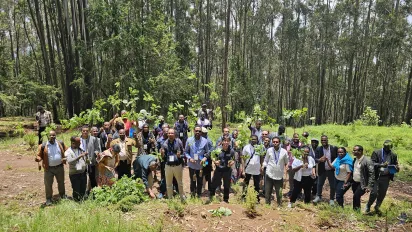
- Nature-based solutions- for 38 participants from government & international organizations.
Policy & institutional support
- Supported the development of the road sector policy in Ethiopia.
- In partnership with ERA, our work involves developing and implementing policies and strategies for employment-intensive infrastructure and environmental projects, alongside creating and integrating a national curriculum for labour-based road construction and maintenance into technical and higher education institutions, and preparing guidelines for green works and climate-proofing road networks.
Partners
- Ethiopian Roads Administration
- Local Contractors
Key Achievements (Since 2019)
- Contributed to the building and rehabilitation of 18 infrastructure facilities (including roads, water facilities, and training centers) in Ethiopia, leading to the creation of approximately 22,000 workdays.
- Constructed a new Satellite TVET Centre in Kebribeyah, near a refugee site, increasing access to vocational training for both refugee and host community youth.
- Building a milk collection and cooling facility in Kebribeyah to revitalize the dairy value chain, directly linking infrastructure development to long-term economic inclusion.
Resources on critical infrastructure
Factsheet
Satellite Technical and Vocational Training Centre for refugees and host communities in Ethiopia
EIIP
Employment-intensive investment
ILO Brief
PROSPECTS: Employment Intensive Investment Program (EIIP) in Ethiopia
Related contents

Employment-Intensive Employment Programme
ILO promotes labour intensive methods to improve livelihoods of host and refugee communities in Ethiopia

Article
Roads to Employment Opportunities and Harmonious Communities

News
Upskilling local contractors in routine road maintenance for better performance and workmanship
Green jobs
ILO's Nature-Based Solutions training empowers African stakeholders to tackle climate and employment challenges