

News
Upskilling local contractors in routine road maintenance for better performance and workmanship
The evident and vital role local contractors play in infrastructure development and employment creation in the construction sector provide recognition for essential investment in upskilling for better performance and workmanship.
15 September 2020
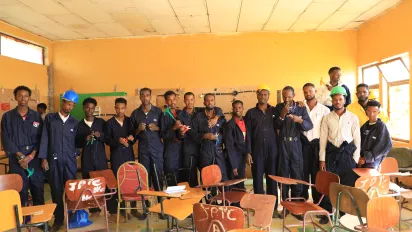
Sixteen private sector contractors from the cities of Jigjiga and Kebribeyah of the Somali Regional State of Ethiopia completed a weeklong training on Routine Road Maintenance Works under the auspices of the International Labour Organization (ILO) and the Jigjiga Polytechnic College at Jigjiga from 10 to 14 August 2020. Two instructors from the college also participated as part of the capacity building endeavor.

The training aimed at building the knowledge base of contractors on the basics of road maintenance processes (planning and programming) and routine maintenance, for improved performance and quality of workmanship. In particular, topics included standard road maintenance, labour productivity and performance standards, quality assurance and control, basics of pricing and bidding, as well as crosscutting issues, including environmental, safety and decent work/social safeguards in relation road works, and the importance of employment-intensive works as a response to COVID-19.
Subsequently, the contractors will undertake routine maintenance and spot improvement activities during follow-up demonstration works of selected roads in the Fafan Zone of the Somali Region in Ethiopia, encompassing both Jigjiga and Kebribeyah, and which is host to refugees from the Federal Republic of Somalia. Such demonstrations would use labour-intensive methods and employ labourers from host and refugee communities, and whom will have acquired (on the job) construction skills, which could be used after the completion of their contracts.
These endeavours are part of ILO’s flagship Employment Intensive Investment Programme (EIIP), which aims to improve livelihood opportunities (wage & self-employment) and road infrastructure for both refugees and their host community members. Endeavours also support the operationalization of the recent Refugees Right to Work Directive (No. 02/2019) by availing a conduit for refugees to partake in joint projects, and are in line with the Ethiopian Government’s Refugee Proclamation (No. 1110/2019), which provides refugees with a set of socio-economic rights and progressively advance local integration options.
This programme came to reality thanks to PROSPECTS – a multiannual (2019-23) multi-agency (ILO, IMF, UNHCR, UNICEF, and the WB) partnership and funding by the Government of the Kingdom of Netherlands.
Related contents

Article
Roads to Employment Opportunities and Harmonious Communities

Employment-Intensive Employment Programme
ILO promotes labour intensive methods to improve livelihoods of host and refugee communities in Ethiopia
Relevant projects
ILO-Netherlands Partnership
Partnership for improving prospects for forcibly displaced persons and host communities (PROSPECTS) in Ethiopia
Programme
Partnership for improving prospects for forcibly displaced persons and host communities (PROSPECTS)