


Colombia
Laboratories for the promotion of labor formalization and occupational health and safety in the oil palm sector in Colombia
Duration
1 May 2023 - 30 June 2025
Development partner(s)
ANDI, CUT, CARGILL, FEDEPALMA.
Reference
COL/22/10/CAC
Location
Colombia
Contact
Paola Campuzano ([email protected])
Context
In Colombia, the oil palm industry generates approximately 200,000 direct and indirect jobs, benefiting thousands of families across 21 of the country's 32 departments (according to FEDEPALMA). Additionally, Colombia ranks as the leading producer of palm oil in Latin America and the fourth globally, underscoring its significance at national, regional, and global levels.
The high levels of informality in Colombia's rural areas highlight the potential of the oil palm industry to create formal employment in the agricultural sector, offering better working conditions than the average rural jobs in the country.
53,4%
of rural employment is self-employed, followed by private employees (24.2%) and day labourers (11%).
17,6 %
of the national agricultural GDP is attributed to the oil palm sector.
27 %
of Colombia's palm oil production is marketed for export
However, despite offering better working conditions than the average rural employment, subcontracting has become a common practice in the oil palm sector, limiting workers' opportunities to access direct employment that ensures social protection, labour rights, and access to social dialogue.
In response, the International Labour Organization, in collaboration with Cargill and the National Federation of Oil Palm Growers (FEDEPALMA), along with employers and workers, are working to improve conditions in this industry by promoting labour formalisation and enhancing occupational safety and health practices, aiming for a more sustainable and competitive supply chain.
Expected outcomes
- Develop strategic intervention plans for medium and large producers with the participation of workers' organisations.
- Design a support scheme for the labour formalisation of small producers in four departments of the country.
- Achieve the labour formalisation of workers linked to small, medium, and large companies in the oil palm sector.
Producers from the departments of Norte de Santander, Cesar, Santander, and Meta will receive support for formalization.
Progress
During 2023 and 2024, the project facilitated coordination meetings with employers and workers in the oil palm sector to advance processes such as the design of the Formalizómetro, a self-assessment tool to determine levels of formalisation and compliance with labour standards in palm oil companies.
With support for FEDEPALMA's "Plan Padrino" initiative in its 2023 and 2024 editions, more than 658 workers from 119 production units were formalised. Additionally, a monitoring programme was integrated for the first time to address the needs of production units during an initial implementation period.
The first edition of the diploma course "Palma Sostenible: Training Programme for Decent Work" was launched. This programme, certified by the Industrial University of Santander, included participation from over 130 companies and 100 small and medium producers, who accessed 120 hours of academic content on labour formalisation and occupational safety and health. Topics covered included: work as a human right, fundamental labour rights, due diligence, Green Pact, labour formalisation, social security, social benefits, occupational safety and health, freedom of association, combating discrimination, and strategic planning for compliance.
The initiative “Palma al día: virtual assistance for employers”, developed in close collaboration with Cargill, focuses on promoting compliance with labour regulations in medium and large enterprises within the sector.
Through Palma al día, companies have access to theoretical and practical training capsules, as well as free and personalised legal assistance to better understand labour regulations and thus foster compliance.
This programme covers a range of topics relevant to companies in the sector, including: Compliance with labour regulations, labour formalisation, social security, occupational safety and health, social benefits and resolution of employer-worker disputes.
ILO Voices
On World Day of Social Justice (20 February), we spoke with Elva Molina, an oil palm grower in the department of Norte de Santander (northeastern Colombia).
Project stakeholders
The proposed actions are the result of joint efforts over the past nine years, involving the Ministry of Labour as the authority overseeing labour relations and promoting compliance with labour standards, along with trade union organisations, particularly the Central Unitaria de Trabajadores (CUT), in promoting labour formalisation and preventing disguised employment relationships, thereby promoting, among other things, the free exercise of freedom of association.
While the project will be carried out in coordination with our constituents and FEDEPALMA as the representative guild of the sector and the workers' organisations in the sector, the project's outcomes will also benefit companies in the oil palm industry.
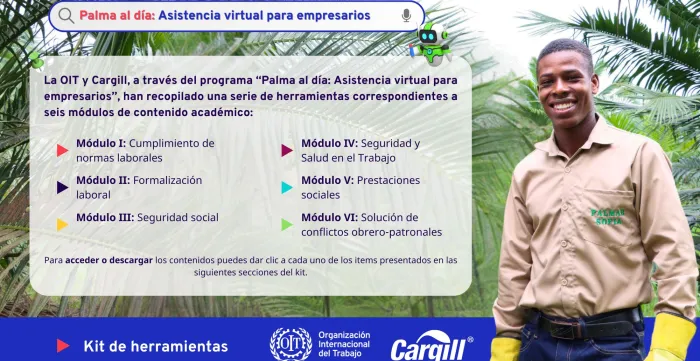
Toolkit to harvest decent work in Colombia’s oil palm sector
Strategy
Under a participatory and ownership approach, strategic intervention plans are being developed for small, medium, and large oil palm producers, workers, and labour inspectors in the targeted territories.
In this regard, self-assessment processes are proposed through technological tools, support, training, and technical assistance to ensure the proper implementation of new formalisation processes and the implementation of occupational safety and health measures.
Related international labour standards
Latest news
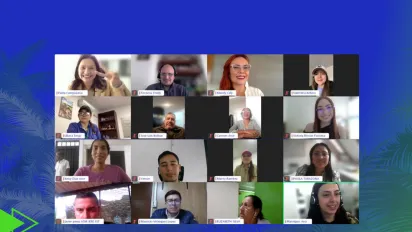
Oil palm employers complete assistance programme on labour standards compliance with support from the ILO and Cargill
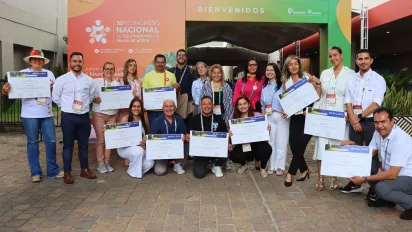
Generational transition and training for decent work at the 2024 Oil Palm Congress with the support of the ILO and Cargill

Oil palm companies and producers successfully complete the ILO and Cargill academic programme to promote decent work in the sector