

World Forum for Local Economic Development 2025
ILO champions social and solidarity economy for local transformation
The ILO highlighted the transformative role of the social and solidarity economy (SSE) in fostering sustainable development, resilience, quality care services, youth employment, and financial inclusion at the VI World Forum for Local Economic Development.
28 April 2025
SEVILLA, Spain (ILO News) - The ILO team, dedicated to advancing decent work through the SSE, actively engaged in the Sixth Edition of the World Forum for Local Economic Development (WFLED). The Forum convened representatives from over 60 countries, including local governments, employers’ and workers’ organizations, international agencies, civil society, and academia.
This global platform offered the opportunity to explore how territorial approaches and community-rooted solutions can advance the Sustainable Development Goals (SDGs). Central to the Forum’s vision was the SSE, underscored as a catalyst for resilient, inclusive, and sustainable local development.
The ILO contributed to five SSE-related sessions, each demonstrating strategies and practical tools that empower local actors to implement transformative change through the SSE.
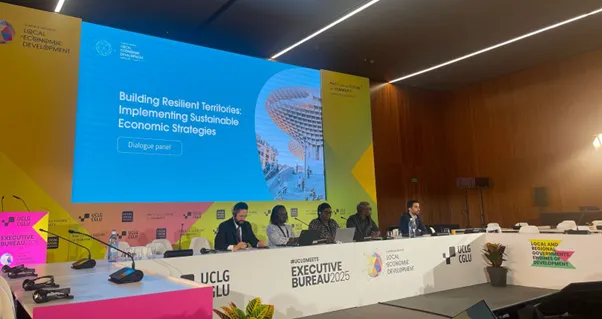
SSE as a catalyst for local resilience in crisis settings
In the session Building Resilient Territories: Implementing Sustainable Economic Strategies, Rayann Koudaih, ILO Technical Specialist in Cooperative and SSE Development, shared the ILO’s cross-country experience on how the SSE fosters resilience in crisis-affected contexts. Drawing from Uganda, Kenya, Jordan, and Lebanon, he demonstrated how cooperatives and other SSE entities are revitalizing livelihoods, enhancing social cohesion, and creating decent work opportunities in communities affected by conflict and displacement.
Rayann Koudaih emphasized that for the SSE to flourish in such contexts and contribute effectively to resilience and development, several key conditions must be met. These include the establishment of and legal frameworks that uphold SSE principles and values, the strengthening of SSE secondary and tertiary organizations, and the integration of SSE into national development, recovery, and crisis response strategies. He also underscored the importance of accessible financing mechanisms and context-responsive impact assessment tools to better capture the SSE’s contributions to resilience.
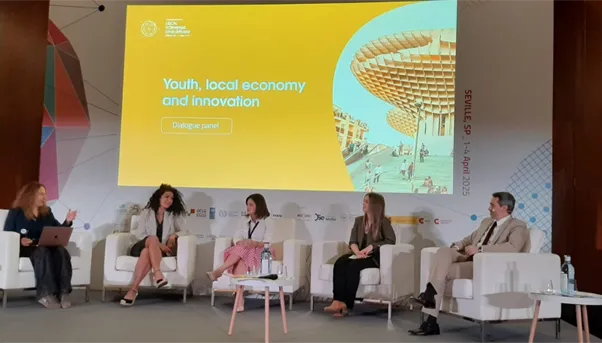
Youth employment through the SSE: Innovation rooted in local realities
In the session Youth, Local Economy and Innovation, Youssef Fennira, Project Manager of the ILO’s JEUN’ESS programme in Tunisia, shared an innovative approach to youth employment grounded in the SSE. He showcased how the project, implemented in Tunisia’s most vulnerable regions, used a bottom-up strategy to structure value chains tailored to local needs.
JEUN’ESS supported the creation of new SSE entities, reinforced existing ones, and facilitated market access. It brought together incubators, civil society organizations, public bodies, and financial institutions to co-create a support ecosystem for the SSE. As a result, more than 170 structures were created and over 3,600 decent jobs were generated. The JEUN’ESS model also inspired national-level dialogue, particularly with the banking sector, on how to better support youth and SSE actors. The session demonstrated that trust-building, local experimentation, and knowledge of territorial realities are key ingredients for sustainable youth inclusion.
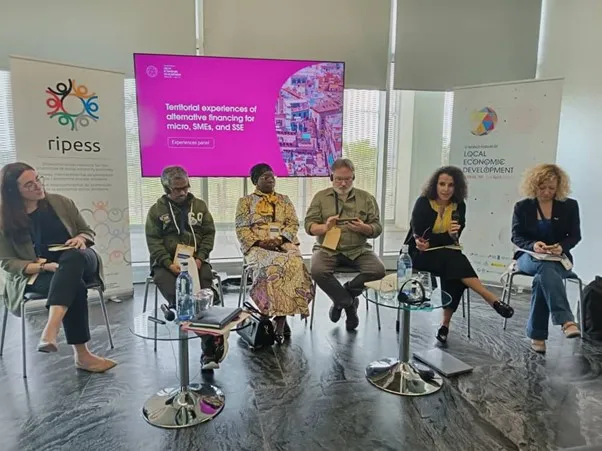
Financing the SSE: From traditional models to modern strategies
During the session Territorial Experiences of Alternative Financing for Micro, SMEs, and SSE, Yousra Hamed, Financial Inclusion Specialist, illustrated how traditional community-based finance mechanisms—like Self Help Groups in India, Tontines in Senegal, and Daret in Morocco—embody enduring principles of participatory governance and mutual support that are foundational to SSE financing.
She explained that the ILO builds on these traditions through a three-pronged approach that enhances access to finance at the policy, institutional, and grassroots levels.
This includes:
- Working with National Authorities: Collaborating with entities like the Central Bank of Iraq to design blended finance instruments that reduce lending risks.
- Strengthening Financial Service Providers: Tailoring financial products to the realities of SSE actors.
- Improving Financial Literacy: Educating entrepreneurs to better manage funds and engage with financial institutions.
Recognizing that SSE entities often depend on short-term grants and lack tailored financial tools, Hamed emphasized the role of the ILO jointly with the financial sector to further support the development of SSE financial institutions, build the financial capabilities of SSE actors, and work with banks to better serve this sector. Going forward, the ILO advocates for:
- Greater involvement of development banks in local financing.
- Formal recognition of SSE financial actors within national frameworks.
- Integration of MSMEs and SSEs into digital financial strategies.
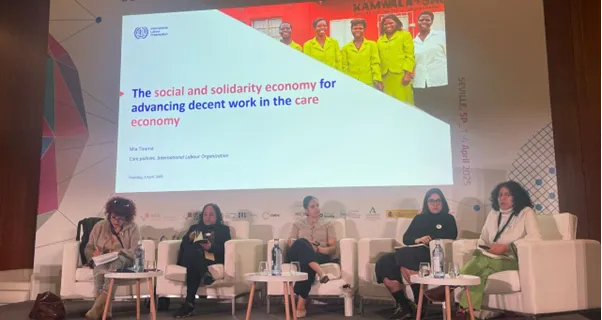
Transforming care systems: SSE models deliver local and inclusive solutions
In the session The SSE and Care, Mia Touma, Junior Project Officer on Care Policies, presented the ILO’s model for advancing coherent and integrated care policies and systems through the SSE. The session emphasized how cooperatives and community-led initiatives can deliver equitable care services that promote decent work and gender equality while strengthening community resilience.
Mia Touma shared how the ILO’s recent resolutions—on SSE (2022) and the care economy (2024)—recognize the role of SSE actors in providing quality care and call for their integration into policy responses, while ensuring decent work for workers in cooperatives. She introduced the ILO’s five-step intervention model for cooperative care provision, which supports the creation of community-based, multi-stakeholder initiatives that are tailored to local needs and guided by decent work principles. Drawing on ILO-supported projects in Colombia and the Occupied Palestinian Territory, she demonstrated how SSE-led care initiatives are expanding culturally relevant access to care while simultaneously improving the working conditions of care providers. These models represent powerful ways for addressing both service gaps and labour market inequalities.
Revitalizing rural economies: SSE as a pathway to jobs and territorial equity
In the session Employment in Rural Areas and Alliances for the Promotion of Rural Economic and Decent Employment, John Bliek, Specialist in Sustainable Enterprise Development, highlighted the strategic importance of rural areas as engines of inclusive and sustainable development. He argued that rural territories, while rich in resources and critical to food systems and ecological balance, are often marginalized in national development strategies.
John Bliek emphasized the role of cooperatives and SSE entities in delivering decent work in low-infrastructure and remote environments, particularly for women and youth. He also highlighted how this model is being applied in the Caribbean, where the ILO supports the cooperative ecosystem at every level—from designing cooperative policy in Dominica, reviewing support institutions in Suriname, and training trainers using ILO tools like Start.Coop and My.COOP, to strengthen fisher cooperatives in Guyana and SSE organizations in Barbados. These diverse interventions underline how SSE contributes to local resilience and economic vitality across a variety of contexts. He concluded by calling for greater policy coherence, multi-actor coordination, and investment to unleash the full potential of SSE-led rural transformation.
From global agendas to local action: The SSE at the heart of local development
Through its contributions at WFLED 2025, the ILO underscored the central role of the SSE in building inclusive, equitable, and future-ready local economies. The sessions demonstrated that SSE actors are already responding to complex global challenges—from care provision and youth employment to financial inclusion and post-crisis recovery—using solidarity, participation, and innovation approaches.
These insights were echoed in the WFLED’s Final Declaration, which called for more inclusive, decentralized, and resilient economic systems. It highlighted the need for national and global institutions to recognize the value of SSE, care work, and territorial financing, and to shift toward a development and financial architecture grounded in justice, well-being, and sustainability. The declaration also referred to the importance of the International Year of Cooperatives 2025, emphasizing that this global milestone should be seized to raise awareness and accelerate investment in the cooperative model as a vital contributor to decent work, territorial equity, and community resilience.
Related content

Thematic page on the cooperative, social and solidarity economy
SSE: Migration, forced displacement and crisis response
Thematic page on the cooperative, social and solidarity economy
SSE: Sustainable finance
Thematic page on the cooperative, social and solidarity economy
SSE: Rural economy
Thematic page on the cooperative, social and solidarity economy
SSE: Youth employment
SSE: Care economy