

Press release
Ministry of Women’s Empowerment and Child Protection and ILO launch Care Economy Working Group to advance Indonesia’s care system
The Care Economy Working Group serves as a collaborative platform uniting ministries, academics, civil society, the business sector and development partners to formulate policies and strategic measures to strengthen Indonesia's care economy system.
25 June 2025
JAKARTA, Indonesia (Joint Press Release) - The Ministry of Women's Empowerment and Child Protection (MoWECP), with support from the International Labour Organization (ILO), officially launched the Care Economy Working Group in Jakarta, on 26 June. This initiative follows the launch of the Indonesia Care Economy Roadmap 2025–2045, held in 2024.
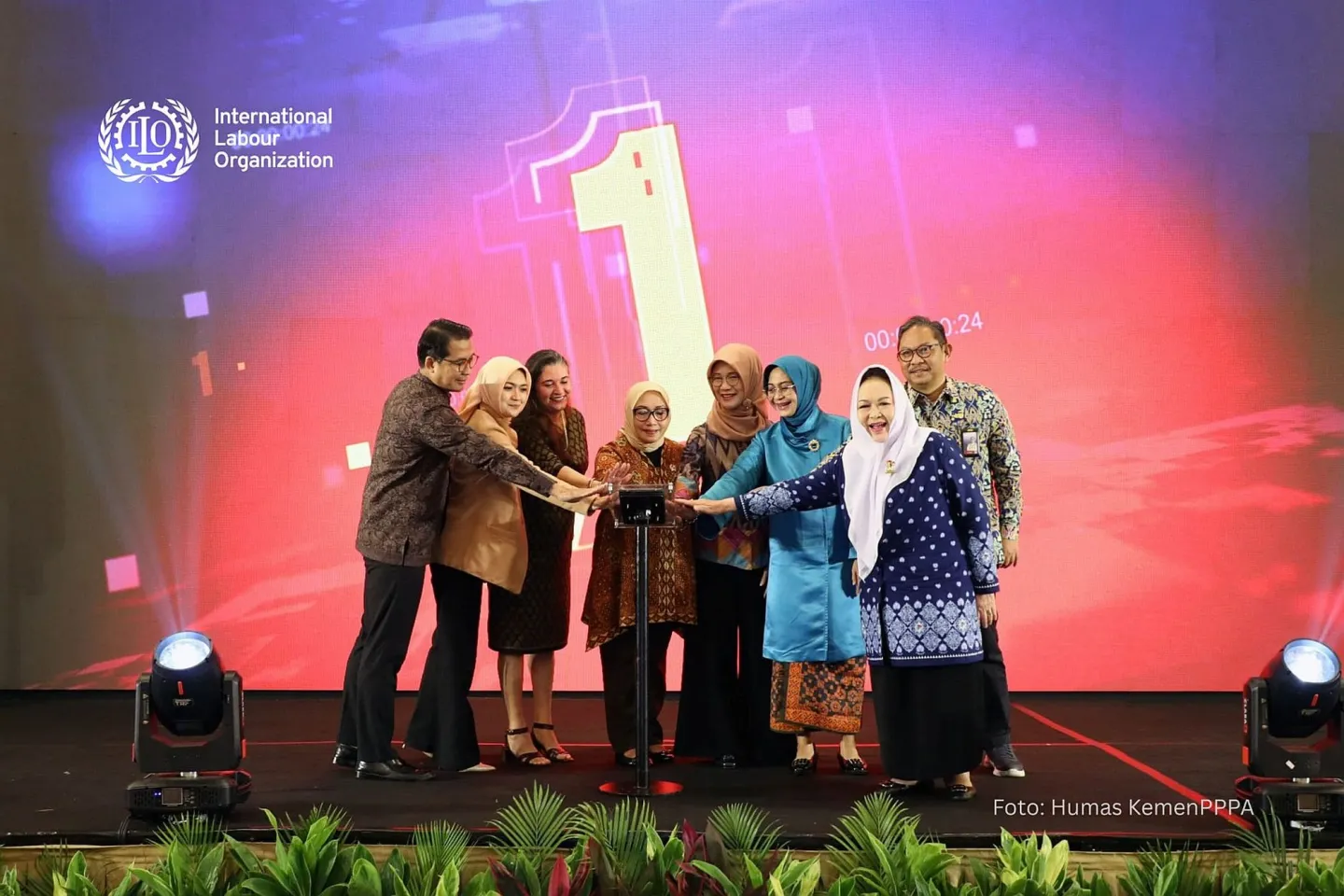
During the event, the Minister of WECP, Arifah Fauzi stated that the establishment of the Care Economy Working Group signifies the Indonesian Government’s commitment to accelerating the transformation of the care economy, fostering a more equitable world of work and promoting increased female labour force participation as part of efforts to achieve the Golden Indonesia Vision 2045.
“The issue of care for children, the elderly and persons with disabilities forms a fundamental pillar of societal sustainability. Yet care work—predominantly carried out by women and often unpaid—has not been sufficiently acknowledged within our economic system. The formation of this Working Group marks not only a beginning but also a strengthening of collaboration and synergy to advance the care economy in Indonesia,” said Minister Arifah.
The care economy policy will support the enhancement of women’s capabilities, promote a more equitable division of care work between men and women, increase the female labour force participation rate and encourage women’s engagement in the public sphere.
Arifah Fauzi, Minister of Women's Empowerment and Child Protection
The Care Economy Working Group serves as a collaborative platform uniting ministries, academics, civil society, the business sector, and development partners to formulate policies and strategic measures to strengthen Indonesia's care economy system. The Minister of WECP emphasized that the care economy policy seeks to assign economic value to previously uncounted care work, while fostering a safe and supportive work environment for women and contributing to economic growth through care-related industries.
“The care economy policy will support the enhancement of women’s capabilities, promote a more equitable division of care work between men and women, increase the female labour force participation rate and encourage women’s engagement in the public sphere. This policy is also expected to make a tangible contribution to national economic growth, driven by the rise of care industries and the expansion of employment in the care sector,” added the Minister of WECP.
According to Law No. 59 of 2024 on Long-Term National Development Plan (RPJPN) 2025–2045, Indonesia aims to raise the female labour force participation rate to 70 percent by 2045. In 2024, the participation rate stood at 56.42 percent.
"To achieve this target, it is essential to increase the average annual rate of women’s labour force participation. In addition to proactive affirmative efforts aimed at engaging at least 750,000 women in the workforce each year, it is equally important to retain those who are already employed," added the Minister.

In her speech, ILO Country Director for Indonesia and Timor-Leste, Simrin Singh, emphasised the importance of integrating care economy policy into national development by fostering cross-sectoral collaboration. She also outlined three key actions for ensuring the effective implementation of the care economy.
“Let us seize the momentum of the launch of the Care Economy Working Group to prioritise the development of care infrastructure in Indonesia’s national budget and development agenda, promote broad engagement from the private sector and amplify the voices of care workers across all sectors,” Singh remarked.
The Care Economy Roadmap 2025–2045 was jointly developed by MoWECP, the Ministry of National Development Planning (Bappenas), and the ILO, and was officially launched on 28 March 2024. The roadmap addresses seven strategic issues: 1. Childcare services; 2. Services for the elderly; 3. Inclusion-based care services: people with disabilities and other vulnerable groups; 4. Maternity protection; 5. Maternity protection; 6. Recognition and protection of care workers; and 7. Social security and the care economy. The roadmap outlines specific targets and strategic measures for each issue, aligned with Indonesia’s five Mid-Term National Development Plan (RPJMN), culminating in 2045.
Let us seize the momentum of the launch of the Care Economy Working Group to prioritise the development of care infrastructure in Indonesia’s national budget and development agenda, promote broad engagement from the private sector and amplify the voices of care workers across all sectors.
Simrin Singh, ILO Country Director for Indonesia and Timor-Leste
The launch of the Care Economy Working Group was attended by representatives from various ministries and agencies, community organizations, universities, the private sector, and the media. The event also featured a talk session with several keynote speakers, including Woro Srihastuti Sulistyaningrum, Deputy for Coordination of Family and Population Quality Improvement at the Coordinating Ministry for Human Development and Cultural Affairs; Chairul Saleh, Assistant Deputy for Productivity Improvement and Labour Ecosystem Development at the Coordinating Ministry for Economic Affairs; and Amurwani Dwi Lestariningsih, Deputy for Gender Equality at the MoWECP.
In addition to the talks, the event included a Focus Group Discussion (FGD) themed “Mapping Sectoral Issues in the Care Economy Working Group,” which served as an initial step in developing a cross-sectoral work agenda to strengthen national care economy policies.
For further information, please contact:
Early Dewi Nuriana
ILO’s Programme Coordinator for Care Work
Email: [email protected]
Gita Lingga
ILO Senior Information and Communications Management Assistant
Email: [email protected]
Related content
Project
The Care Economy in Indonesia

Indonesia launches its Road Map for Care Economy for a more Gender Equal World of Work

Care economy
Media in action: Advancing reporting on care work in Indonesia

Care economy
Pressing for progress: Indonesia’s media drive the care economy forward
Relevant projects
Project
The Care Economy in Indonesia