


News
ILO supports Kenya to refine national plan for green jobs and skills
Kenya is advancing a national strategy to create green jobs and support a sustainable economy. A stakeholder review supported by the ILO brought together experts, government officials, and partners to refine the plan and ensure an inclusive transition to a low-carbon future.
1 April 2025
Nairobi, KENYA (ILO News) - Kenya is laying the foundation for a sustainable, low-carbon economy by equipping its workforce with the skills needed for green jobs. A key milestone in this journey is the development of the National Strategy on Green Skills and Green Jobs.
The State Department of Labour and Skills Development, in partnership with the International Labour Organization (ILO) PROSPECTS programme and supported by the Ministry of Foreign Affairs of the Netherlands, convened a stakeholder validation meeting to refine the draft National Strategy on Green Skills and Green Jobs in Kenya on 26 March 2025.
Hon. Alfred Mutua, Cabinet Secretary, Ministry of Labour and Social Protection, Kenya, said, “The transition to a low-carbon, resource-efficient, and climate-resilient economy will create new business models and green jobs. The ILO predicts that, with the right policies in place, 24 million green jobs will be created globally by 2030. This underscores the need to prioritise the green transition, ensuring that our young people benefit from new and emerging green jobs.”
The validation meeting brought together a diverse range of stakeholders including different ministries, public and private sector partners, industry experts, NGOs, social and development partners, and youth groups. It underscored the importance of a just transition, ensuring that vulnerable groups including refugees are supported as industries evolve ensuring the inclusive nature of the strategy.
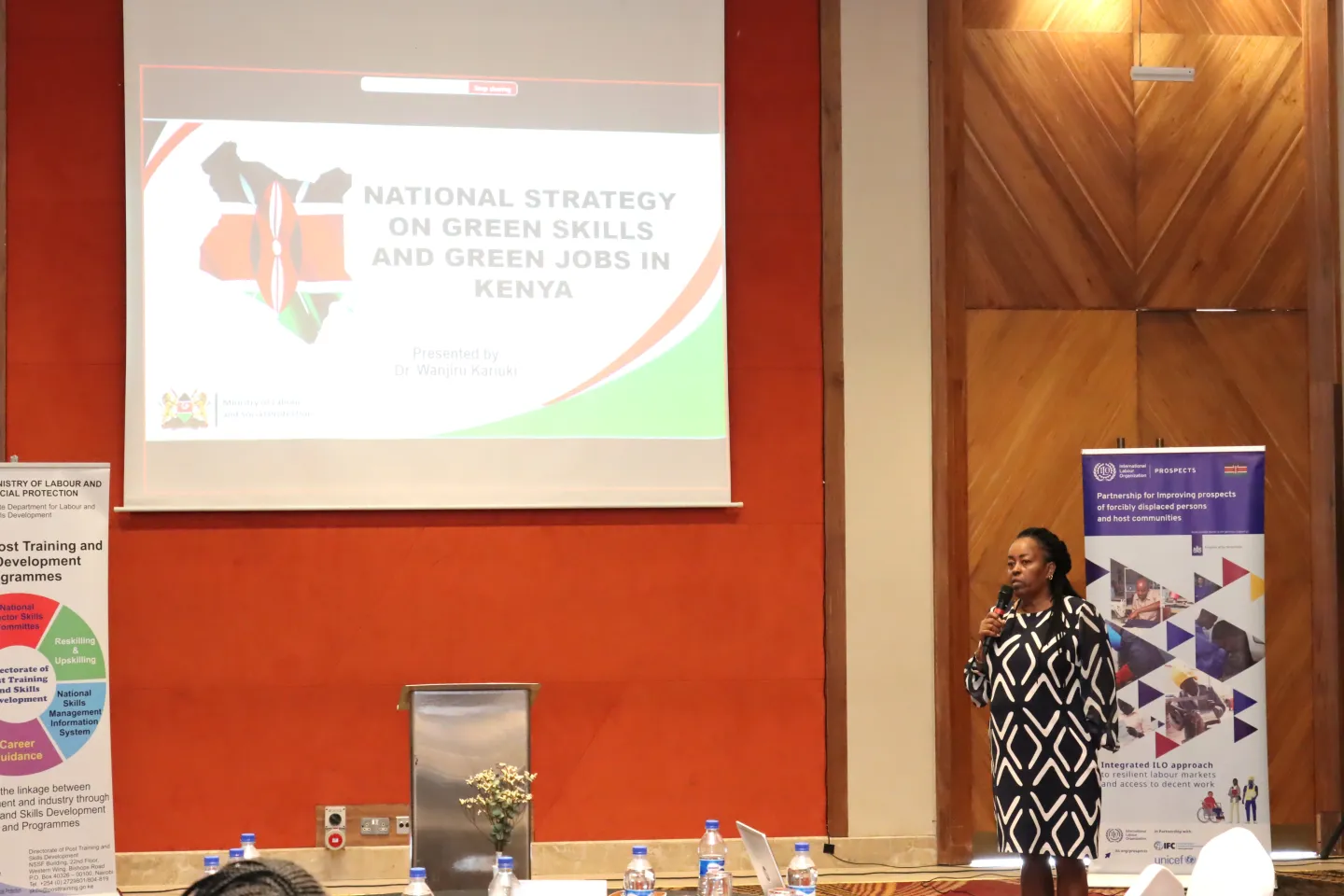
A blueprint for change
Introducing the strategy, Shadrack Mwadime, Principal Secretary, State Department for Labour and Skills Development said, “This strategy is more than a document—it is a call to action. It provides us with a unique opportunity to create a legacy of change, it is time for tangible action. We must steer Kenya towards a climate-resilient, sustainable future.”
The strategy is anchored on six key pillars:
- Green governance: strengthen the governance framework for the delivery of green skills and jobs
- Green skills: develop green skills that are aligned to the needs of industry
- Green research and technology: enhance green research and technology transfer to drive innovation in green enterprises
- Green jobs: facilitate the creation and growth of green enterprises and jobs creating sustainable employment opportunities.
- Green labour market: Enhance labour market performance within the green economy
- Green finance: establish a sustainable financing mechanism for the delivery of green skills and jobs

Impact and opportunities
The green transition opens doors to new job opportunities in renewable energy, sustainable agriculture, eco-tourism, circular economy and more. As Kenya accelerates its efforts toward achieving a 32 per cent reduction in greenhouse gas emissions by 2030 through its Nationally Determined Contribution (NDC), the development of green skills becomes paramount.
“At the heart of the strategy lies the potential of green jobs for our young people. The growth of green industries has the potential to unlock significant returns and economic opportunities that will stimulate youth employment. This will help in averting the high youth unemployment crisis facing the country,” added Mwadime.
A well-equipped workforce will not only meet the demands of emerging industries but also drive innovation and enhance productivity across sectors. The strategy aims to tap into the large youth population by leveraging Kenya’s 18.4 million youth population and guiding them towards green employment pathways.
“Greening isn’t a new concept—it’s about inculcating knowledge and skills that make our activities more cost-effective and environmentally friendly over time, while enhancing decision-making. It's crucial that we stop working in silos; when everyone does their own thing, our processes become more expensive. But when we come together and work collectively, we can truly achieve our goals,” explained Dr Osawa Otta, Deputy Director Standards Development, TVET Authority, a participant at the validation meeting.

Closing the green skills gap
Further to presentation of strategy, the stakeholder validation meeting underlined the need for developing quality green skills to reduce environmental risks and ecological scarcities, ultimately contributing to a more inclusive and resilient economy.
While speaking about green labour markets, Kim Matu from Global Development Incubator stated that, "We have a lot of people working on green jobs and many more training for them. However, I believe we need to establish a small working group to curate these opportunities—there’s a wealth of activity, yet no central point to gather the information. We must identify which jobs are available now, in the mid-term (two to four years), and in the long term (four to ten years). With that data, we can map out the required skills and connect them with available training partners".
By integrating green learning across basic, technical, and tertiary education—as well as promoting on-the-job training programs—the initiative aims to close the growing green skills gap. This approach is set to empower workers, boost competitiveness, and ensure that Kenya remains at the forefront of the global green transition.
"The National Strategy on Green Skills and Jobs is a timely step toward turning Kenya's climate challenges into decent work and inclusive growth opportunities. By investing in people and equipping communities with the right skills, we foster innovation and resilience, ensuring that the green transition leaves no one behind for more sustainable future," said Caroline Njuki, Chief Technical Advisor, ILO PROSPECTS Kenya.
ILO's support included providing technical inputs to advance the National Strategy on Green Skills and Green Jobs so that it is responsive to international labour standards, principles of just transition, and best global practice. Through expert guidance and policy review, the ILO helped Kenya establish a robust framework for green job creation and workforce development.
Related content
PROSPECTS Impact
Kenya’s Journey to Recognizing Informal Skills: The Making of the Recognition of Prior Learning Policy
ILO PROSPECTS Impact
ILO transforms camel milk value chain in Kenya by strengthening entrepreneurship and infrastructure
Tackling water woes: ILO’s vocational training success in Kenya
Relevant projects

ILO-Netherlands Partnership
Partnership for improving prospects for forcibly displaced persons and host communities (PROSPECTS) in Kenya
Programme
Partnership for improving prospects for forcibly displaced persons and host communities (PROSPECTS)