


ILO PROSPECTS Impact
ILO transforms camel milk value chain in Kenya by strengthening entrepreneurship and infrastructure
The host and refugee communities in Kenya benefitted from ILO’s Approach to Integrated Market Systems which enhanced water access driving growth in camel milk production and job creation. By restoring water systems and supporting women-led businesses, the initiative improved livelihoods, increased milk yields, and opened new market opportunities.
14 October 2024
Garissa, KENYA (ILO News): Garissa County, located in the arid northern region of Kenya, faces significant challenges due to water scarcity and harsh environmental conditions. With limited rainfall, communities mainly rely on boreholes, dams, water pans, and wells for water, essential for both human and livestock consumption. However, frequent equipment breakdowns and poor maintenance of water infrastructure have often disrupted water access, critically impacting livelihoods, including those involved in camel milk production.
To address these challenges, the International Labour Organization (ILO), through its PROSPECTS programme funded by the Kingdom of the Netherlands, set out to address the root causes of poor productivity in the camel milk value chain. This effort focused on increasing access to water, better management of water resources, improving milk handling and hygiene, and promoting aggregation and entrepreneurship. The interventions have not only restored essential water infrastructure but also provided employment and technical skills to refugees and host communities, building resilience, enhancing livelihoods, boosting production, and creating sustainable market linkages.
Rehabilitation of Water Dams using Labour-based approaches
The rehabilitation of community water points using the Employment-Intensive Investment Programme (EIIP) approach has been a lifeline for the region, significantly improving water availability for both households and livestock in Skanska, Delasagar, and Awlyia in Fafi, Lagdera, and Balambala Sub-counties, respectively. The rehabilitation works involved desilting and clearing heavily silted dams to increase their capacity to store more rainwater, laying new water piping systems for dams, replacing leaking systems at a borehole, providing water tanks and pumping equipment, and constructing eleven animal water troughs, water kiosks, and a pump house.
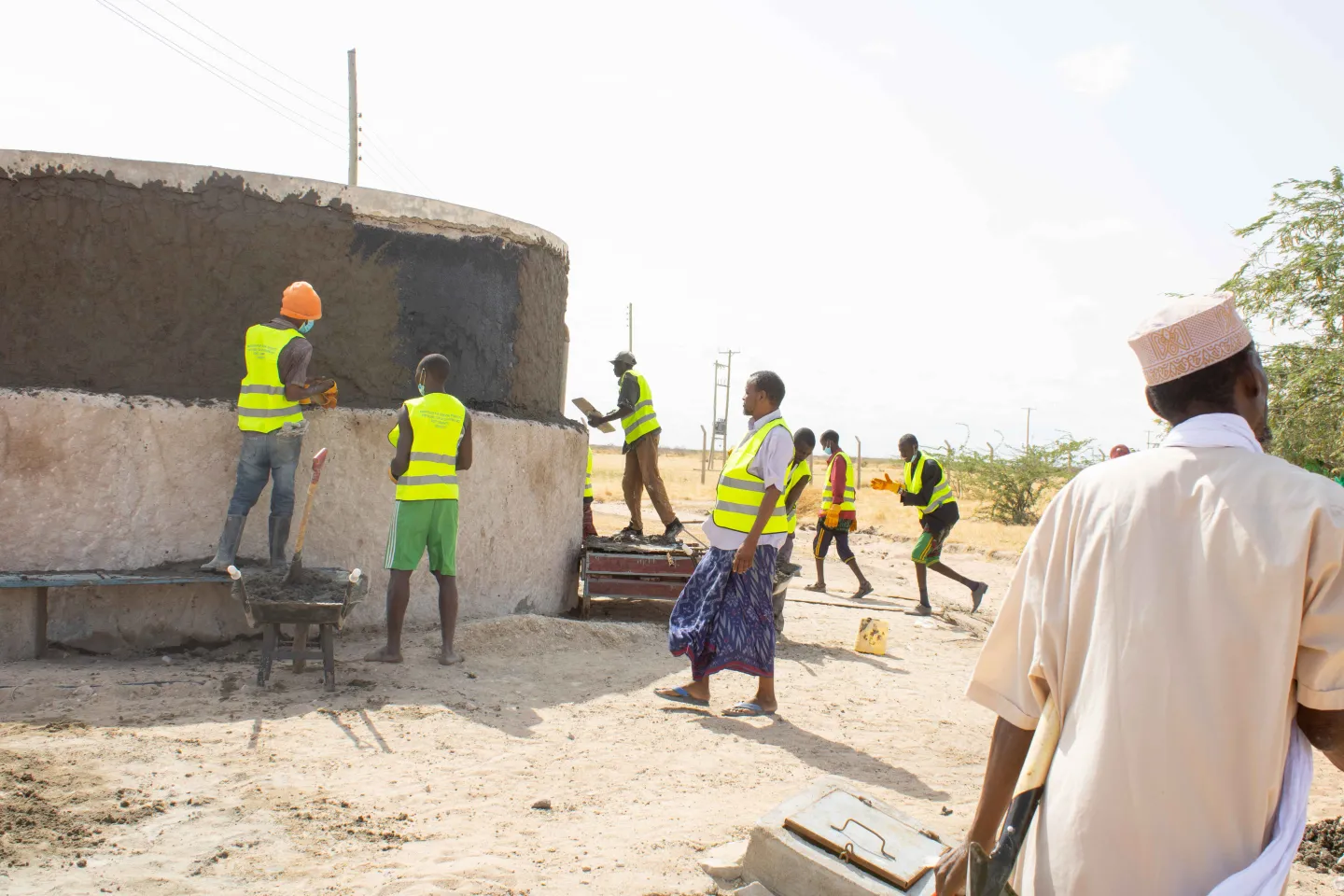
After the rehabilitation, Awlyia dam now conserves water for 7 months, compared to 5 months previously, serving households from 13 surrounding villages. The camel population accessing water daily increased from 1,500 to over 3,000. Camel milk production rose from 6,000 litres during the dry season, generating an income of Ksh360,000 (US$ 2,761), to 18,000 litres after the rains, resulting in a daily income of Ksh1,080,000 (US$ 8,372). In July and August, daily production reached 21,000 litres, yielding Ksh1,260,000 (US$ 9,767) before the onset of the dry season.
The rehabilitation works across the three water points has also generated 569 new jobs (56 for women and 434 for men) in labour-based activities, as well as 40 new milk businesses for women.

ILO’s intervention has involved training local youth in technical skills such as basic masonry, plumbing, and water pumping systems operation. This ensures that Water Resource Operators (WROs) can maintain and repair the water infrastructure, ensuring consistent water supply, particularly for camel milk farmers whose livelihoods depend on the availability of water.
"Through our employment-intensive approach, we have ensured that youth from the refugee and host community are not only involved in the works at the water points but are also equipped with the necessary skills to repair, maintain and manage these resources sustainably," said Lilyanne Ndinda, National Programme Coordinator for Enterprise Development, ILO PROSPECTS Kenya. She adds, "This is critical in ensuring that the community can sustain the water infrastructure for the long term."
In partnership with SITE Enterprise Promotion and the County Government of Garissa, the ILO has successfully trained 18 WROs at the Garissa Vocational Training Centre. These trainees are now playing a key role in ensuring that water infrastructure in eight water points remains operational and effective for the local community.
Mohammed Abdi Duale, a beneficiary of the WRO training, stated: "The training has given me the technical skills to maintain water pipes and troughs. Now I can ensure water is consistently available for livestock, which is vital for our livelihoods. The stipend I earn from this work has also allowed me to start a small grocery business."

The county government has also recognised the value of this collaboration. Ahmed Sheikh Hussein, Technical Services Manage at Garissa Rural Water Company, remarked, "We’ve worked closely with ILO and SITE to design a curriculum that meets the needs of our water operators. The skills they’ve gained will enhance water management across the county, and this will have a direct positive impact on livestock farmers."
Kasha Camel Milk Centre: A Catalyst for Change
The steady improvement in water availability has laid the foundation for other key interventions, particularly in the camel milk value chain. One of the most impactful efforts has been the establishment of the Kasha Camel Milk Collection Centre, situated along the River Tana in Saka Ward, Balambala Sub-County. Before the centre was established, camel milk traders, most of whom were women, faced significant challenges, including the lack of proper storage and hygiene facilities.
"Before the intervention, we were selling milk under a tree, and it was difficult to maintain hygiene standards. With the construction of the Kasha Camel Milk Centre, we now have a proper facility, and our business has grown immensely," said Isinino Hussein, Chairlady of the Kasha Camel Milk Centre.
In early 2022, the Kasha women’s group consisted of 15 members. After receiving training in milk hygiene and entrepreneurship, the group expanded to 45 members, with their milk production increasing from 300 litres to over 6,000 litres daily by September 2023.
"ILO’s approach to capacity building and market systems has been crucial in helping the Kasha group scale their operations," said Elizabeth Katuba, Programme Manager at SITE Enterprise Promotion. "By addressing key bottlenecks in the camel milk value chain—such as water scarcity, poor milk handling, and market access—ILO has enabled these women to increase their income and improve their quality of life."
The Kasha Camel Milk Centre, equipped with a 750,000-litre milk cooler and essential storage containers, has transformed the local camel milk industry. It currently serves a producer group of 155 members, including camel herders, traders, and transporters, allowing them to bulk, cool, and add value to camel milk.

Economic Impact and Market Linkages
The centre has had a transformative effect on the local economy, providing traders with access to new market opportunities and helping them improve the quality of their products. By ensuring proper handling and cooling of milk, traders now sell higher-quality products, fetching better prices.
"With the Kasha centre, we are now able to ensure that our milk remains fresh and meets the hygiene standards required by buyers. This has opened new markets for us, and we’re now selling to 86 bulk buyers in Garissa town," said Salad Ado Omar, Secretary of the Kasha Camel Milk Centre.
As of early 2024, the centre processes over 10,000 litres of milk daily, generating Ksh600,000 (approximately $4,000) in income, with plans to scale up to 15,000 litres by December 2024. The centre’s success has also created 379 new jobs in the community, with 326 of these jobs going to women.

According to Dr Haret Hambe, Garissa County Director of Livestock Development: "Garissa County is home to approximately 840,000 camels. About 15 per cent of them are lactating, which results in the production of around 190 million litres of milk annually." Dr Hambe emphasises that ILO’s interventions have not only improved the livelihoods of camel milk producers but also enhanced the county's overall camel milk output.
"We’ve seen a significant improvement in the livelihoods of the camel milk traders and herders thanks to ILO’s interventions. The availability of water and proper infrastructure has allowed these women to not only increase their income but also access better market linkages," added Dr Hambe.
Looking Ahead: Scaling Up Camel Milk Production
With the continued support of ILO and its partners, the Kasha Camel Milk Centre has set ambitious goals for the future. The group plans to establish a mini-processing plant to diversify its product line, with offerings such as camel milk yoghurt, chocolates, and sweets. This will add value to the raw milk, further increasing their income and creating more job opportunities.
"By adding value to our camel milk and exploring new markets, we’re confident that we can improve our earnings even more. Our dream is to see Kasha camel milk products on the shelves of supermarkets across Garissa and beyond," said Isinino Hussein, Chairlady of the Kasha group.
The combination of water resource management, capacity building, and market development has not only strengthened the camel milk value chain but also laid the foundation for a brighter and more sustainable future for the communities in Garissa.
"Our work in Garissa exemplifies the ILO’s commitment to improving livelihoods through integrated interventions. By addressing key constraints in the camel milk value chain and ensuring sustainable water resource management, we are helping communities build resilience and create lasting economic opportunities."
Caroline Njuki, Chief Technical Advisor for ILO PROSPECTS Kenya
See also
Topic portal
Employment-intensive investment
Approach to Inclusive Market Systems (AIMS) for refugees and vulnerable groups
Programme
Partnership for improving prospects for forcibly displaced persons and host communities (PROSPECTS)
Relevant projects

ILO-Netherlands Partnership
Partnership for improving prospects for forcibly displaced persons and host communities (PROSPECTS) in Kenya
Programme
Partnership for improving prospects for forcibly displaced persons and host communities (PROSPECTS)