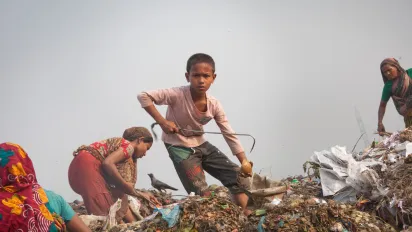
On 30 November, the Committee on Development and the Committee on International Trade of the European Parliament held a public hearing on child labour in the agricultural sector in Sub-Saharan Africa, the region and sector with the largest number of child labourers globally. The hearing took place in the context of the International Year for the Elimination of Child Labour and the publication of the first joint ILO-UNICEF global estimates in June, which showed a worrying rise in the number of children in child labour since 2016 and the first increase in numbers since the ILO began publishing estimates in 2000.
Child labour remains a persistent problem in the world today. The impact of the COVID-19 crisis on household and national incomes, and the resultant economic and social disruption has further contributed to and worsened the situation for many children, especially in Africa, and has reversed years of progress. According to the recently published global estimates, at the start of 2020, prior to the outbreak of the pandemic, there were 160 million child labourers, or almost 1 out of every 10 children worldwide, and this number is expected to increase by 8.9 million by the end of 2022 unless joint and decisive action is taken by the international community to reverse the upward trend and achieve the UN’s 2030 Agenda goal of eliminating child labour, including in all its forms, as committed to by 2025. Furthermore, millions more children are at risk of falling into child labour with the number rising by 46 million if access to critical social protection is withdrawn.
At the hearing, MEPs heard from representatives of governments, the private sector, international organisations, including the ILO, and civil society on how the EU’s development and trade policies could address the complex, intertwined and multifaceted root causes of child labour. Such causes can include extreme poverty and hunger, crisis and conflict situations, inadequate incomes and unfair prices for agricultural produce and livestock, lack of access to education and social protection, under-investment in farm modernisation and labour-saving technologies and a lack of awareness, monitoring, and inspection systems to identify and combat child labour.
Benjamin Smith, ILO senior technical specialist on child labour, provided a global overview of the situation. Breaking down the estimates, of the 160 million child labourers, there were 63 million girls and 97 million boys. The number of children aged 5 to 11 years in child labour accounts for over half of the total global figure. Furthermore, seventy-nine million children aged 5 to 17 years were engaged in hazardous work which endangers their health, safely and moral development and undermines their fundamental human and labour rights. Nearly 28 per cent of children aged 5 to 11 years and 35 per cent of children aged 12 to 14 years in child labour were out of school, even before the disruption to education from the pandemic is taken into account.
In geographical and regional terms, the prevalence and largest number of children in child labour is highest in Africa (86.6 million) followed by Asia and the Pacific (34.4 million), Latin America and the Caribbean (8.2 million), and Europe and Central Asia (3.8 million). During the period 2016-2020, child labour has increased in Sub-Saharan Africa by 16.6 million, continuing a trend which started in 2012. This is in marked contrast to improvements seen in Asia and the Pacific and Latin America and the Caribbean. Breaking down by economic activity, agriculture accounts for the largest share worldwide with over 70% of child labour found within this sector, mainly in subsistence and commercial farming and livestock herding.
With strong and determined political will and effective policy action, Mr Smith expressed an optimistic view that the recent deterioration could be reversed. He noted that during the period 2000 to 2016 there was an almost 40% decrease in children in child labour or 94 million children, bringing the numbers down from 246 million in 2000 to 152 million in 2016. The international community has the knowledge and tools available to tackle the problem, as it did before, so that no child is left behind and is free from child labour.
Immediate steps are needed. To reverse the upward trend, the ILO and UNICEF are calling for adequate social protection for all, including universal child benefits; increased spending on free and good-quality education; the promotion of decent work for adults, so that families do not have to resort to child labour; an end to harmful gender norms and discrimination; investment in child protection systems, agricultural development, rural public services, infrastructure and livelihoods. In addition, trade policy and due diligence in global supply chains, when coupled with development cooperation and dialogue can contribute towards eliminating child labour.
Throughout the ILO’s 100 plus year-history, it has been working towards the abolition of child labour. Indeed, one of the first Conventions adopted by its member States was on the minimum age in industry. In 2020, the ILO reached a significant milestone with the universal ratification of Convention No. 182 on the Worst Forms of Child Labour. Convention No. 138 on the Minimum Age is close to full ratification with 173 of the 187 ILO member States having adopted it.
The ILO, with financial and political support from the EU and its Member States, engages in development cooperation to help countries in Sub-Saharan Africa overcome and tackle child labour. This includes the EU-funded CLEAR Cotton project covering Burkina Faso, Mali, Pakistan and Peru, the ACCEL Africa project funded by The Netherlands, and the Accelerator Lab 8.7 programme with German/BMZ support for activities in the mining sector in the Democratic Republic of Congo.
With the support of the EU or its member states, the ILO also operates on Child Labour in other regions. For example, it receives support from Spain on the Regional Initiative Latin America and the Caribbean Free of Child Labour. Last but not least, the Trade for Decent Work Programme, co-funded by the EU and Finland, assists governments, employers’ and workers’ organisations in strengthening their capacities to prevent child labour, by promoting the ratification of the Child Labour Conventions and fostering compliance in the countries that have ratified them. It operates in Bangladesh, Mongolia, Myanmar, Philippines, Vietnam and undertakes ad-hoc activities in Ecuador, Peru & Pakistan. See the country project pages here.
For more information on the ILO’s activities to combat child labour, please see the ILO’s child labour portal and flagship programme – International Programme for the Elimination of Child Labour and Forced Labour (IPEC+), which seeks to eliminate child labour by 2025, in line with SDG Target 8.7. The ILO also serves as the Secretariat for Alliance 8.7, an inclusive global partnership committed to eradicate forced labour, modern slavery, human trafficking and child labour around the world, as outlined in the 2030 Sustainable Development Goals. As pathfinder countries, France and The Netherlands are leading the way in achieving Target 8.7.