

ILO and PERC strengthen regional dialogue on the future of work at Summer School in Armenia
Trade union leaders from Eastern Europe and Central Asia discussed artificial intelligence, platform work, social dialogue and the outcomes of the 114th International Labour Conference.
1 July 2026
YEREVAN (ILO News) – The International Labour Organization’s Bureau for Workers’ Activities (ILO ACTRAV) and the Pan-European Regional Council of the International Trade Union Confederation (ITUC PERC) jointly organized the 2026 PERC Summer School in Yerevan, Armenia, from 30 June to 1 July 2026, bringing together trade union leaders from across Eastern Europe and Central Asia to discuss the future of work, technological transformation, social dialogue and trade union priorities for the region. The Summer School was preceded by a policy seminar on artificial intelligence (AI) and occupational safety and health, jointly organized by PERC and the Friedrich-Ebert-Stiftung (FES), with technical contributions from the ILO.
Held weeks after the conclusion of the 114th Session of the International Labour Conference (ILC), the Summer School provided an opportunity to discuss the implications of the Conference outcomes for the region, including the adoption of the new Decent Work in the Platform Economy Convention, 2026 (No. 193), the conclusions of the recurrent discussion on social dialogue and tripartism, and the resolution on gender equality.
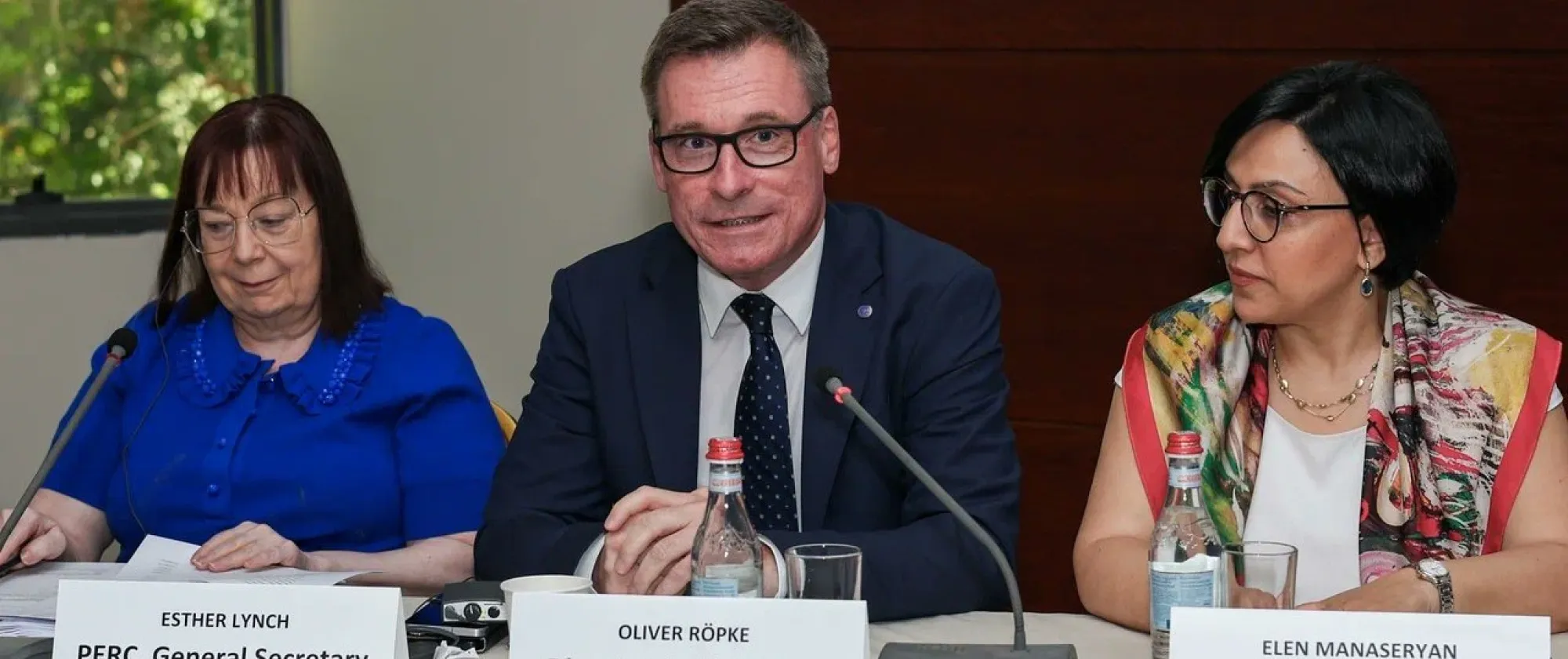
The programme combined high-level policy discussions with practical exchanges on the future of the trade union movement. It was opened by PERC President Igor Zubcu, President of the Confederation of Trade Unions of Armenia Elen Manaseryan, ILO ACTRAV Director Oliver Röpke and United Nations Resident Coordinator in Armenia Françoise Jacob, who highlighted the importance of social dialogue, decent work and international cooperation in supporting democratic governance, resilience and peace in a period of profound economic and geopolitical transformation. PERC General Secretary Esther Lynch delivered the keynote address, calling on trade unions to move beyond reacting to change and instead play a leading role in shaping the future of work through collective action, social dialogue and international solidarity.
Opening the Summer School, Oliver Röpke emphasized that the future of work will be determined not by technology itself, but by the policies, institutions and social dialogue that shape its deployment. He underlined that technological innovation must strengthen, not weaken, workers' rights, and highlighted Convention No. 193 as a landmark achievement ensuring that labour rights follow workers regardless of how work is organized. He stressed that education, capacity building and international solidarity remain central to ACTRAV's mandate and to preparing trade unions for the profound transformations affecting the world of work.
During the thematic session on technological transformation, Röpke further explored the implications of artificial intelligence, algorithmic management and digital labour platforms for workers and trade unions, calling for a human-centred approach based on rights, strong labour institutions and meaningful worker participation. He stressed that technological change without social dialogue risks deepening inequality, whereas collective bargaining and tripartite cooperation enable innovation to contribute to decent work and productivity.
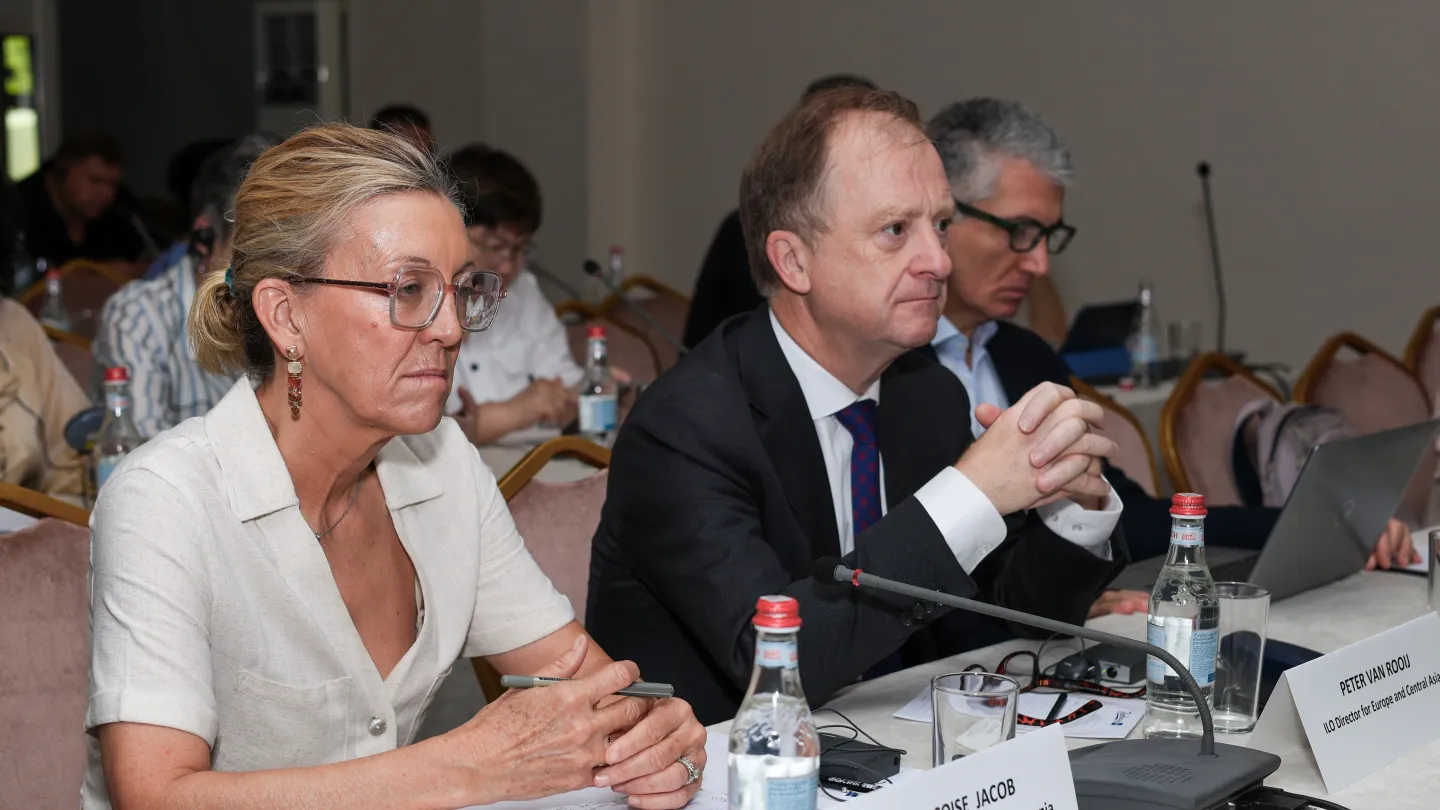
Peter van Rooij, ILO Regional Director for Europe and Central Asia, engaged participants in an interactive discussion on the strategic priorities emerging from the 114th ILC and the evolving role of the ILO in Europe and Central Asia. He highlighted the importance of strengthening national capacities rather than creating dependency on external assistance. He emphasized that future ILO support will continue to focus on reinforcing institutions of work, strengthening tripartite dialogue and improving the practical implementation of recommendations from the ILO supervisory bodies through technical cooperation, including Decent Work Country Programmes.
A dedicated session on defending social dialogue in challenging times featured Gocha Aleksandria, ILO Senior Specialist in Workers' Activities for Eastern Europe and Central Asia, who presented an evidence-based regional assessment of social dialogue in Eastern Europe and Central Asia. Drawing on the ILO's Social Dialogue Report 2024 and recent regional research, he analysed the paradox facing the region: while Europe and Central Asia possesses some of the strongest institutional foundations for social dialogue globally, their effectiveness increasingly depends on the broader enabling environment, including respect for freedom of association, collective bargaining and civic space.
The ILO also contributed to the second day of the Summer School through a session on Decent Work as a Foundation for Peace and Resilience. Cristina Martinez, ILO Senior Specialist on Enterprise Development and Green Jobs for Eastern Europe and Central Asia, presented the ILO-UNDP programme supporting recovery in Armenia's Syunik region, highlighting how decent work, social dialogue and local economic development can strengthen resilience, facilitate formalization and contribute to sustainable peace.
Beyond the ILO-led sessions, participants exchanged views on the implications of technological change, artificial intelligence and platform work, regional priorities for the 2027 ITUC Congress and the role of trade unions in promoting peace, resilience and democratic governance. Through a live online exchange, ITUC General Secretary Luc Triangle invited affiliates to contribute to preparations for the Congress, while regional consultations addressed the draft Congress Statement, constitutional reforms and priorities for strengthening the voice of the Pan-European region within the global trade union movement.
The Summer School was preceded by a Policy Workshop on Artificial Intelligence Deployment in the Workplace, organized by PERC and the Friedrich-Ebert-Stiftung with ILO participation. Antonio Santos, ACTRAV Senior Specialist in Workers' Activities, outlined how international labour standards, including the newly adopted Convention No. 193, provide a framework for addressing the occupational safety and health implications of AI and digital transformation through prevention and social dialogue.
Across both events, participants emphasized that rapid technological change, artificial intelligence and digitalization reinforce rather than diminish the importance of freedom of association, collective bargaining and effective social dialogue. They stressed that managing digital and green transitions successfully requires strong institutions of work, representative social partners and meaningful worker participation in shaping technological and economic transformation.
The Summer School reaffirmed the long-standing strategic partnership between the ILO and PERC in strengthening trade union capacity across Eastern Europe and Central Asia. It equipped trade union leaders with new analytical tools and strategic perspectives to advance decent work, strengthen social dialogue and contribute to a more inclusive, resilient and democratic future of work.
