

Domestic workers
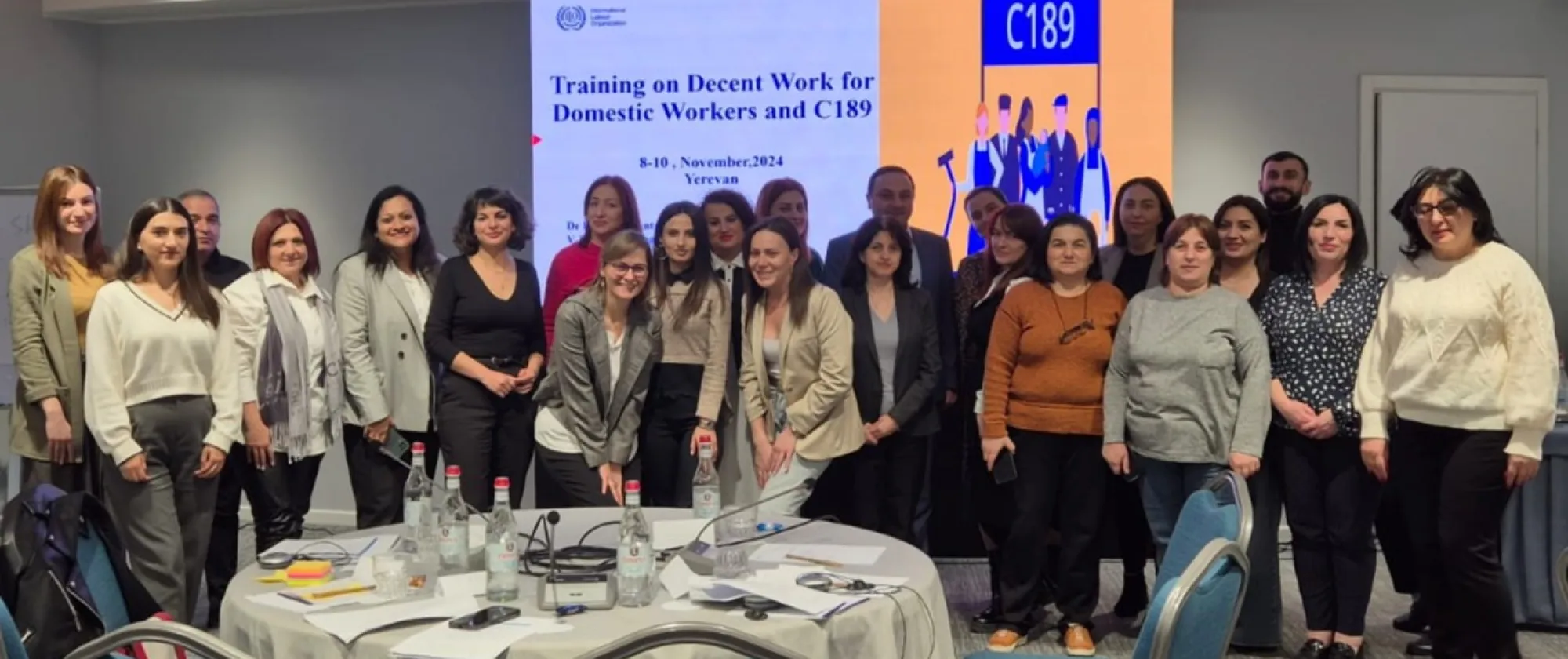
ILO and CTUA conducted a training on decent work for domestic workers and the Domestic Workers Convention
Trade union representatives and state labour inspectors are ready to protect and advocate decent work for domestic workers in Armenia.
4 December 2024
YEREVAN (ILO News) - Domestic workers are key members of the care economy and constitute an integral part of the global care workforce. According to the International Labour Organization (ILO) estimates (2021), there are 75.6 million domestic workers over the age of 14 worldwide, the vast majority of whom are women. By this definition, 1 in 22 employees works as a domestic worker, accounting for 4.5 percent of all employees worldwide.
Yet, domestic workers face serious decent work deficits throughout their working lives and continue to be invisible in national frameworks. The majority of domestic workers work informally, with no or limited labour and social protection, as they are excluded from the scope of Labour Codes. The large number of domestic workers in the informal economy face additional challenges, including limited access to unemployment assistance or employer compensation, unsafe and unhealthy working environments, a lack of formal channels to report violence and harassment, and restricted access to workers’ organizations, which limits their voice and bargaining power.
To raise awareness about decent work for domestic workers and the ILO Convention on Domestic Workers, 2011 (No. 189), the ILO’s Bureau for Workers’ Activities (ACTRAV) and the Gender, Equality, Diversity and Inclusion Branch (GEDI) have launched an awareness-raising and organizing campaign on "Rights, Advocacy, and Representation" in collaboration with the Confederation of Trade Unions of Armenia (CTUA). The campaign was initiated within the framework of the RBSA intervention on "Building the capacity of constituents of pre-empting informalisation of work and promote transition to formality in the context of a refugee crisis."
The campaign is based on three pillars:
- capacity building on decent work for domestic workers and C189,
- increasing organizing, negotiation, and advocacy skills of trade unions, and
- organizing domestic workers in trade unions.
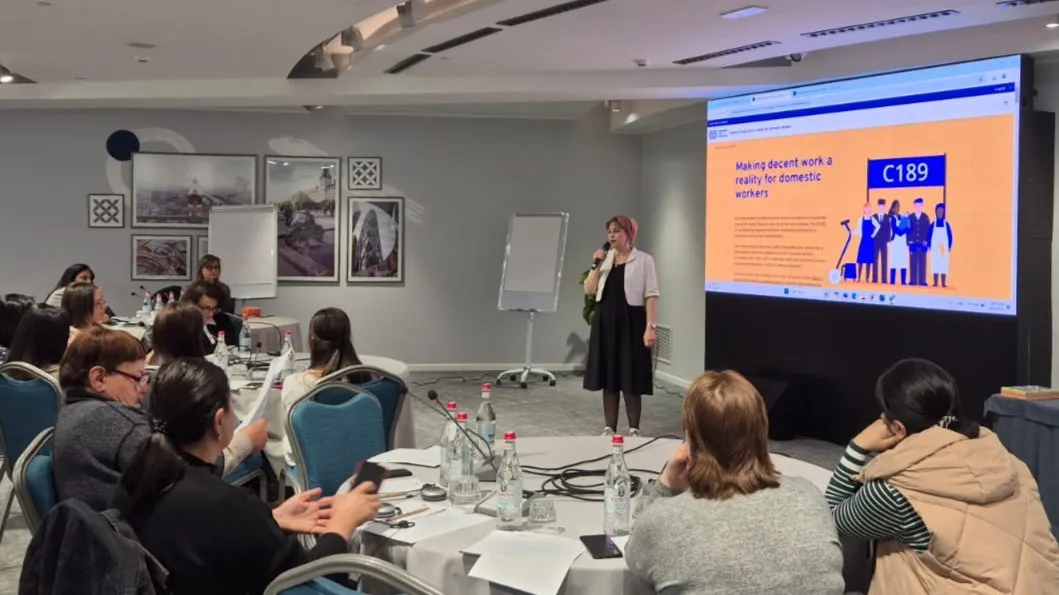
With an extensive three-day training session held from 8-11 November 2024 in Yerevan, the first phase of the programme was completed with the participation of 25 trade union members of CTUA and 2 State Labour inspectors. The training provided an open space for all participants to discuss gaps in national legislation, challenges in protecting the rights of domestic workers through labour inspection, securing safe and healthy working environments, addressing decent work deficits in the domestic work sector, initiatives of domestic workers across the world, examples of extending labour and social protection to domestic work, and innovative ways to organize and extend representation of domestic workers in Armenia.
Here are some reflections from the participants:
- Varduhi Brutyan, CTUA, Head of Training and Research Center:
"The seminar was important for the Confederation of Trade Unions of Armenia, as it was the first time that the topic of domestic workers was discussed among trade union activists. The activity of the seminar participants showed that regardless of their main profession and work, trade unionists are interested in the working conditions of domestic workers. This is a very important first step towards the ratification of Convention C190 in Armenia." - Liana Amiraghyan, CTUA, Head of the Committee on Equality in Labour Relations:
"The session presenting cases from foreign countries was very effective and could be one of the key tools for future work. In the Armenian context, one of the challenges could be the stereotypical thinking that bad experiences cannot be stopped and a lack of belief in success. The work in this sphere will be challenging and tricky, but it is conquerable." - Ann Barikyan, CTUA, Lawyer:
"The training on the ILO Convention provided knowledge on international labour standards to advocate for decent working conditions for domestic workers. It will give us the tools to promote the adaptation of legislation related to domestic workers and raise awareness about the challenges they face in their communities. It is necessary to advocate for the legal recognition and protection of domestic workers' rights, ensuring that they are included in labour law protections, promoting fair wages, safe working conditions, respect for human dignity, and their organization in trade unions." - Ara Mkrtchyan, The Health and Labour Inspection Body of the Republic of Armenia:
"This course provided both me and the Chief Specialist of the Department, Davit Martirosyan, with valuable insights into international practices and experiences. Regarding the implementation of inspection functions, the information covered in the course will be applicable once ILO Convention No. 189 is ratified. I believe the primary issue will be determining how to clearly and accurately define provisions concerning inspectors' access to private areas. This will raise concerns about balancing inspection needs with the right to private property."

Relevant projects
Building the capacity of constituents of pre-empting informalisation of work and promote transition to formality in the context of a...