

Ghana launches its first National Productivity Statistics report: A milestone for economic growth and policy dialogue
5 March 2025
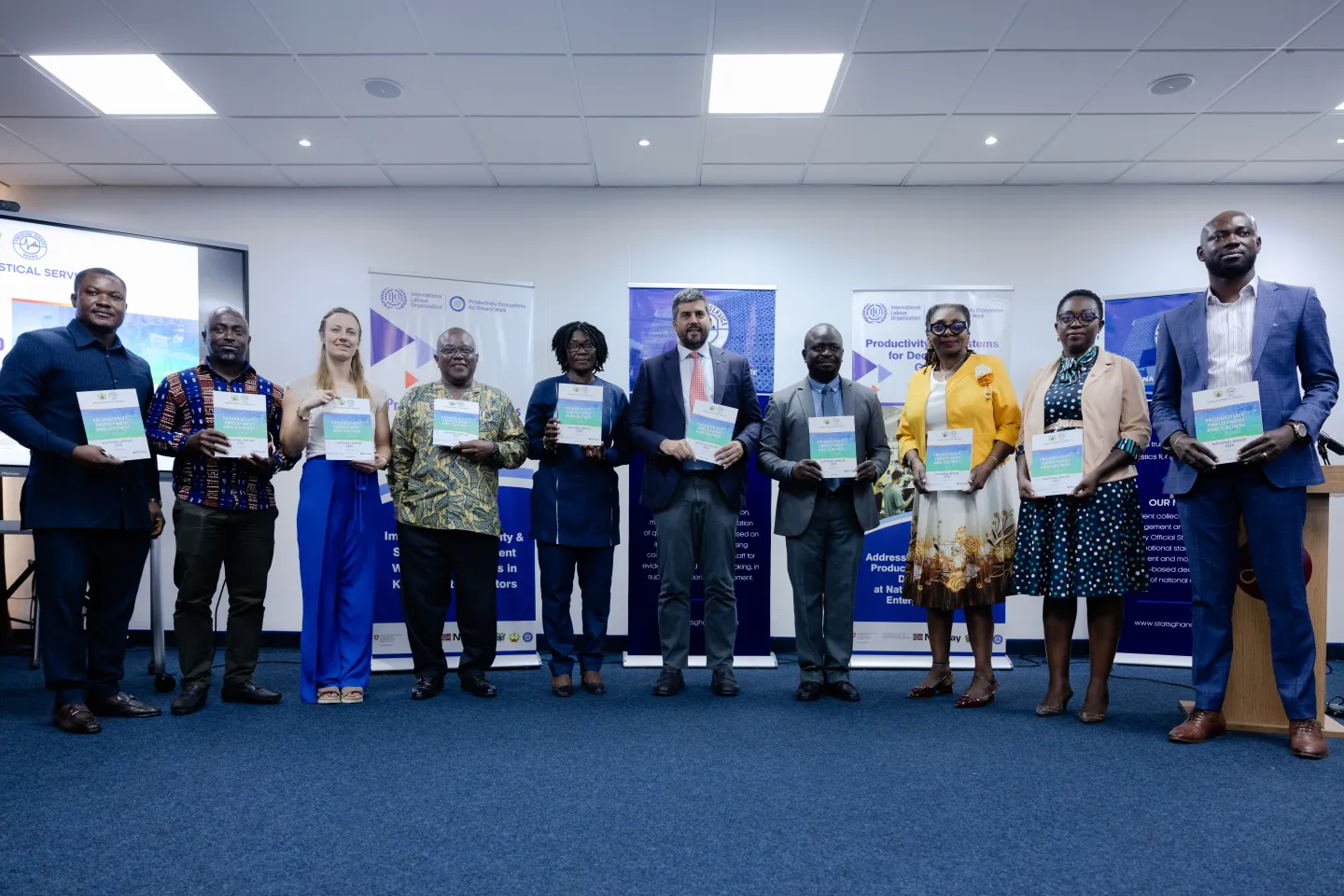
Accra (ILO News) - Ghana has officially launched its first-ever National Productivity Statistics Report, providing a comprehensive overview of the country’s productivity trends over the past two decades. The report, released by the Ghana Statistical Service (GSS), offers invaluable insights into productivity, employment, wages, and economic growth, with data aligned to international standards. Backed by the International Labour Organization (ILO), the report will serve as a foundational tool for future economic policies and national dialogues aimed at enhancing the country’s productivity and growth.
The launch, which took place on February 24, 2025, was a momentous event attended by a total of 81 senior management representatives from 21 institutions. Notably, the event saw the participation of key stakeholders, including the National Planning Commission, Ministries of Finance, Industry, Trade, Labour, Agriculture, and others. The ILO, along with the embassies of Norway and Switzerland, also played a significant role in supporting the event.
Key insights from the report
The report reveals that while Ghana has made strides in improving productivity over the years, wage growth has not kept pace with productivity increases. According to Kingsley Laar, representing the Ghana Employers Association, the findings will play a crucial role in upcoming negotiations. He stated, “The report is going to help us a lot with our negotiations.”

Richard Acheampong from the Trade Union Congress, Ghana, emphasized the need for stronger dialogue and negotiation. He commented, “Average earnings in Ghana increased at a slower pace than productivity growth. As a union, it is only right that we intensify our negotiation and dialogue for a fair share of earnings.”
The report is also expected to shape future policy discussions, with Professor Samuel Kwabena Annim, the Government Statistician and Head of the Ghana Statistical Service, noting that it will serve as a key resource for the upcoming National Economic Dialogue.
The report should form the foundation for the upcoming National Economic Dialogue scheduled by the recently elected new Government for the first quarter of 2025. It informs policymakers on the critical productivity sectors to drive the desired increase in economic growth.
Professor Samuel Kwabena Annim, Head of the Ghana Statistical Service

A tool for policy and economic growth
The National Productivity Statistics Report not only highlights the productivity trends across various sectors but also provides valuable data on job creation and economic growth. It serves as a vital tool for policymakers and social partners to design informed, targeted strategies that can foster sustainable economic development.
The launch was widely covered by national media outlets, including JoyNews, GhanaWeb, Citi Newsroom, and other major platforms. Various media reports highlighted the key findings of the report and its potential to influence the national economic dialogue scheduled for the 3–4 March, 2025 as well as policy-making in the years to come.
Key media coverage included:
- Joy News on TV coverage
- Ghana web business report
- Ghana Statistical Service facebook live
- Citi Newsroom report on labour productivity
- Norvan report
- My Joy Online report

A step forward for Ghana’s economic future
As Ghana continues its path towards economic development, the national productivity statistics report stands as a critical resource for the government, businesses, and labor unions alike. It provides a snapshot of the country's economic performance while offering a clear roadmap for the future of labour, wages, and productivity.
This report sets the stage for future efforts to create a more balanced and sustainable economy, where the benefits of increased productivity can be shared more equitably across all sectors of society. By engaging in dialogue and using this data as a foundation, Ghana is well-positioned to strengthen its economy and improve the well-being of its workforce.
Next steps
As stakeholders across sectors engage with the data, it is expected that the insights gained will guide national policies and conversations surrounding economic growth, wages, and productivity. With continued support from organizations like the ILO, the Ghana Statistical Service, and international partners, the country is poised to take significant steps toward achieving sustainable and inclusive economic development.
For more information on the report and its findings, visit the GSS official website.
ILO Productivity Ecosystems for Decent Work is a global multi-country programme initiated in 2021. Funded by the governments of Switzerland and Norway, it has operations in Ghana, South Africa, and Viet Nam. The programme seeks to promote productivity growth for decent work, combining different approaches that strengthen productivity drivers across policy, sector, and enterprise levels.
Relevant projects
Productivity
Productivity Ecosystems for Decent Work Project

Productivity Ecosystems for Decent Work
Productivity Ecosystems for Decent Work Programme Ghana