


From Compliance to Commitment: Industry Leaders gathered to promote Responsible Business Conduct in New Delhi
29 April 2025
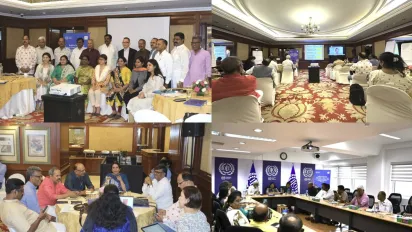
On 29 April 2025, The International Labour Organization (ILO), in collaboration with the Employers’ Federation of India (EFI) and the Confederation of Indian Industry (CII), organized a Capacity Building Workshop on Responsible Business Conduct (RBC) for the manufacturing sector in New Delhi. The event brought together 31 participants from 25 companies, along with Ministry of Labour & Employment and senior representatives of EFI/CII, and explored how ethical, transparent, and sustainable practices can be embedded into core business operations.
In her opening address, Ms. Rashmi Mansharamani, Chairman (HR & IR), CII and CHRO, Wave Group, emphasized that responsible business practices are no longer optional but essential for long-term growth and global competitiveness. She outlined four key pillars for responsible value chains - human rights and labor practices, sustainable sourcing, governance and compliance, and technology-driven innovation - urging businesses to adopt global best practices and leverage digital tools to enhance traceability and accountability.
Ms. Michiko Miyamoto, Director, ILO Decent Work Technical Support Team for South Asia and Country Office for India (DWT/CO-New Delhi), highlighted the distinction between Corporate Social Responsibility (CSR) and Responsible Business Conduct (RBC). “RBC differs from CSR in that it integrates responsible behavior into the fabric of daily operations”, she noted, stressing the importance of aligning business practices with international standards on human rights, labor conditions, and environmental protection.
The workshop featured sessions on realization of decent work through RBC and Human Rights Due Diligence (HRDD), including examples from companies actively promoting these principles. Participants discussed the importance of ethical leadership, inclusive workplaces, and sustainable supply chains. A recurring theme was the need to view employees as individuals with unique needs, and to embed fairness and dignity into every level of organization.

During a panel discussion, Dr. Nirav Mandir, Chief Hyman Capital & Sustainability Officer, Shree Ramkrishna Exports Pvt. Ltd. (SRK) stated “Responsible Business Conduct is built around what I call the “Four Ps”—People, Planet, Profit, and Purpose. It’s not just about compliance, it’s about being proactive, forward-looking, and ethically grounded.”
With regard to practical examples in workplaces, “We ensure equitable treatment across the board. Contract laborers and full-time employees eat in the same canteen, have access to the same resources, and are treated with dignity and fairness”, said Dr. Mandir. Another panelist, Mr Sandeep Kumar, COO, ONGC Foundation, also added “We celebrate festivals together, and actively involve unions in decision-making. In fact, unions are just as important as management in ensuring fairness and transparency.”
The workshop was held as part of the ILO’s project “Building Responsible Value Chains in Asia through the Promotion of Decent Work in Business Operations (Phase II)”, funded by the Ministry of Economy, Trade and Industry of Japan. It aims to promote inclusive, responsible and sustainable enterprises and decent work in supply chains through capacity-building programmes for enterprises and ILO’s constituents - government, employers and workers - in four Asian countries including India.
Related content
Trade unions as key enablers of effective Responsible Business Conduct in India
Catalyzing decent work and sectoral resilience: ILO at National Conference on Responsible Business Conduct 2025

Advancing Responsible Business Conduct in India’s manufacturing sector: Insights from the capacity building workshop in Chennai
Indian employers’ organizations take the lead on Responsible Business Conduct (RBC) amidst the growing global momentum
Indian employers’ and workers’ organizations forge a joint roadmap for responsible business conduct

Multi-stakeholder dialogue marks launch of historic bipartite roadmap on responsible business conduct for decent work in India