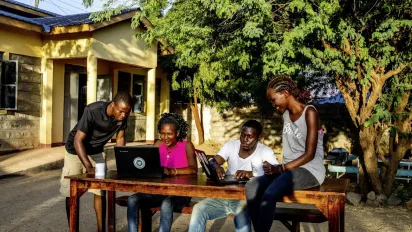
Geneva (ILO News) –Online labour platforms have emerged as a new way of organizing work that is rapidly expanding across the world. The platform economy has the potential to connect refugees with the global economy, allowing them to make a living and to skill up. While the digital gig economy brings opportunities and provides flexibility, it also raises questions about working rights and whether working arrangements are aligned to decent work principles. Recognizing the opportunities and challenges faced by both online platform operators and refugees, as well as the need to enhance targeted assistance for those affected by forced displacement and their host communities, the International Labour Organization (ILO) launched the Learning Lab Series, with the first instalment discussing “the potential of online labour platforms to connect displaced talent with decent jobs”.
This Learning Lab explored effective ways in which digital labour platforms can connect displaced individuals with decent work while addressing potential challenges and risks. Speakers, including Amadou Daffe, CEO and Co-Founder of Gebeya, and Marwan Abdelaziz, CEO and Co-Founder and of Ureed, shared their experiences and insights regarding the inclusion of refugees in their talent pool. They underscored the immense potential of digital job opportunities and highlighted the demand for competitive talent arising from the pandemic and the quick expansion of the online gig economy.
Businesses are looking to the hire talent that is available, regardless of location or migration status. “Online labour platforms do not see if you are a refugee but if you have talent”, said Daffe. Refugees who possess market-demanded skills, remarkable motivation, and who demonstrate a willingness to invest significant time and effort into learning are delivering excellent work for clients. With improved internet connectivity and increased access to digital devices, this untapped talent pool can be introduced to a global market in desperate need of skilled workers.
Abdullahi Abdirahman Noor, CEO of Dadaab Collective Kenya, shared their collective approach of bidding as a collective, distributing work among members and then reviewing for quality, thereby enabling refugees to compete alongside the global workforce. By working online, refugees can enjoy flexible work hours and locations, enhance their skills through continuous education, and establish a professional network.
However, working through online platforms also entails several challenges, primarily related to regulation and payment issues. Taxation and currency conversion complexities arise, especially in cross-border transactions, posing significant challenges for platforms and for platform workers. Payment becomes a barrier as many freelancers lack access to bank accounts. Additionally, refugee freelancers require reliable internet connectivity and the establishment of a strong profile to competitively position themselves in the global marketplace, starting from securing their first job and progressing to multiple engagements.
To foster the inclusion of refugees and other underrepresented worker groups on their platforms, initiatives such as subsidizing clients to hire refugee freelancers help some collectives to build a strong profile and reputation. Providing Information and Communication Technology training to women has also yielded positive results in countries where women do not often work or have access to connected jobs.
“We need a new model of freelancing, including working with larger corporations in the Middle East region to expand access”, said Abdelaziz, pointing also to the need of testing new ways of upskilling. On-the-job learning, for example, may yield better results in the online world of work than traditional training.
PROSPECTS Learning Labs Series: moving towards decent work in online labour platforms
Nicholas Grisewood, PROSPECTS Global Programme Manager at the ILO, emphasized the manifold opportunities and challenges presented by the digital economy. Ensuring that work organized within this space aligns with the principles of decent work is crucial to provide protection and socially secure employment. By fostering conversations and partnerships, initiatives like the Learning Labs ensure that digital livelihoods are supported by the principles of decent work for all, Grisewood, commented.
Hovig Etyemezian, Head of Innovation Service at UNHCR, also highlighted the progress made through partnerships with organizations such as the ILO. He emphasized “such collaborations serve as starting points for broader alliances, and community-driven solutions are vital for fostering inclusion.”
This discussion marks the first instalment of a series of Learning Labs under the PROSPECTS Opportunity Fund Project, “Promotion, inclusion and protection of refugees and host communities in the gig economy”, funded by the Kingdom of the Netherlands. Bringing together a diverse cross-section of humanitarian and development actors, including the ILO, UNHCR, UNDP, UNICEF, IFC, ITC, and the World Bank, this initiative aims at combining mandates, expertise and experience to forge partnerships focused on durable solutions for refugees and the host communities to harnessing the potential of digitally enabled jobs, said, Zulum Avila, ILO Specialist on Employment Strategies in the Digital Economy.
These labs serve as a stepping-stone to the Inclusive Digital Economy Forum scheduled for November-December 2023, where insights and recommendations derived from the labs will inform the discussions held during the forum.