

Unlocking digital work opportunities for refugees
29 May 2024
Closing session of ITC-ILO course on “Promoting decent work access for forcibly displaced persons”, discusses how the digital economy can offer new pathways into the labour market for these groups.
Geneva (ILO News) – The International Training Centre of the International Labour Organization (ITC-ILO) concluded the 4th edition of the course on "Access to Decent Work for Refugees and Other Forcibly Displaced Persons," with an online session focused on improving labour market access for refugees through digital jobs and inclusive strategies.
The session was organized in collaboration with the Partnership for improving prospects for forcibly displaced persons and host communities (PROSPECTS) in response to the challenges refugees face in accessing decent work in the countries that host them.
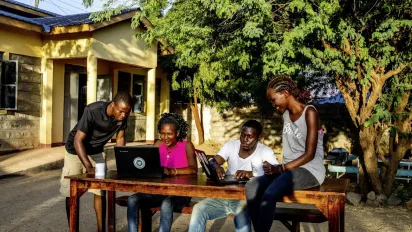
The experts in the session mapped some of these barriers and discussed how emerging digital technologies, such as artificial intelligence (AI), innovation and partnerships can increase refugee’s chances of earning an income for their families, improving their skills and contributing productively to prosperity of the communities hosting them.
“Evidence shows that forcibly displaced populations value digital work for its flexibility and potential to overcome geographic and mobility barriers, especially in areas with limited job options,” explained Zulum Avila, Specialist on Employment Strategies in the Digital Economy the ILO. However, she emphasised that while opportunities exist, it remains vital to tackle digital divides, protect rights, and ensuring decent working conditions.
Innovation and collaboration: the case of AI
Among the various examples on digital innovation showcased during the session is the experience of Humans in the Loop, ILO’s implementing partner, in empowering refugees through AI. “The demand for quality annotation of training data for machine learning is very high and can help conflict- and displacement-affected communities to rebuild financial independence faster,” shared Tess Valbuena, Chief Operations Officer at Humans in the Loop.
Looking beyond opportunities, Chief Impact Officer Hester Gartrell also cautions, “There is a conversation that needs to be had on how microwork, such as in the AI sector, can be safe. For instance, low wages can push workers to work very long hours or accept tasks that could involve mentally traumatic content.” She explained that the refugees and conflict-affected individuals they work with are supported through upskilling and paid digital work opportunities that match fair work principles on working hours and wages.
Inclusion and protection in digital jobs and livelihoods
The session also gave a preview of the forthcoming joint publication by the ILO, UNDP and UNHCR which delves deeper into emerging practices on improving access and working conditions on digital labour platforms for forcibly displaced persons and host communities.
Amy Fallon, Associate Innovation Officer at the UN Refugee Agency (UNHCR), highlighted that the report takes “a systems approach for inclusion in the digital economy”, which looks at various dimensions such as the regulatory environment, access to connectivity, skills training, financial services, and intersectional barriers like gender and disability.
Bringing another crucial aspect to the conversation, Henny Ngu, Senior Policy Adviser for Forced Displacement at the UN Development Programme (UNDP), underscored the role of data. She noted, “Baseline data is needed to better understand the barriers and make informed policy decisions. The question now is, how can we also make use of digital tools to better gather information on working conditions of refugees or their current use of technology?”
The session is a step to mainstream digital employment matters into the ITC-ILO training offer. “We need to further unpack the challenges and opportunities of linking refugees to digital jobs,” concluded, Héloïse Ruaudel, Senior Specialist on Crisis Migration with the ILO.
This webinar was supported by the PROSPECTS Opportunity Fund project “Promotion, inclusion and protection of refugees and host communities in the gig economy” funded by the Kingdom of the Netherlands.
See also
Promotion, inclusion and protection of refugees and host communities in the digital and gig economy
Relevant projects
Promotion, inclusion and protection of refugees and host communities in the digital and gig economy

PROSPECTS Opportunity Fund project
Advancing Young People’s Engagement and Meaningful Participation in the PROSPECTS Partnership