

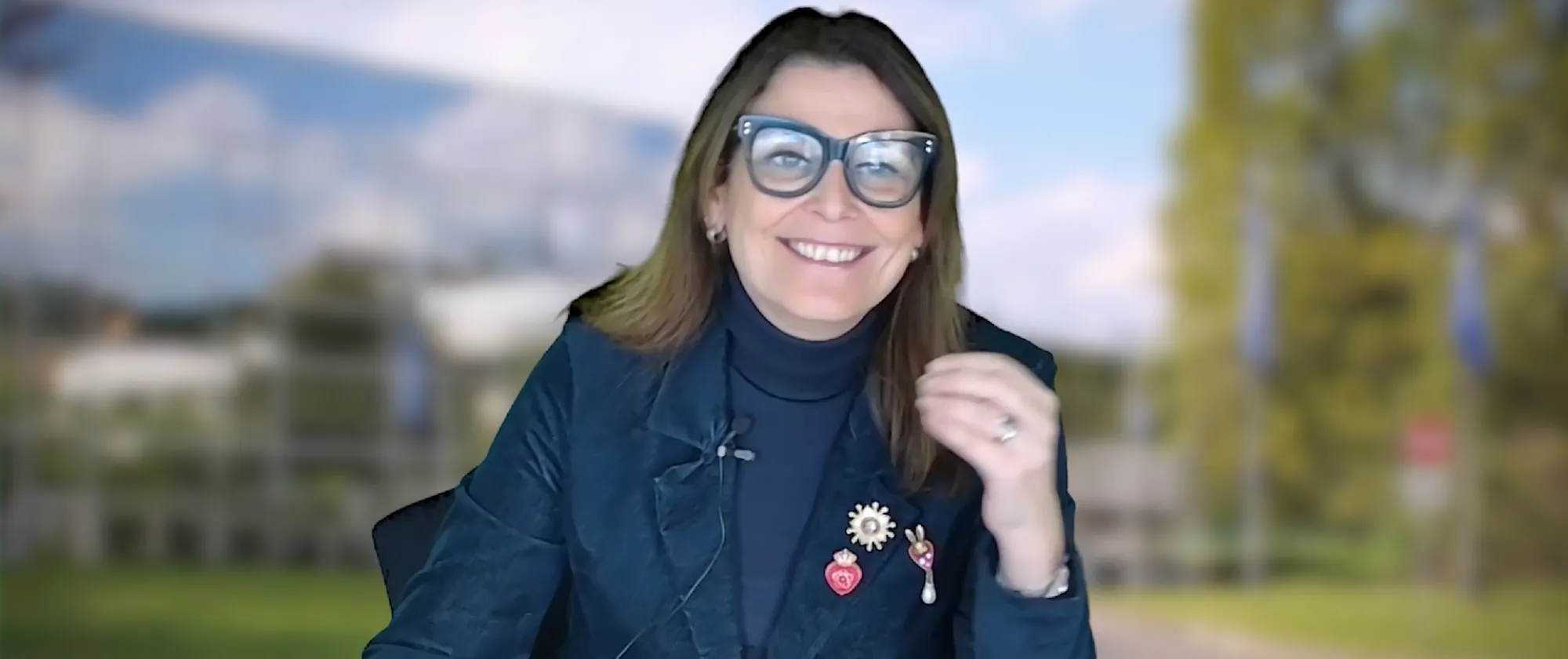
Video interview
Workers education at ITCILO: what are the opportunities for Unions in 2025?
On this International Day for Education, we spotlight the vital role of education in empowering workers and fostering social justice. Vera dos Santos Costa, Programme Manager for Workers' Activities at the International Training Centre of the ILO, shares insights into how education enables workers and their organizations to navigate global challenges, embrace innovation, and advocate for equitable work environments. Discover how ACTRAV's transformative programmes and initiatives are building a brighter future for all.
24 January 2025
Today, January 24th, marks the International Day for Education. From the perspective of the Bureau for Workers' Activities at the ILO, it’s an important milestone to celebrate education, and its importance for workers and their organizations as a tool to build a fairer world of work for all. To delve deeper into this, we’re speaking with the training and education arm of the ILO—the International Training Centre located in Turin—where ACTRAV plays a crucial role in promoting education for workers and their organizations.
We’re very glad to be chatting with Vera dos Santos Costa today, the Programme Manager for Workers' Activities at the ITCILO.
ACTRAV INFO: What is the significance of education for workers and their organizations, and how can education contribute to building strong and representative workers’ organizations?
Vera dos Santos Costa: Through education, workers gain the necessary knowledge, skills, and capacities to deal with the challenges of the world of work. Education and workers' organizations have always been a powerful couple.
Workers' education has been a historical objective for workers' organizations—it is almost seen as a duty rather than an option. It is rooted in their mission. They understand that education is power: the power to understand, to navigate, and certainly, to influence the world of work.
The ACTRAV education programme offers a unique opportunity to learn in a global environment, benefiting from the expertise of the best workers’ specialists in ACTRAV and elsewhere, in technical and trade-union related issues. Workers are trained to be actors of change, to be the designers of a better future for all.
In this sense, we strengthen workers and their organizations to do what they do best: engage in dialogue at different levels to improve and protect workers and their rights. In this constantly changing environment, with multifaceted challenges, workers need support to activate their abilities and combine their skills, experiences, and capacities in a different way. And this is what we do at ACTRAV, we bring to the workers a different approach on some day-to-day challenges and help them build the capacity to anticipate future ones.
Today is the International Day for Education, and this year’s theme is dedicated to AI and education. At ACTRAV, we have been developing Academies focused on what we call the Quad Transition. AI is considered one of these transitions, alongside the green transition, the digital transition, and the transition to formality.
Workers need to understand what AI is but also its consequences for them and for society as a whole. They need to combine all those different transitions and adapt their trade union actions and daily responses to address these challenges. By doing so, they contribute to better working conditions and a more equitable working environment for all.
ACTRAV INFO: ACTRAV is launching the 2025 Core Programme for Workers' Activities. What are the highlights of this programme?
Vera dos Santos Costa: Our core programme operates on a biennial basis—this is the 2024-2025 programme. While the structure of the programme remains the same, with the same number of global and regional academies, we at ACTRAV adapt it each year to address the most challenging issues of the moment. These may include challenges specific to the year or topics being discussed at the global or regional levels.
For instance, this year, our Global Academy on Transitions will focus particularly on the transition to formality, connecting it to the green transition and the AI transition. This adaptation ensures the academy remains relevant to the current global context. When we talk about action, we talk about an academy that is truly transformative.
The second highlight of the programme is International Labour Standards. This is a recurring theme, but in today’s world, we must emphasize the usefulness of those standards. For trade unions, these standards are essential and strategic tools to advance social justice.
The third highlight, a very pressing and forward-looking issue, is migration and demographic shifts. They are reshaping labour markets, the world of work, and societies as a whole. These cannot be treated as just issues; instead, they must be seen as transformative forces. Trade unions need to integrate these shifts into their actions and even their structures. Our programme aims to support trade unions in adapting to these transformations.
Lastly, we will focus on wages and collective bargaining—core issues for workers and workers' organizations. For us, the emphasis is on providing a fresh approach to how true social dialogue, one of the ILO’s pillars, can be used to improve living and working conditions.
These are the highlights of the 2025 Care Programme.
ACTRAV INFO: One of the Global Workers’ Academies in 2025 is dedicated to workers' education. Could you tell us more about this academy?
Vera dos Santos Costa: This academy has been a part of our programme for about 10 years, it’s tied to our very “raison d’être.” We are the ITCILO, we are the training center, at the forefront of learning innovation. We are privileged to operate in a training and learning environment, and it’s our duty to share that with workers and their organizations.
We aim to ensure that workers’ organizations benefit from new trends, technologies, and approaches that enhance learning. Innovation doesn’t always mean technology—it can also involve new ways of thinking, as we do with transitions. It’s about thinking differently and supporting workers’ organizations in developing their training programmes.
This academy is not just about learning new things—it’s mainly about exchange. During the programme, a trainer from Latin America can exchange ideas with a trainer from Burundi; they discover interesting parallels and find that they face similar challenges. This platform of exchange opens participants' eyes on what is going on in the broader training and trade union movements.
For us as ACTRAV, it’s also an opportunity to train new facilitators who can replicate methodologies and strategies they learn with us. These facilitators can bring global issues to their national organizations and help contextualize them locally, which isn’t always easy.
Additionally, as innovation is happening rapidly, we are also constantly learning from our participants. This reinforces our motto at ITCILO ACTRAV: “Learning is everywhere.” This motto resonates strongly within the Education Academy, where we see this spirit of exchange and collaboration in action.
ACTRAV INFO: How can workers and their organizations benefit from the 2025 ACTRAV programme? Can you share a bit more about this?
Vera dos Santos Costa: Our activities are open and free to all workers' organizations. The programme is available on our websites— on the ILO ACTRAV website as well as the ITCILO website. We also promote it through social media and other communication channels.
Together with colleagues from the ILO Workers’ Group, we make a deliberate effort to include a variety of organizations from all regions. We look at gender balance and actively encourage young trade unionists to participate in our courses.
We like to say that education is a public good and so are ACTRAV courses!
ACTRAV INFO: Could you share examples of success stories about how active training programmes have positively impacted workers and organizations?
Vera dos Santos Costa: Evaluation is extremely important when it comes to training, we always ensure we receive feedback from participants. We know that we’ve had an impact when we hear from former participants.
A few months ago, I was in India, and a former participant from the Education Academy told me: “This course was fantastic because I could apply what I learned and I have designed a new training activity in my organization, applying the strategic thinking methodology.”
The feedback from his organization was so positive that they asked him to repeat the training. It is remarkable as he wasn’t a trainer before joining the academy. Thanks to the techniques we provided, he felt proud and confident.
This is when you see that you have made a positive change, for this person and also for their organization.
ACTRAV INFO: Any final message before concluding this interview?
Vera dos Santos Costa: One thing we’ve been emphasizing strongly at ACTRAV—and it was also one of the key conclusions of our 2023 symposium on workers’ education—is that education cannot be seen as a cost; it should be seen as an investment.
Education is the most powerful tool we have to achieve social justice and peace. In today’s world, this is more important than ever.
As the ACTRAV team—whether in Geneva, Turin, or in the field—we all feel incredibly energized knowing that we’re contributing, even if it’s just a drop, to promoting education as a human right.
For courses offered by ITCILO, please visit: https://www.itcilo.org/