

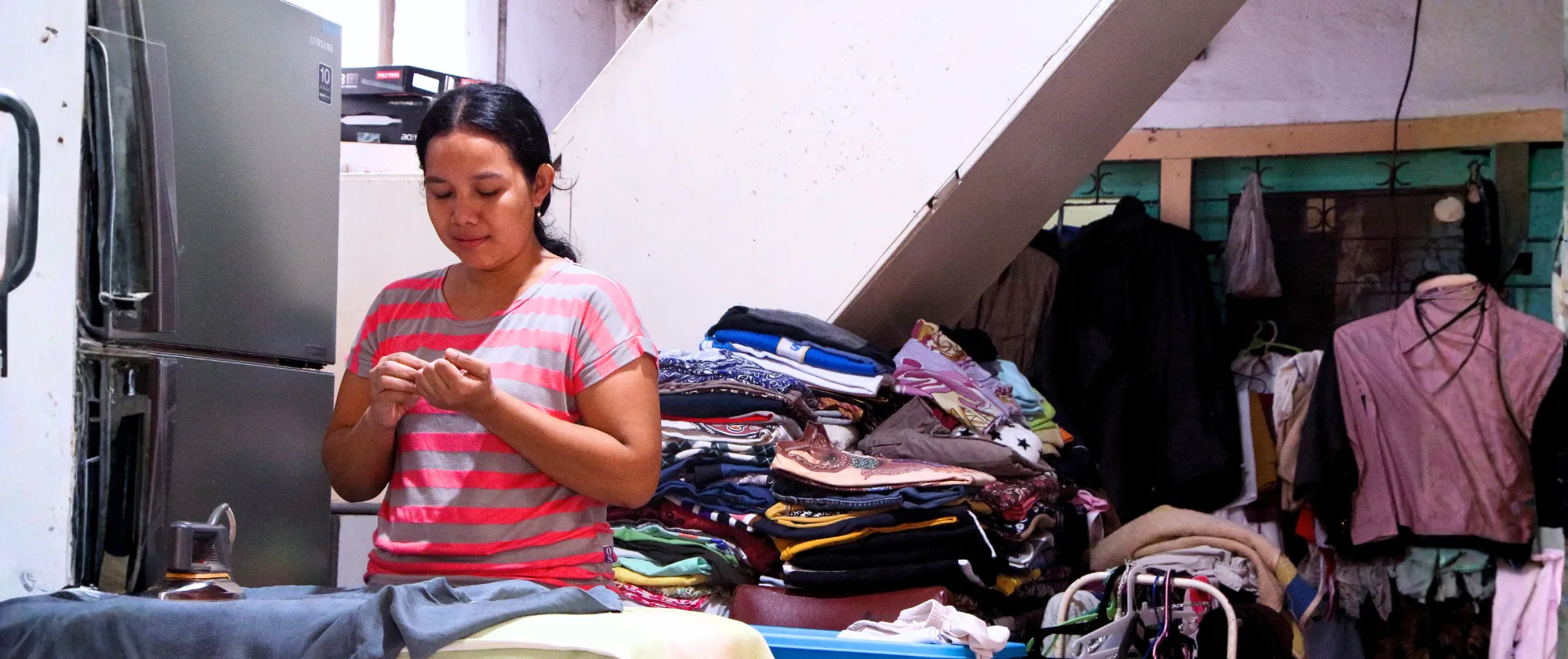
A long road to recognition: domestic workers’ rights in Indonesia
After more than two decades of collaboration, the ILO and its partners have helped bring domestic workers’ rights in Indonesia from the margins to the national policy agenda, advancing stronger legal protection and recognition.
30 April 2026
JAKARTA, Indonesia (ILO News) - After more than 22 years of sustained engagement, the ILO has supported Indonesia’s efforts to strengthen legal protection for domestic workers. Through interconnected programmes on gender equality, labour rights and migration, the ILO and its social partners have helped transform domestic work from an invisible sector into a national policy priority, contributing to the advancement of the Domestic Workers Law.
While the advancement of the Domestic Workers Law marks an important step, effective implementation and enforcement will be essential to ensure that these protections translate into tangible improvements in working conditions.
Simrin Singh, ILO Country Director for Indonesia and Timor-Leste
The ILO has promoted decent work for domestic workers by aligning national efforts with international labour standards, particularly ILO Convention No. 189 on decent work for domestic workers and its accompanying Recommendation No. 201. This has included advocating for fair working hours, social protection and access to grievance mechanisms, as well as facilitating tripartite dialogue among government, parliament, employers and workers to ensure that domestic workers’ perspectives are reflected in policy and legislative processes.
Domestic work in Indonesia remains largely informal, with limited legal protection and significant gender-based vulnerabilities. Most domestic workers are women and girls, many of whom face risks of exploitation, including forced labour and trafficking. The ILO’s contribution has been cumulative, strengthening institutions, supporting workers and informing policy development over time.
Laying the groundwork: 2004–2012
The foundation for reform was established through ILO efforts to address forced labour and trafficking among Indonesian domestic workers, both domestically and abroad. This included the projects Mobilizing action for the protection of domestic workers from forced labour and trafficking in Southeast Asia, funded by the United Kingdom, and Combating forced labour and trafficking of Indonesian migrant workers, funded by the Royal Norwegian Embassy, implemented in three phases (2006–2012).
These initiatives raised legal awareness, strengthened labour inspection and protection systems, and highlighted the structural vulnerabilities faced by domestic workers. From the outset, the ILO adopted a dual approach – supporting protection both within Indonesia and for migrant workers abroad – to advance recognition of domestic work as work.
Building momentum: 2009
In 2009, the ILO implemented the Equality and decent work promotion for Asian women through prevention of human trafficking, protection of domestic workers and gender capacity building project. The project linked gender equality, anti-trafficking and domestic worker protection, and strengthened gender-responsive policymaking.
From advocacy to policy influence: 2012–2018
A key milestone was the Decent work for domestic workers to end child domestic work (PROMOTE) project, funded by the United States Department of Labor (USDOL). The project addressed child domestic work and contributed to raising the issue in national policy discussions through research, policy support and public awareness.
During this period, the ILO also supported protection efforts through the Tripartite action for the protection and promotion of the rights of migrant workers in the ASEAN region (ASEAN Triangle Project – Phase I, 2012–2016), funded by the Government of Canada. This contributed to promoting ILO Convention No. 189 and strengthening collaboration among government, workers’ and employers’ organizations, and civil society.
Strengthening worker voice: 2014–2016
The ILO supported worker organization through Migrant workers organizing through cooperation with trade unions (2014–2015) and the UN Women–ILO project Preventing the exploitation of women migrant workers in ASEAN (2015–2016), funded by the Australian Government. These initiatives strengthened the capacity of domestic workers to organize and advocate for their rights.
Expanding protection frameworks: 2018–2023
The Safe and fair programme: Realizing women migrant workers’ rights and opportunities in the ASEAN region (2018–2023), implemented under the European Union–UN Spotlight Initiative, marked a shift towards more integrated protection systems. It supported safe migration pathways, strengthened institutional capacity and facilitated policy dialogue, including on Convention No. 189.
At the same time, the ILO strengthened efforts to prevent violence and harassment against domestic workers through the promotion of ILO Convention No. 190. Activities included awareness-raising, institutional capacity-building and the development of prevention and response mechanisms, particularly relevant for workers in private households.
Consolidating gains: 2024–2026
Current efforts under the Protection of the rights of women and children in labour migration (PROTECT) project (2024–2026), funded by the European Union, focus on implementation and enforcement. The project supports institutional strengthening, improve access to justice, enhance multi-stakeholder collaboration, promote fair recruitment practices and contribute to safer migration pathways.
Simrin Singh, ILO Country Director for Indonesia and Timor-Leste, stated: “The progress toward stronger protection for domestic workers in Indonesia reflects years of collaboration between government, workers and employers, and development partners. While the advancement of the Domestic Workers Law marks an important step, effective implementation and enforcement will be essential to ensure that these protections translate into tangible improvements in working conditions.”