

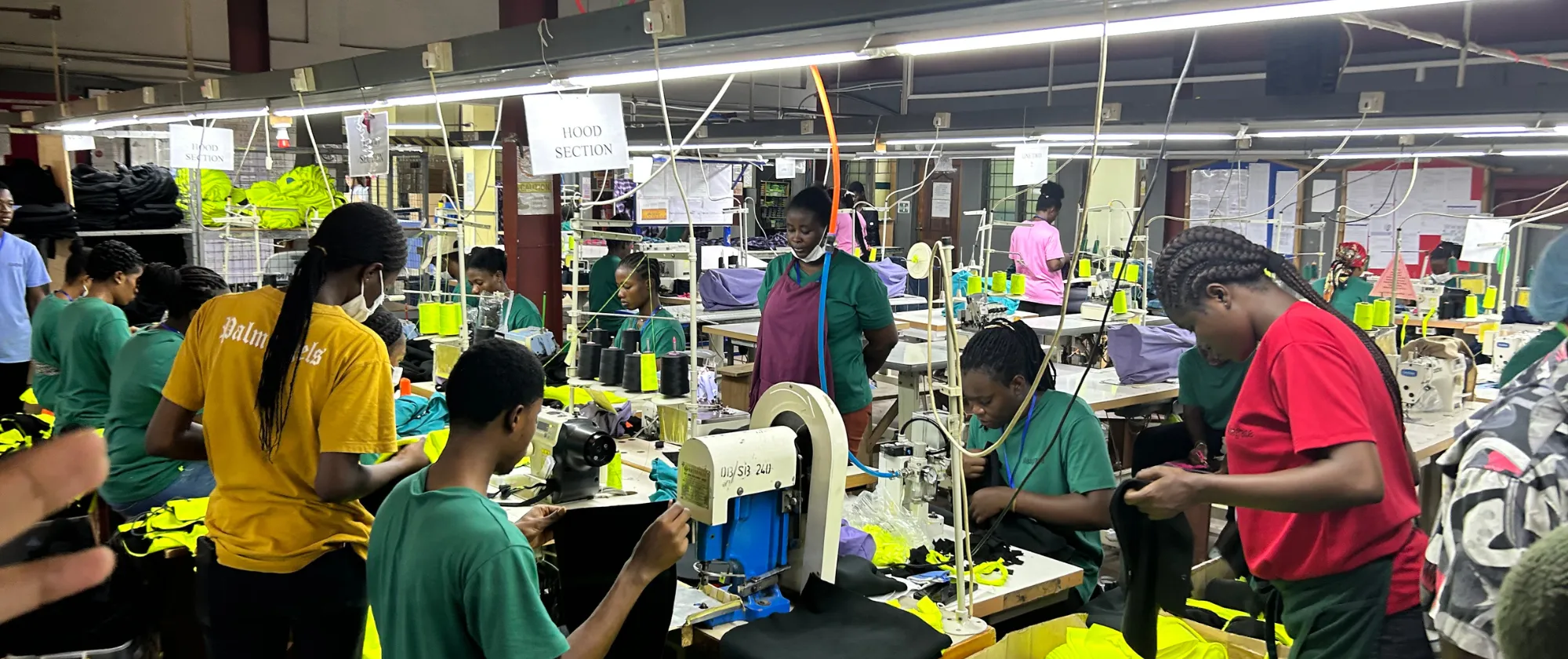
ILO promotes industrial engineering as catalyst for productivity improvements in factories
The International Labour Organization (ILO) is collaborating with the Association of Ghana Apparel Manufacturers (AGAM) to support the creation of industrial engineering departments in garment factories. This initiative is one of the strategies to introduce a systemic approach to improve productivity, its measurement, and optimize operations in garment factories.
26 May 2025
ACCRA, GHANA (ILO News) – The ILO and its partners have validated a productivity improvement manual at an event organised in Accra on 19th May 2025. With invaluable input from AGAM, the manual was developed with a focus on Industrial Engineering to improve operations on the factory floor.
Using the productivity manual, SCORE trainers, factory managers, supervisors and operators will be trained in the tools to calculate essential performance indicators such as the Standard Minute Value (SMV), Throughput Time, efficiency, and productivity. The factories will also acquire the techniques for time studies, work studies, motion studies, standard work, and capacity calculations. Other important skills that will be transferred are line balancing, value stream mapping, and productivity in the cutting room and sewing lines.
At the validation workshop were key partners such as the Ghana Employers Association (GEA), Trade Union Congress (TUC), Ministry of Trade Agribusiness and Industry (MOTAI), Ministry of Employment Jobs and Labour Relations (MEJLR), implementation partners and garment enterprises.
Speaking on behalf of the ILO Country Director, Abuja Country Office, Ms Vanessa Phala, the Project Manager, Mr. David Marcos, chronicled the major interventions the ILO Productivity Ecosystems for Decent Work Project was making to improve the performance of the garment industry in Ghana. He emphasised that, the manual was for the garment industry and would be of tremendous help to their operations. Mr. Richard Acheampong of the TUC commended the ILO for the well-tailored continuous support to the garment industry. He added that these interventions were creating the framework for better working conditions in the garment industry and urged the ILO to sustain these efforts.

Mr. Vijay Allaham, the consultant who developed the manual took participants through the content of the manual, explaining the themes that addressed productivity and working conditions. The manual which had 11 chapters, covered topics on Working Conditions, Industrial Engineering, Value Stream Mapping and strategies for optimising operations in sewing lines, cutting rooms, and finishing lines. In a prelude to his presentation, the consultant established the nexus between productivity and working conditions at the workplace. In his assertion, good working conditions go beyond just checking the boxes for social compliance. According to him, good working conditions also hinged on respect for workers’ rights, promotion of fair treatment, and safeguarding of their wellbeing.
This manual has come at a time when the garment industry is in need of industrial engineering tools to scale up production and meet the orders of buyers. It would therefore contribute significantly to improvements in productivity and growth in factories.
Mr. Abdulai Amdaway, the Human Resource Manager of Wadata Fashion
In a concluding remark, Ms. Nana Pocqua Adiabah, the National Coordinator of AGAM expressed her gratitude to the Governments of Switzerland and Norway for supporting the garment industry through the ILO Productivity Ecosystems for Decent Work Project. She added that the support had been of great value to the garment industry. This support included training programmes, participation in trade shows, technical assistance in their factories, an implementation agreement which was underway and the development of the productivity improvement manual. Finally, she pledged the commitment of AGAM to partnering with the ILO to achieve the project objectives.
About the Programme
The Productivity Ecosystems for Decent Work is a global multi-country programme initiated by the ILO in 2021, with operations in Ghana, South Africa and Vietnam. It is funded by the governments of Switzerland and Norway and seeks to promote productivity growth for decent work, combining different approaches that strengthen productivity drivers across policy, sector and enterprise levels.
The programme is in line with the United Nations’ Sustainable Development Goal (SDG) 8.2, which encourages member states to pursue “higher levels of economic productivity through diversification, technological upgrading, and innovation, including through a focus on high value added and labour-intensive sectors”. As a project in Ghana, the focus is on SMEs and their workers in sectors that show the potential for productivity growth and job creation. The textiles & garments (T&G) and shea sectors have been selected for support in Ghana.
Relevant projects
Productivity ecosystems for decent work