

Interview
How to strengthen trade union resilience in 2026
Amid growing global instability, General Secretary of the International Trade Union Confederation (ITUC) Luc Triangle reflects on the resilience of the trade union movement. With the 114th International Labour Conference expected to shape new standard for the platform economy and advance social dialogue, tripartism and gender equality at work, he outlines a clear and hopeful path forward for unions.
12 February 2026
-
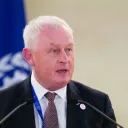 Luc TriangleGeneral Secretary of the International Trade Union Confederation (ITUC)
ACTRAV INFO: 2025 has been a challenging year for both the multilateral system and the labour movement worldwide. Looking back, what would you identify as the most significant achievements and defining moments for the international trade union movement, and why do they matter for workers?
Luc Triangle: 2025 was marked by authoritarianism, conflict, deepening inequality and a sustained assault on democracy and multilateralism. The ITUC Global Rights Index shows the scale of the crisis clearly: 87 per cent of countries violated the right to strike, 79 per cent restricted collective bargaining and three quarters excluded workers from unions. Against this backdrop, the most significant achievement of the international trade union movement has been its capacity to defend democratic space and rebuild power under pressure.
A defining moment was the strengthening of our For Democracy campaign. The ITUC was among the first to sound the alarm on the hostile takeover of democracy by billionaire and corporate interests. By naming this threat early and clearly, unions exposed how extreme wealth is being converted into political power to weaken democratic institutions and workers’ rights - and why defending democracy is essential for workers to have a voice, protection and a future.
We exposed the coordinated threat posed by far-right forces and billionaire corporate actors. The Corporate Underminers of Democracy 2025 report named and challenged companies that use their economic power to weaken democratic institutions. This work has helped workers and unions understand that attacks on labour rights are part of a broader strategy to concentrate power and wealth.
We also made important advances in defending fundamental rights. Presenting the workers’ case on the right to strike before the International Court of Justice was historic. Solidarity campaigns helped secure the release of Belarusian trade union leader Aliaksandr Yarashuk and kept global attention on repression in Myanmar and Hong Kong.
Finally, organising remains a great source of hope. From platform workers campaigning for a binding ILO Convention to new organising programmes engaging thousands of workers worldwide, unions are growing, renewing leadership and building the power workers need to shape a fairer future.
ACTRAV INFO: In a context of rising geopolitical tensions and global fragmentation, why does the world need a stronger ILO today, and what should that strength look like in practice?
Luc Triangle: Working people need for a strong ILO more than ever as we witness open attacks on multilateralism. A strong ILO can anchor social justice, democratic governance and peace in a rules-based international system.
Recent attempts to weaken the ILO by threats to cut funding, political pressure and efforts to reshape its governance are not isolated incidents. They reflect a broader challenge to multilateral institutions and to the idea that workers’ rights are universal and non-negotiable. That is precisely why the ILO’s constitutional mandate must be defended without compromise.
Strength in practice means an ILO that remains firmly rooted in its core business: international labour standards, a credible supervisory system and genuine tripartism. These are not technical functions; they are the backbone of democracy at work.
Finally, strength requires clarity of purpose. The ILO exists to protect workers, advance social protection, fair wages, safe working conditions and dignity at work. There is no place at the ILO for narrow business interests or political agendas. At a time of global disorder, the ILO must stand as a pillar of cooperation, fairness and hope for working people everywhere.
ACTRAV INFO: Following the adoption of the Doha Political Declaration, how can trade unions translate its commitments into concrete action at national, regional, and global levels, particularly in engagement with governments and employers?
Luc Triangle: The Doha Political Declaration is a decisive win for workers. It embeds decent work at the heart of development and includes strong commitments on fundamental principles and rights at work, social dialogue, living wages, social protection and gender equality. It also recognises the inseparable link between social justice and democracy, and the need to strengthen multilateralism, with the United Nations and its Charter at the centre.
The challenge now is implementation. The ambition of the Declaration gives trade unions a powerful opportunity to hold governments and employers accountable, but this will only happen if social partners are fully involved at every level, as the Declaration itself recognises.
At national level, trade unions are already using the Doha commitments to influence policy choices. Since the adoption of the 2030 Agenda, unions in more than 50 countries have engaged with governments, civil society and UN Country Teams to shape national development plans, labour market reforms and social protection systems around decent work and rights.
At regional level, trade unions have successfully influenced the monitoring of the Sustainable Development Goals through UN Regional Economic Commissions, demonstrating the leverage of SDG 8 on decent work as a driver of sustainable development, social cohesion and democratic resilience.
At global level, workers’ demands have translated into concrete policy outcomes. The call for a New Social Contract has shaped major UN initiatives, including Our Common Agenda and the Global Accelerator on Jobs and Social Protection for Just Transitions, and has been reflected in the UN Secretary-General’s priorities for 2026.
ACTRAV INFO: Looking ahead to the June 2026 International Labour Conference, discussions will focus on the platform economy, social dialogue and tripartism, and a transformative agenda for gender equality at work. What are your expectations for these debates, and which outcomes would be most meaningful for workers?
Luc Triangle: The objective for the discussions on the platform economy is clear: the adoption of a Convention and a Recommendation that genuinely protect workers and regulate working conditions in the platform economy, fully in line with the ILO’s mandate. We welcome the progress made at the last ILC on the form of the instruments, as well as definitions, scope and exclusions, and the recognition of the right of workers to access information on automated systems, and the recognition that all work is work and that all workers have rights. Millions of platform workers are waiting for a global floor of rights. It is essential that the new standards address automated management systems, data protection, deactivation and misclassification. Regulating technology is not anti-innovation; it is how we ensure decent work, social justice and sustainable .
Looking ahead to the recurrent discussion, we expect a strong, action-oriented debate that reaffirms social dialogue and tripartism as pillars of democracy. Effective implementation of ILO instruments, such as on wages, social protection, occupational safety and health, discrimination, and violence and harassment at work is key to this process. For workers, meaningful outcomes would include a renewed commitment to promote the ratification of Conventions 87 and 98, strengthened capacities of social dialogue institutions, and concrete responses to the global decline in respect for freedom of association and collective bargaining. Above all, we expect the ILO to prioritise its resources and actions to reinforce its core mandate as set out in its Constitution and the Philadelphia Declaration in order to deliver real and tangible change for workers on the ground.
On the transformative agenda for gender equality at work, we expect the ILO to enhance its work in addressing structural barriers to gender equality at the societal, economic and governance levels. Through an approach anchored in international labour standards, the International Labour Conference must advance gender-responsive policies that respond to global shifts such as digitalisation, climate change and demographic change. The general discussion should also uphold the role of the ILO in the context of the current UN80 reform process, given its historic expertise in advancing gender equality in the world of work, as well as its unique tripartite structure and normative power, which can deliver tangible improvements in the lives of women workers.
ACTRAV INFO: From the ITUC’s perspective, what do you see as the major challenges and opportunities facing trade unions in 2026, and how is the ITUC positioning itself to respond?
Luc Triangle: The major challenge is clear: a coordinated assault on democracy, workers’ rights and multilateral institutions is intensifying. Far-right political forces, authoritarian governments and a billionaire elite are working together to weaken unions, restrict organising, criminalise protest and block progress at the ILO, the UN and international financial institutions.
At the same time, there is a profound opportunity. Workers are increasingly aware that the current economic and political model is failing them. Inequality, insecurity, climate crisis and unregulated digitalisation are creating anger, but also openness to collective solutions. If we act with clarity and courage, there is space for unions to grow, organise and lead.
The ITUC’s unified strategy for 2026 is the Fight for Democracy. This means defending the foundations of trade union power, starting with the ILO’s fundamental rights, standards and supervisory system. We will move from incremental advocacy to focused action that delivers concrete wins for workers.
We are prioritising support for organising and inclusion, especially for informal workers, migrants, women and young people - because the future strength and independence of the trade movement depends on growing our numbers. We are also supporting affiliates with research, campaign tools and solidarity mechanisms, particularly where unions are on the frontlines of repression.
Finally, we are strengthening alliances beyond the trade union movement. In an era of authoritarianism, defending democracy and social justice requires building common cause with all those whose rights are under attack. Trade unionists are not alone in facing repression; an attack on the rights of one movement is an attack on all.
This is not an abstract fight. In 2026, unions will fight for democracy because it is how workers secure rights, dignity, safety and a shared future.