


Employment in Focus series
Decent work in the Pacific: The role of policy-driven solutions
The Pacific faces enormous employment challenges. Christian Viegelahn, ILO’s Employment Specialist for the Pacific Island countries, explains how National Employment Policies (NEPs) can create decent jobs and positively impact the region's economies.
26 March 2025
-
 Christian ViegelahnILO Employment Specialist for the Pacific Island countries
The Pacific spans over 15 per cent of the earth's surface, with 11 ILO Member States [1] and thousands of islands spread across vast ocean distances. While each nation has a unique and diverse culture and rich traditions, they share common employment challenges—geographic isolation, reliance on imports, vulnerability to climate change, and limited job opportunities. These factors drive high migration rates in search of better work.
Employment challenges in the Pacific Islands
The region has a number of unique challenges. In the Pacific Islands, youths account for a large bulk of the population. In all of the countries for which population estimates are available, the share of youth aged 15-24 in the total population exceeds the corresponding share for the world.[2] Youth unemployment rates are as high as 27 per cent in Kiribati, 24.9 per cent in Marshall Islands or 20 per cent in Tuvalu [3], and the share of youth who are not in education, employment or training (NEET rate) is reaching staggering levels in countries like Kiribati, Vanuatu or Marshall Islands, with young women typically experiencing higher shares than men (figure 1a). These figures suggest that available job opportunities in many cases do not align either with the skills set or with the aspirations of young people. [4]
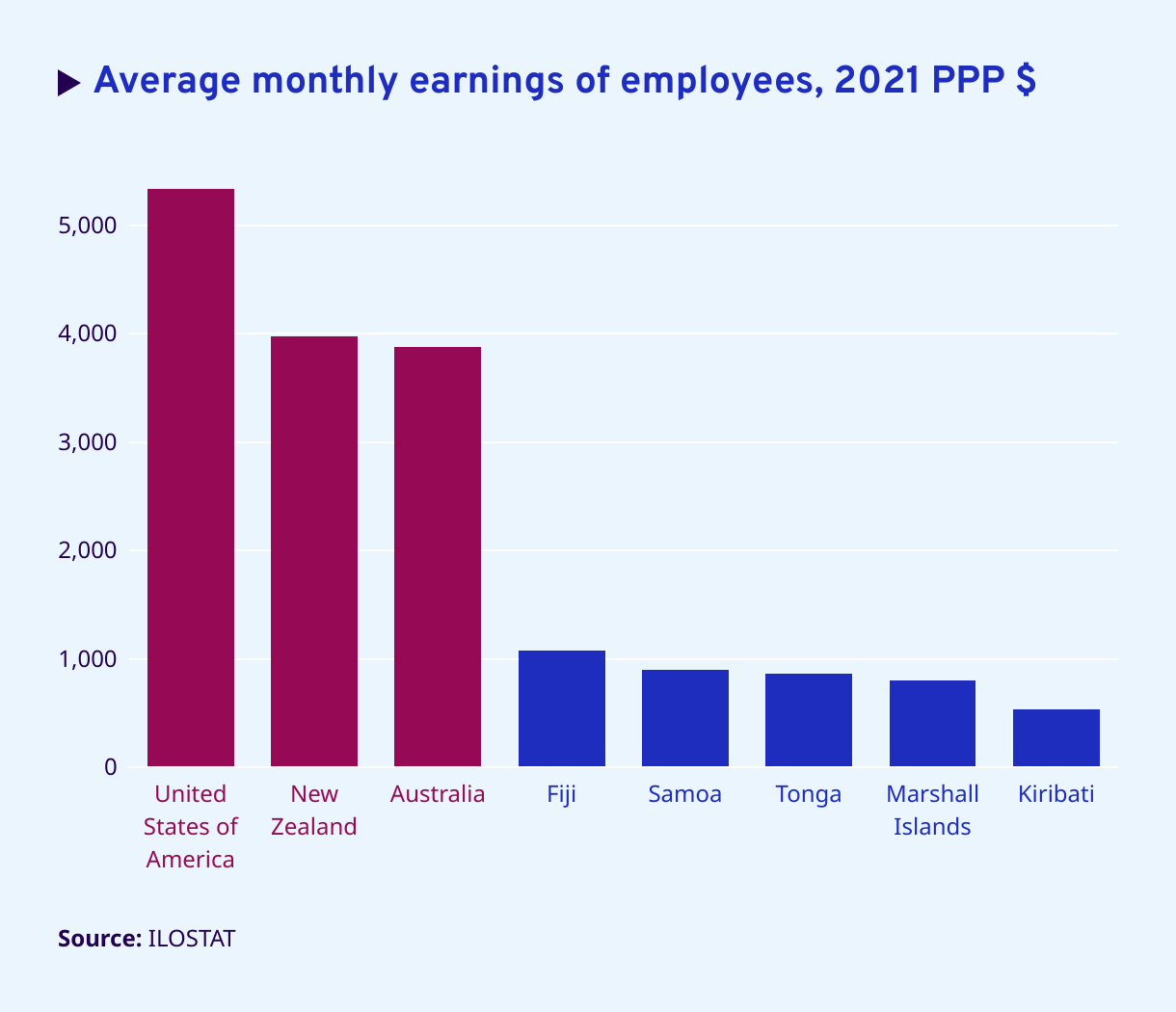
Employment quality, not just quantity, is another key issue, with wages being one of the important indicators. In some of the migrant destination countries like Australia, New Zealand, or United States, wages are 4-10 times higher than in some of the small Pacific Island countries (figure 1b). Given these significant disparities, it is unsurprising that migrating abroad in the search for jobs is an attractive option for many Pacific Islanders. The Pacific Australia Labour Mobility Scheme (PALM) and the New Zealand Recognised Seasonal Employer (RSE) scheme are among the more popular labour migration channels for people in the South Pacific, while people in the North Pacific are benefitting from the Compacts of Free Association (COFA), which grant free access to the labour market of the United States of America.
However, unlike unemployment or wage disparities, some issues need adaptation more than solution. Many of the Pacific Island countries are low-lying islands and atolls that are particularly vulnerable to climate change and rising sea levels. Natural disasters adversely impact livelihoods on a frequent basis, with losses of hours worked and income.[5] Climate change and natural disasters are likely to have impeded faster progress in reducing working poverty (the share of the population below the poverty line despite being in employment).
Figure 1. Employment situation in the Pacific, selected indicators
a. Proportion of youth not in education, employment or training (NEET rate), %
b. Average monthly earnings of employees, 2021 PPP $

|
|
Notes: “Youth” refers to individuals aged 15-24 years. Data are from latest available year.
Many workers choose the pathway of outward labour migration
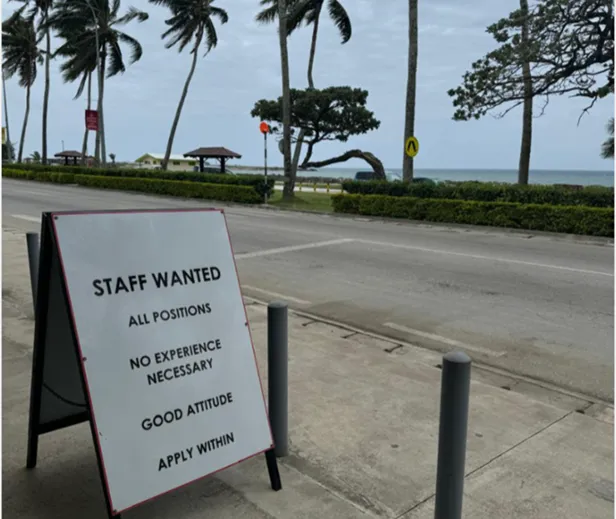
In light of these challenges of the region and opportunities provided by labour mobility schemes, outward labour migration is popular in the Pacific islands. For example, Tonga saw 11 per cent of the labour force participating in the PALM scheme; for Tuvalu and Vanuatu, this figure was 8 per cent (figure 2b). Outward migration of people in the South Pacific towards Australia and New Zealand, following a pause, has picked up significantly after the pandemic. Main sectors of employment abroad are agriculture and meat processing, but also aged care, hospitality and tourism.[6] Remittances have been on an upward trend (figure 2a), which only recently slowed down and reversed, with consumer price inflation in migrant destination countries likely having taken its toll, given that the number of migrants has remained relatively stable.
Figure 2. Outward labour migration in the Pacific, selected indicators
a. Remittances received, % of GDP, Pacific Island countries
b. PALM scheme workers, average % of total labour force, 2024

|

|
Notes: In panel a, Pacific Island countries include Fiji, Kiribati, Marshall Islands, Federated States of Micronesia, Nauru, Palau, Samoa, Solomon Islands, Tonga, Tuvalu and Vanuatu. In panel b, the number of PALM scheme workers averaged over 2024 is shown as a percentage of the total labour force, using the latest available data for each country.
With an increasing number of both skilled and unskilled workers leaving (figure 2b), labour shortages have become more widespread. Employers in the Pacific Island countries have difficulties filling vacancies, including in key sectors such as tourism or agriculture. Schools and hospitals experience severe staff shortages, with teachers and nurses having left the country, putting strain on the education and health care system, with larger adverse impacts.
Employment policies as a solution
In the face of these complex employment challenges in the Pacific, strong efforts are needed at the national level to ensure that employment is always a top priority on the development agenda. Countries need to promote the collaboration of multiple actors, including different government ministries and institutions, as well as employers’ and workers’ organizations, to work together towards a common employment objective and mainstream employment within the development agenda.
To achieve that, the ILO is currently working with eight countries in the Pacific to develop National Employment Policies (NEPs) with the objective of addressing the enormous employment challenges and leveraging the existing opportunities for decent job creation at home to build sustainable labour markets. The NEPs are grounded in empirical evidence and include concrete action plans and implementation mechanisms, and – once adopted – promise to contribute to the creation of more quality jobs and thereby make a real difference in the lives of Pacific islanders.
* The views and opinions expressed in this article are those of the author and do not necessarily reflect the official policy or position of ILO.
About the author
-
Christian ViegelahnILO Employment Specialist for Pacific Island Countries
Christian Viegelahn is the Employment Specialist of the ILO Office for Pacific Island Countries, providing technical advice to leaders in government, employers’ and workers’ organizations of the subregion on employment and decent work. He has been with the ILO since 2011, with previous roles as Economist at ILO’s Regional Office for Asia and the Pacific in Bangkok as well as ILO’s Research Department in Geneva. He is the author of about sixty publications on issues related to the world of work, and holds a PhD in Economics from the Catholic University of Louvain in Belgium.
Related content

Employment in Focus blog series
Blogs on employment and labour market