


Informal economy
Coffee farmers in Viet Nam face a wide range of risks and vulnerabilities
Due to widespread informality, coffee farmers in Viet Nam face various risks and vulnerabilities, highlighting the need for enhanced cooperation across the sector’s value chain.
10 September 2024
HA NOI (ILO News) - Viet Nam is the world's second-largest coffee producer and the leading producer of the robusta variety. In 2022, coffee exports from Viet Nam totalled approximately US$4 billion. The sector supports the livelihoods of around 1.4 million smallholder farmers.
Approximately 85 percent of Viet Nam's coffee is produced by farms, households, and private individuals, who often have low production capacity. Farmers in this industry encounter a broad spectrum of risks and vulnerabilities, a new report from the International Labour Organization (ILO) has found.
Gaps in social protection and low income
The authors stress that due to the widespread informality in the coffee sector, social protection coverage is low as many coffee farm workers cannot afford enrolment in the social insurance scheme and are unlikely to receive pensions.
According to a forthcoming ILO study on social protection and occupational health among 300 coffee workers in Viet Nam, while health insurance coverage was 93 per cent, social insurance coverage was only 24 per cent.
Financial difficulty was the primary reason given for not participating in social insurance, despite 60 percent of the surveyed households and coffee workers being classified as middle-income, which should theoretically enable them to invest in social insurance.
A manager at one of the 12 cooperatives supported by Simexco in Dak Lak said that the demand for social insurance for farmers is quite high.
“Currently, 30-40 per cent of young members want to pay social insurance, but finance is still a major obstacle. The rest don't need it because most of them are old, and they don't see enough benefits,” the manager said.
Additionally, even though government policies and projects have helped to improve the coffee value chain and promote sustainability, challenges for coffee workers persist due to a lack of recognition of their work and limited income security.
25.9 per cent of employees in the coffee sector earned less than the minimum wage, according to the most recent figures from a 2020 ILO report.
In Dak Lak, for example, farmers earn just VND 1.7 million per person per month (US$68), which is approximately 60 percent of the minimum wage.
In addition, the sector is constrained by gaps in productivity, product certification, traceability, diversification, and efforts to improve the value of coffee products.
A complex value chain
The report stresses that the coffee value chain in Viet Nam is complex with a multitude of actors, including farmers, cooperatives, exporters and retail breweries. Linkages between actors in the value chain take many different forms.
In fact, a number of large international companies work with a chain of purchasing companies, cooperatives and agricultural households to ensure compliance with their own product standards.
For example, Nestle has been implementing 4C standards for the past 10 years and has a number of supply chain partners. Farmers who comply with Nestle’s 4C standards sell products to Nestle at a supported price higher than the base market price by VND 200-300/kg of product and can form 4C coffee groups at their localities.
However, there are times when companies' purchases fall short of farmers' production.
A representative of enterprises in Lam Dong said some years, enterprises produced 10,000 hectares with 4C certification, for instance, but Nestle only purchased 3,000 hectares.
In addition, cooperatives do not recognize their potential role in formalization, despite their
capacity to scale up business activities. The understanding and knowledge of cooperatives can be limited, which decreases the influence of cooperatives on farmers.
Measures to promote formality
The authors emphasize that key priorities for promoting formality in the coffee industry include strengthening coordination and linkages among value chain actors.
FDI enterprises should enhance and utilize their distribution networks, stay informed about market requirements, and choose sustainability certifications with potential for market growth. They should also conduct more accurate and current analyses of market signals and requirements and develop a strategic approach to sustainability certifications.
Vietnamese enterprises should work towards leveraging sustainable development resources from FDI enterprises and international organizations to secure additional financing, including green financing and agricultural insurance coverage for farmers.
Cooperatives need to ensure a clear understanding of their operations, enhance participatory governance and managerial skills, and strengthen collective capacity through coordinated production, improved linkages, expanded cooperative union models, and large-scale cooperatives.
In addition, other measures include improving knowledge on market access, sustainability, and quality requirements; leveraging additional financing for sustainable long-term support; and facilitating crop diversification, improved inputs, enhanced marketing, digitalization, and traceability support.
“To promote formalization and address decent work deficits in the coffee sector, long-term, sustainable support for farmers and cooperatives is needed,” the authors stress.
You may also be interested
Formalization
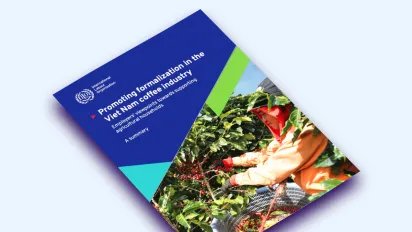
Promoting formalization in the Viet Nam coffee industry : Employers' viewpoints towards supporting agricultural households - A summary
Country portal
Viet Nam
Relevant projects
Ship to Shore Rights South East Asia - Indonesia

Migrant workers
Ship to Shore Rights South East Asia (SEA)