

Skills and Lifelong Learning in Africa
Africa strengthens pathways from training to decent work
At Africa Skills Week 2026 in Harare, the International Labour Organization highlighted how stronger training systems can connect learning with decent work, productivity, and inclusive industrial transformation.
21 October 2026
HARARE, Zimbabwe (ILO News) – The International Labour Organization (ILO) has called for stronger links between training, employment and industrial development across Africa, stressing that learning must translate into decent work, higher productivity and more secure livelihoods.
The message was central to the ILO’s contribution to Africa Skills Week 2026, held in Harare, Zimbabwe, from 12 to 16 October. Convened by the African Union Commission and hosted by the Government of Zimbabwe, the event brought together policymakers, employers’ and workers’ organizations, training institutions, young people, industry representatives and development partners.
For a young person seeking a first job, a woman growing a business or a worker seeking recognition for years of experience, gaining and demonstrating competencies can open new opportunities. But training alone is not enough. What matters is whether it leads to decent employment, sustainable livelihoods and better prospects for workers, enterprises and communities.

Connecting skills to employment opportunities
Digitalization, artificial intelligence, the green transition and regional economic integration are reshaping labour markets across Africa. Responding effectively requires closer collaboration among governments, employers, workers and training providers to anticipate changing demand, improve training quality and expand apprenticeships and workplace learning.
During Africa Skills Week, the ILO contributed to dedicated sessions on these challenges. One discussion examined how governance, social dialogue, institutional coordination and sustainable financing can improve labour market outcomes, drawing on experience from the ILO’s Global Skills Programme in Africa.
The ILO also highlighted its publication Next Generation Sector Skills Bodies, which examines how sector-based institutions can better align training with labour market demand and support economic transformation.
Recognizing knowledge and competencies acquired outside formal education is equally important. People gain valuable experience through work, informal apprenticeships and self-employment, yet these competencies may not always be formally recognized. Recognition of prior learning can support access to certification, further education and decent employment.
A session co-organized by the ILO and SASASNET examined work-based learning and recognition of prior learning, including assessment, quality assurance, certification and career progression. The discussion also highlighted the importance of strengthening capacities for work-based learning across the continent, including through the network of master trainers supported by Germany’s "Towards a Global TVET Agenda" (TGTA) initiative. It also considered how these approaches can respond to the needs of women, young people, persons with disabilities, refugees, displaced populations and rural communities.
Training systems must also prepare people for changing occupations and new forms of work. Technical and digital competencies, combined with problem-solving, communication and adaptability, can help workers respond to economic change and access emerging opportunities, including those linked to the African Continental Free Trade Area.
Putting people and decent work at the centre
Women, young people, persons with disabilities, migrants, refugees and workers in the informal economy can face additional barriers to training, certification and employment. Accessible learning, effective career guidance and stronger links between training, employment services and enterprise development are therefore essential.
For the ILO, the success of training policies must ultimately be reflected in the quality of work they help create. This includes fair earnings, safe working conditions, equal opportunities, workers’ rights and access to social protection.

Progress should therefore be assessed not only through enrolment and completion rates, but also through outcomes such as employment, earnings, working conditions, enterprise productivity and business creation.
Another ILO contribution examined the potential of Skills Hubs to connect governments, employers, workers, training institutions, research centres and development partners. The session, co-organized with the United Nations Industrial Development Organization (UNIDO) and Humana People to People, explored models that can strengthen labour market anticipation, innovation and engagement with industry. Learn more about the ILO Africa Skills Hub initiative.
The ILO, UNIDO and Humana People to People also announced the African Skills Hubs Competition, designed to promote promising approaches that connect training with employment, entrepreneurship and improved livelihoods.
Turning skills into opportunity
Africa Skills Week 2026 provided an opportunity to deepen cooperation around systems that respond to labour market needs, support productive enterprises and promote inclusive economic transformation.
Ultimately, progress will be measured by what happens after training: whether young people move into decent jobs, workers gain recognition for what they know and can do, enterprises become more productive, and people are better able to build secure livelihoods.
The priority is to ensure that learning leads to opportunity, decent work and a better future for workers across Africa.
Related content

ILO's Africa Skills Hub
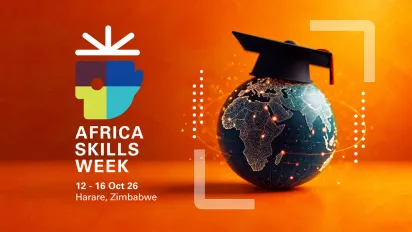
Regional conference 12–16 October 2026
Africa Skills Week 2026

Guide
Next generation sector skills bodies