

Social dialogue and tripartism
50 years of ILO Convention No. 144: putting tripartism into practice
Marking 50 years since its adoption, Convention No. 144 remains a key instrument for promoting tripartism and effective consultation on international labour standards.
29 May 2026
For 50 years, the Tripartite Consultation (International Labour Standards) Convention, 1976 (No. 144), has helped turn one of the ILO’s founding principles into national practice: governments, employers and workers should come together to discuss international labour standards.
Convention No. 144 promotes effective consultation between governments and representative employers’ and workers’ organizations on ILO standards-related matters. It helps ensure that decisions on international labour standards are informed by the views of those most directly concerned with them.
In a period marked by economic uncertainty, digital transformation, climate change and growing pressure on public institutions, Convention No. 144 remains highly relevant. It helps build trust between representatives of the government, employers’ and workers’ organizations, supports better-informed decision-making, and strengthens institutions for the achievement of social justice and decent work. 50 years after its adoption, it remains a key instrument for promoting tripartism at the national level.
Ratifications over 50 years
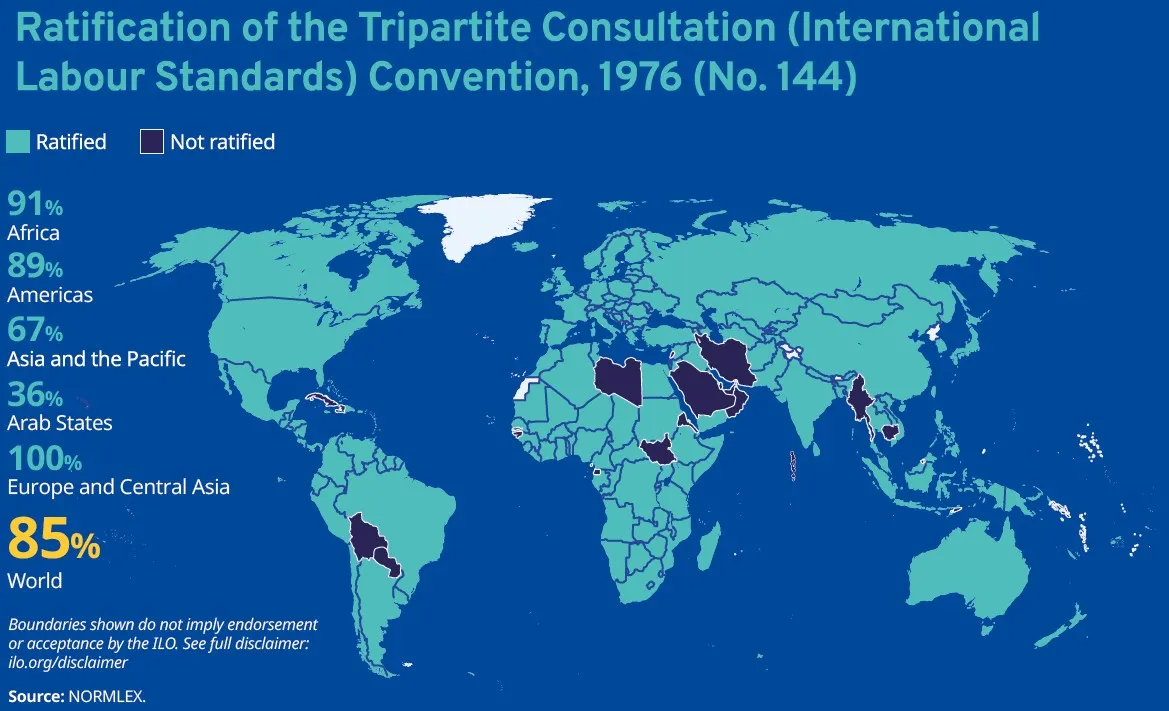
Since its adoption in 1976, Convention No. 144 has become one of the most widely ratified ILO Conventions. To date, it has been ratified by 159 ILO Member States, representing 85 per cent of the ILO’s 187 Member States. The most recent ratification was by Saint Lucia, registered on 29 April 2026.
Why Convention No. 144 matters
Convention No. 144 is one of the ILO’s Governance Conventions. It should be read in conjunction with the Tripartite Consultation (Activities of the International Labour Organization) Recommendation, 1976 (No. 152).
Ratifying and implementing the Convention can help countries:
- Ensure that governments take into account the views, needs and priorities of employers’ and workers’ organizations, including on matters beyond those expressly set out by the Convention.
- Keep employers’ and workers’ organizations better and more regularly informed about government views and proposals on ILO matters.
- Promote policy decisions that are more informed and representative, and grounded in the realities of the world of work.
- Build trust and strengthen a culture of tripartism and social dialogue, including in times of crisis and heightened social tensions.
- Improve ownership of decisions and support their effective implementation.
- Promote the better application of ILO Conventions and Recommendations, including by helping to address implementation issues at an early stage, and can minimize the need to raise these issues before ILO supervisory bodies.
Convention No. 144 also supports the implementation of the 2030 Agenda for Sustainable Development, particularly Goal 8 on decent work and economic growth and Goal 16 on peace, justice and strong institutions. By promoting inclusive and representative decision-making, it contributes to more effective, accountable and participatory institutions.
Consultations required under Article 5
Convention No. 144 requires ratifying countries to operate procedures for effective consultations between representatives of government, employers and workers on matters related to international labour standards.
Under Article 5, these consultations should cover five main areas:
- Items placed on the agenda of the International Labour Conference. These include governments’ replies to questionnaires on agenda items and their comments on draft texts of instruments. The final content of the replies and comments remains the responsibility of governments.
- Submission of newly adopted ILO Conventions and Recommendations to the competent national authorities, such as parliaments or other legislative bodies, so that they can be considered for ratification or implementation. This is required under the ILO Constitution and is to be undertaken in consultation with employers’ and workers’ organizations.
- Re-examination of unratified Conventions and Recommendations to promote their ratification and application. This re-examination is to take place at “appropriate intervals”, which is determined by national practice. It provides an opportunity to assess whether developments may have improved prospects for ratification and application.
- Reports to the ILO on ratified Conventions. Upon ratification of a Convention, Member States must report on its implementation in law and practice on a regular basis. Employers’ and workers’ organizations should be consulted before each report on ratified Conventions is finalized and forwarded to the ILO.
- Proposals for the denunciation of ratified Conventions.
Additionally, Recommendation No. 152 provides for other related issues that could be the subject of consultations, including:
- ILO technical cooperation activities;
- resolutions and conclusions of ILO Conferences and meetings;
- promotion of better knowledge of ILO activities.
Effective consultations in practice
Consultation under Convention No. 144 is more than merely sharing information. It is also different from negotiation: consultations do not necessarily need to lead to an agreement, but are intended to help the government make informed decisions.
For consultations to be effective, they should be undertaken in good faith and take place before decisions are taken. Employers’ and workers’ organizations should receive the necessary information in time to express their views, and those views should be given serious consideration.
Flexible procedures adapted to national practice
Convention No. 144 does not impose a single model of consultation. Countries can decide how to organize consultations in line with national practice, after consulting representative employers’ and workers’ organizations.
Consultations may take place through permanent or ad hoc bodies, existing institutions dealing with labour, economic or social policy, dedicated committees constituted for questions concerning the activities of the ILO, written procedures or other suitable arrangements. Employers and workers should be represented on an equal footing. In practice, this does not require equal numbers of representatives, but rather that the views of each side be given equal consideration.
A practical step towards stronger tripartism
Ratifying Convention No. 144 is a practical way towards strengthening tripartism and social dialogue at national level. Its flexibility allows countries to build on existing consultation arrangements, provided that they ensure effective consultations on the matters covered by the Convention.
By ratifying and implementing Convention No. 144, countries reaffirm the value of dialogue between governments, employers and workers in shaping international labour standards and promoting decent work.
Questions and answers on Convention No. 144
Key resources
Related content

Topic portal
Social dialogue and tripartism

ILO Flagship report
Social Dialogue Report 2024: Peak-level social dialogue for economic development and social progress

Social dialogue and tripartism
National Social Dialogue Institutions (NSDI) Database

Publication
The self-assessment method for social dialogue institutions (SAM-SDI)