

International experiences in the development of Viet Nam’s private sector
This report examines international experiences in private sector and SME development from the Republic of Korea, China, Singapore, Indonesia, Thailand, India and Estonia.
Small and medium-sized enterprises (SMEs) form the backbone of Viet Nam’s private sector, accounting for approximately 98 per cent of all enterprises and making significant contributions to employment, investment and economic growth. However, SMEs continue to face structural constraints related to access to finance, innovation, technology adoption, market access, workforce skills, business formalization and participation in global value chains. As Viet Nam seeks to strengthen the role of the private sector as a driver of sustainable and inclusive growth, learning from international experience is increasingly important for identifying effective policy approaches, avoiding common pitfalls and adapting proven development models to the national context.
This report examines international experiences in private sector and SME development from the Republic of Korea, China, Singapore, Indonesia, Thailand, India and Estonia. It analyses a range of policy instruments and institutional models, including credit guarantee systems, venture capital and Fund of Funds mechanisms, technology and innovation support programmes, export promotion initiatives, digital transformation strategies, SME–FDI linkage programmes, startup ecosystems, public procurement policies and business formalization frameworks.
The review finds that successful countries have combined strategic government leadership with market-based mechanisms to create enabling environments for enterprise growth. Common features include streamlined regulatory systems, diversified financing channels, strong support for research and innovation, investment in skills development, effective digital governance, and targeted measures to strengthen linkages between SMEs and larger enterprises and foreign investors.
Drawing on these international experiences, the report proposes policy recommendations for Viet Nam across eight priority areas: improving the business environment, expanding access to finance, promoting science, technology and digital transformation, strengthening SME–FDI linkages, developing leading domestic enterprises, enhancing market access and export capacity, supporting business formalization and startups, and fostering inclusive business development.
Additional details
References
- DOI: https://doi.org/10.54394/00033733
- ISBN Print: 9789220436998
- ISBN Web PDF: 9789220437001
Related content
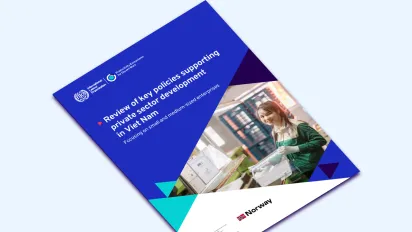
Review of key policies supporting private sector development in Viet Nam
Relevant projects

Productivity ecosystems for decent work