


Strengthening resilience to climate change for the elimination of child labour in cocoa producing areas in Ghana
Protecting children. Empowering families. Growing sustainability.
Duration
17 March 2025 - 16 March 2026
Budget
USD 1,485,148
Development partner(s)
Ministry of Foreign Affairs of Japan
Reference
GHA/24/02/JPN
Location
Bibiani Ahwiaso Bekwai District, Western North Region of Ghana
The Challenge
Across Ghana’s cocoa-growing communities, thousands of children are involved in hazardous work, especially in cocoa farms and small-scale gold mining, robbing them of their right to education and a safe childhood.
At the same time, climate change is making cocoa farming harder. Irregular rainfall, deforestation, and rising temperatures reduce crop yields and push families deeper into poverty, often leading them to rely on child labour as a last resort. This feeds a cycle that keeps children out of school and families trapped in hardship.
Our Solution: Two Problems, One Approach
To tackle the interlinked crises of child labour and climate vulnerability in Ghana’s cocoa belt, this ILO-led project funded by the Government of Japan, offers a holistic, community-driven solution that addresses human rights, provides livelihood options and environmental sustainability.
Rather than focusing on child labour in isolation, we are:
- Creating Child Labour Free Zones in cocoa communities.
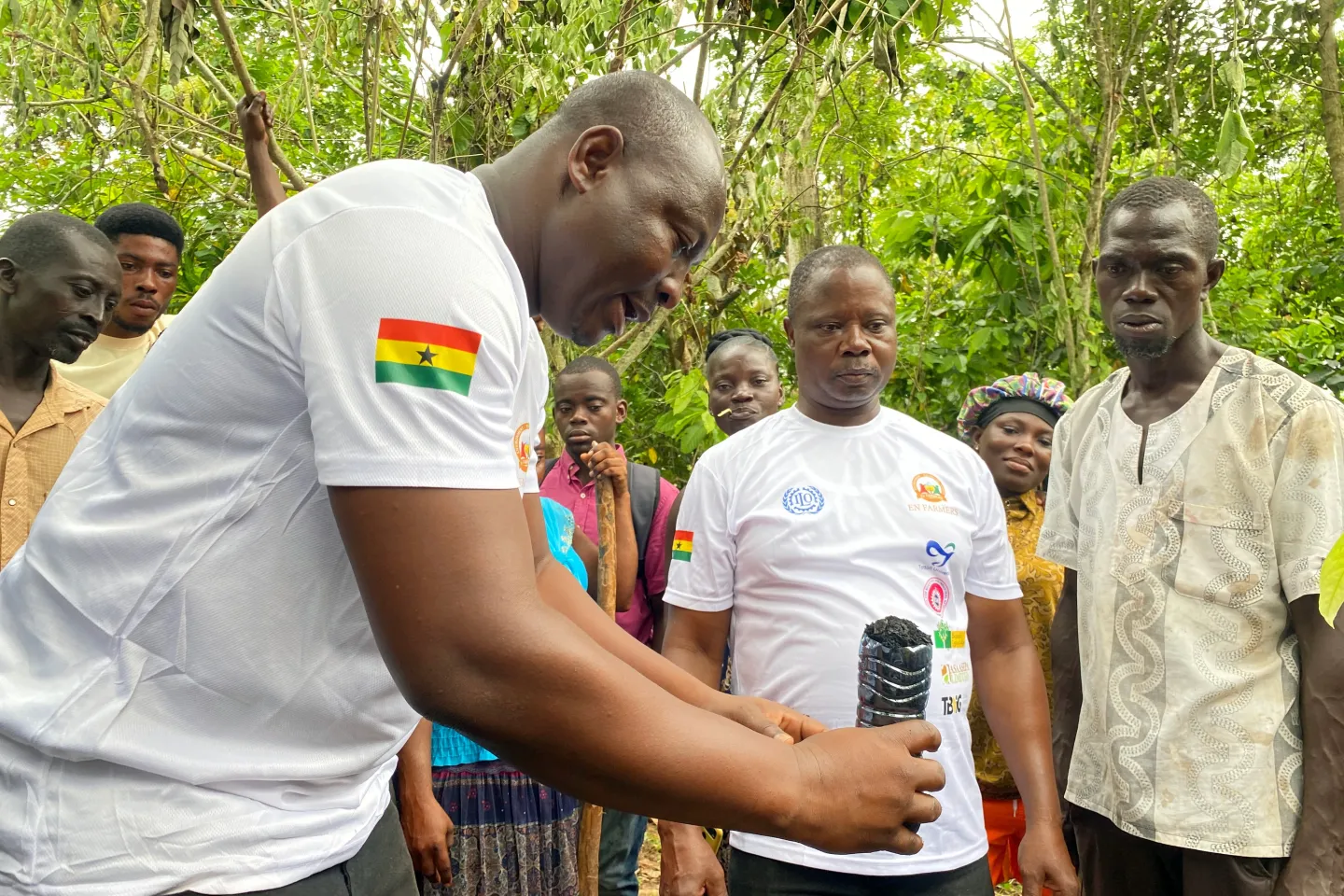
- Training families to use biochar, a green technology that boosts cocoa yields and cuts costs, as well as providing alternative livelihoods (such as cultivation of cereals & vegetables using the same green technology).
- Building resilience against climate shocks and poverty.
- And bringing partners together to invest in long-term change.
We’re combining local action with global innovation to protect children, restore ecosystems, and give cocoa farmers a better future.
Results at a glance
Discover how the Climate Cocoa Project supported cocoa-growing communities in Ghana to eliminate child labour while promoting climate resilience through strengthened child protection systems and climate-smart biochar technology.
The project will
Create 24 youth-run biochar business units
of five people each, aged 18–40
Train them in biochar production,
entrepreneurship, and marketing
Ensure 40% women’s participation
in all training and activities
Support over 27,000 indirect beneficiaries,
including cotton farmers and their families
What the Project Delivers
A Model of Inclusive Partnership
This project is made possible through funding by the Government of Japan, bringing together a powerful alliance:
- ILO: leading global efforts on child labour and decent work.
- Government of Japan: committed donor championing innovation and sustainability.
- ACE Japan, JICA, EN-Farmers and consortium: implementing and technical partners.
- Local government, cocoa farmers, Community Child Protection Committees, community leadership, and trade unions: the heart of community ownership.
Together, we’re creating systems that last beyond the project’s lifespan.
The project also aligns with Japan’s commitment under the TICAD 8 Tunis Declaration and contributes to its Women, Peace and Security agenda by prioritizing women’s economic inclusion.
Why Biochar?
- Improves soil fertility and water retention.
- Increases cocoa yields and reduces need for chemical fertilisers.
- Lowers greenhouse gas emissions.
- Can unlock access to carbon markets; a new source of income for smallholders.
This project plants more than cocoa, it plants hope. Hope for every child in school instead of on a farm, for every family earning enough to dream, and for every community rising stronger against climate change.

Key outcomes
- 📍 8 cocoa communities on the path to being Child Labour Free
- 👨🌾 300 cocoa-farming families trained on biochar use
- 🧒🏽 100+ children supported to return to school
- ♻️ 1 new carbon trading model piloted for farmer income
- 📈 Up to 30% increase in cocoa yield with biochar
- 🌍 4 SDGs addressed: SDG 1 (No Poverty), SDG 8 (Decent Work), SDG 13 (Climate Action), and SDG 16 (Peace, Justice and Strong Institutions)
This project shows what’s possible when we connect the dots between climate justice, child protection and decent work. It proves that a better future for children starts with better livelihoods for families.
Funded by
Related content

Child labour
Japan and ILO support cocoa farmers to fight child labour through climate-smart solutions
Climate Cocoa Project
Climate Cocoa Project: Results at a Glance