

Supply chains
Decent Work in the Garment Sector Supply Chains in Asia
The Decent Work in the Garment Sector Supply Chains in Asia project funded by the Government of Sweden, provides concrete follow-up to the resolution adopted in 2016 by the International Labour Conference concerning decent work in global supply chains.
Duration
15 January 2019 - 31 December 2022
Development partner(s)
Government of Sweden
Reference
RAS/18/05/SWE
Location
Bangkok, Thailand
Project objectives
The project aims to contribute to improved working conditions and rights of women and men workers as well as improved social dialogue, productivity, gender equality and environmental sustainability in the garment sector in Asia. To achieve this, the project will deliver focused interventions in two complementary areas of work: firstly, by strengthening knowledge of research findings, good practices and tools in four main and inter-connected problem areas: 1) social dialogue and industrial relations systems; 2) advancement of gender equality; 3) enhanced productivity and competitiveness; and 4) reduced environmental impact. Secondly, by strengthening the coordination among the many stakeholders already actively working to ensure decent work in the garment industry in Asia. The project will build on ongoing work by the ILO and other development partners to further compile, analyse and disseminate knowledge for better knowledge-sharing, follow up on good practices, and coordinate ongoing efforts.Target beneficiaries
Working women and men in the garment sector in Asia who will see their rights and working conditions improved as a result of the project.Project outcomes
- ILO constituents and other stakeholders and the regional network use platform and available research and tailored tools for inclusive policy development, workplace cooperation, social dialogue and collective bargaining.
- Increased availability of and advocacy for evidence-based policy recommendations for gender equality in the garment sector.
- Employer and Business Membership Organizations (EBMOs) and key actors have improved knowledge and capacity, applied to support productivity and competitiveness in the garment sector.
- Improved environmental sustainability capacity of key actors in ensuring Just Transition in the garment sector in Asia
Main activities
Knowledge generation and sharing
A body of gender-sensitive knowledge on industrial relations, gender equality and closing the pay gap, good practices for productivity, competitiveness and working conditions, as well as on eco-innovation, environmental regulation systems, and access to finances for small and medium enterprises (SMEs) will be developed. To contribute to the sharing of knowledge and experience, a regional web-based platform will be made available to a large community of stakeholders.Capacity building
The project will build capacity in partners through a suite of ILO training and advisory tools. These tools and guidance materials will enhance the capacity of institutional partners, employers’ organizations, affiliated business associations and training centres to assist manufacturing firms to develop systems that ensure quality, reduced environmental impact, eliminate waste and strengthen competitiveness. Capacity development of workers’ organizations will aim at improving industrial relations systems, on the basis of effective exercise of the right to freedom of association and strengthening of collective bargaining at enterprise, sectorial and national levels. Leadership trainings to a regional cohort/network of tripartite female leaders will be organized to enable increased female participation in tripartite policy dialogue and promote gender sensitive social dialogue across the sector.Advocacy and networking
The project will organize two regional tripartite plus meetings to provide further opportunities to discuss issues related to the four inter-related thematic priorities. A Regional Gender Taskforce for the Garment Sector, made up of partners and experts in the sector and from across the region will also be established to advocate, champion, nudge and promote a gender equality agenda across the region. A regional research network for environmental sustainability will also be established to provide for peer review and knowledge sharing of project findings.Related content

Supply chains
ILO – Sweden Regional Meeting on Promoting Decent Work in Garment Sector Supply Chains in Asia
Development cooperation
ILO and Sweden join forces to promote decent work in Asian garment supply chains
Decent Work in the Garment Sector Supply Chains in Asia
Decent Work in the Garment Sector Supply Chains in Asia
Recommendations for Asia garment factories on how to address the COVID-19 pandemic
Decent Work in the Garment Sector Supply Chains in Asia
Technical webinar: Environmental Regulatory Systems in the Textile & Garment Sector
Decent Work in the Garment Sector Supply Chains in Asia
Investing in the post COVID–19 garment sector in Asia: How should gender and environment be integrated for decent work?
Asian dialogues on sustainability
Business Resilience: How can garment factories bounce back from COVID-19?
COVID-19 business resilience guides for garment factories in Asia
Asian dialogues on sustainability
COVID-19 and beyond: Making gender equality a reality
Asian dialogues on sustainability
COVID-19 and beyond: “How can social dialogue help us get through the crisis together?”
Expert roundtables explores how COVID-19 might reshape garment production in Asia
Asian dialogues on sustainability
Asian dialogues on sustainability - COVID-19 and beyond: "How can social dialogue help us get through the crisis together?"
What next for Asian garment production after COVID-19? The perspectives of industry stakeholders
COVID-19
Quick impact assessment of COVID-19 pandemic on the key economic sectors: Responses, adjustment and resilence of business and workers
Women's Leadership in Social Dialogue for Gender Equality in the Asian Garment Sector
Webinar Series: Women’s leadership in social dialogue for gender equality in the garment sector
Women's Leadership in Social Dialogue for Gender Equality in the Asian Garment Sector
Evidence for amplifying women’s voice, representation & leadership
Garment sector supply chains in Asia
Online Seminar: How is COVID 19 changing the digital landscape for the textile and garment industry
Women's Leadership in Social Dialogue for Gender Equality in the Asian Garment Sector
Promising practices in advancing equality and non-discrimination in the garment sector
ILO-CNTAC-PAGE Just Transition in the Textile and Garment Sector in Asia – Discussion series: China
Drivers of innovation for environmental sustainability in the garment sector
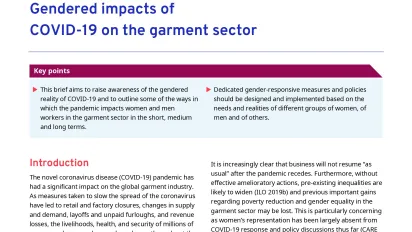
Brief
Gendered impacts of COVID-19 on the garment sector
Decent Work in the Garment Sector Supply Chains in Asia
Technical webinar: Mapping environmental initiatives and tools in the garment sector in Asia
Garment sector in Asia and the Pacific
Women hit hard by COVID-19 impact on garment sector
COVID-19 impacts on women garment workers
Women's Leadership in Social Dialogue for Gender Equality in the Asian Garment Sector
Closing the gender pay gap – practical measures and initiatives in the garment sector
Women's Leadership in Social Dialogue for Gender Equality in the Asian Garment Sector
Sharing is caring: unpaid care work, families and the world of work
Women's Leadership in Social Dialogue for Gender Equality in the Asian Garment Sector
Ending violence and harassment in the garment sector– what will it take?
Introducing the Factory Improvement Toolset to partners in Cambodia
Decent Work in the Garment Sector Supply Chains in Asia
Roundtable: Strategies on reducing and utilizing CO2 for cost effective business
Factory productivity improvement
Productivity interventions available to garment factories in Asia: A mapping study
19-23 April 2021: ILO Green Week
“Strategies on Reducing and Utilizing CO2 for Cost Effective Business” Roundtable
Reducing the footprint? How to assess carbon emissions in the garment sector in Asia
Full report
Moving the Needle: Gender equality and decent work in Asia’s garment sector
Video highlight - Moving the Needle: Gender equality and decent work in Asia’s garment sector
Report highlights need for gender equality in Asia’s garment sector
ILO Working paper 31
Turning up the heat: Exploring potential links between climate change and gender-based violence and harassment in the garment sector
Decent Work in Garment Supply Chains Asia
Greener clothes? Environmental initiatives and tools in the garment sector in Asia
Decent Work in Garment Supply Chains Asia
Effective regulations? Environmental impact assessment in the textile and garment sector in Bangladesh, Cambodia, Indonesia and Viet Nam
Decent Work in Garment Supply Chains Asia
A "Just Transition Toolkit" for textile and garment supply chain in Asia
Decent Work in the Garment Sector Supply Chains in Asia
Let’s talk! Social dialogue helps Asian garment industry navigate the COVID-19 crisis
Asia Garment Hub - A digital gateway to sustainability and decent work resources for the garment and textiles industry - is launched
Decent Work in Garment Supply Chains Asia
Sustainable Fashion: A Focus on the Environmental Dimensions discussion
Decent Work in Garment Supply Chains Asia
Opportunities for a Just Transition to environmental sustainability and COVID-19 recovery in the textile and garment sector in Asia
Asian garment and textile industry seeks path to bright and sustainable future (ILO meeting highlights, 18-20 October 2021)
Decent Work in Garment Supply Chains Asia
Promising practices, experiences and lessons learned in eliminating gender inequality in the garment sector in Asia
What works to eliminate gender inequality in the Asian garment sector?
Decent Work in Garment Supply Chains Asia
What moves the needle on gender equality in the garment sector?
Decent Work in Garment Supply Chains Asia
Asia still ‘garment factory of the world’ yet faces numerous challenges as industry evolves
Decent Work in Garment Supply Chains Asia
Employment, wages and productivity in the Asian garment sector: Taking stock of recent trends
Decent Work in Garment Supply Chains Asia
Women entrepreneurs leading the way: Promoting a circular economy and more sustainable practices in the garment sector
Productivity improvements
Productivity and decent work: A workers' manual
Gender equality
Regional workshops for ILO partners on delivering inclusive business development services
Supply chains
Decent Work in Garment Supply Chains Asia – Experience and Knowledge Sharing from the ILO-Sida project (2019 – 22)
Supply chains
Decent Work in Garment Supply Chains Asia: Project highlights (2019-22)
Supply chains
Implementation of the Factory Improvement Toolset in the Asian garment sector: Final report
Supply chains
Factory Improvement Toolset case studies: Bangladesh
Supply chains
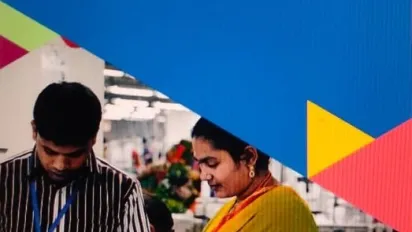
Factory Improvement Toolset case studies: Pakistan
Supply chains
Building back better with environmental sustainability and gender equality: Bangladesh country summary
Supply chains
Building back better with environmental sustainability and gender equality: Cambodia country summary
Supply chains
Building back better with environmental sustainability and gender equality: Indonesia country summary
Supply chains
Building back better with environmental sustainability and gender equality: Viet Nam country summary
Supply chains
Building back better with environmental sustainability and gender equality: Recommendations for the textile and garment sector in the...
Supply chains
ILO-Sida Decent Work in Garment Supply Chains Asia: Publication summary
Research Brief
A COVID-19 retrospective: How is the garment sector in Asia rebuilding?
Asian garment industry
Greener clothes: Environmental initiatives and tools in the Asian garment sector
Asian garment industry
Reducing the footprint: Assessing carbon emissions in the Asian garment sector
A Just Transition
Introducing the "Just Transition Toolkit" for the Textile and Garment Supply Chain in Asia

Project highlights - Bangladesh
Knowledge intensive business services gaps in environmental management in the textile and garment sector
Supply chains
Knowledge intensive business services (KIBS) gaps in environmental management in the textile and garment sector: Project highlights:...
Supply chains
A Just Transition in the Textile and Garment Sector in Bangladesh Technical Stakeholder Workshop, 31 October 2022, Intercontinental Hotel,...
Supply chains
Achieving a Just Transition in the Textile and Garment Sector in Cambodia Technical Stakeholder Workshop, 17 October 2022, Himawari Hotel,...
Supply chains
A Just Transition in the Energy, Textile & Garment Sectors in Indonesia Technical Stakeholder Workshop, 24-25 October 2022, Pullman Hotel...
Supply chains
Achieving a Just Transition in the Textile and Garment Sector in Viet Nam Technical Stakeholder Workshop, 20 October 2022, UN House, Hanoi,...
Supply chains
Knowledge intensive business services (KIBS) gaps in environmental management in the textile and garment sector: Project highlights: Viet...
Supply chains
A Just Transition in the textile and garment sector in Asia: Decent Work in Garment Sector Supply Chains project
Supply chains
Knowledge Intensive Business Services - gaps in environmental management in the textile and garment sector: Synthesis report