

ILO Voices | Women's leadership and equal pay
Our fish-processing cooperative has empowered women and earned them recognition and safety
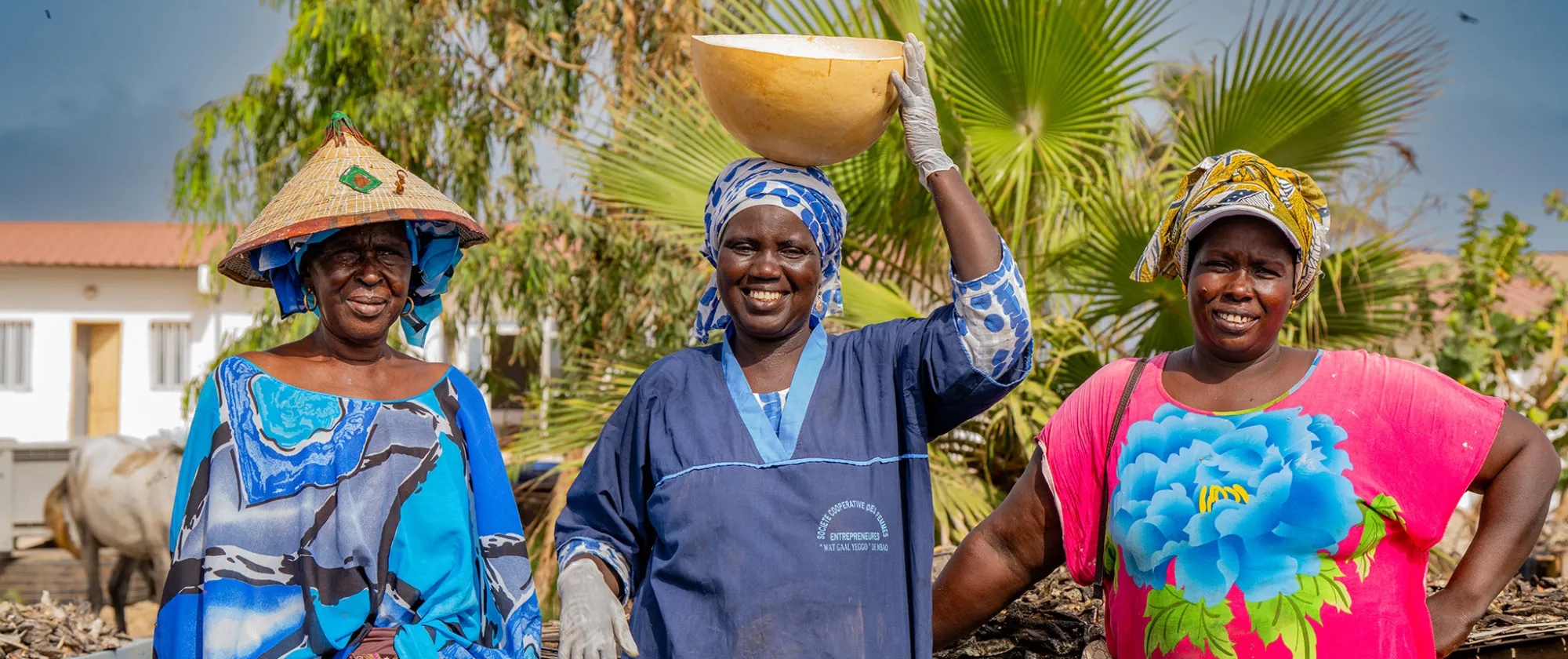
I come from a family of fishers in Senegal. My mother was a fish processor, and I discovered the trade through her at a young age. Life was challenging and I wasn’t able to finish school right away, but I’ve always carried the spirit of a leader. Today, I’m proud to lead a cooperative that improves livelihoods, strengthens our community, and empowers women to stand up against all forms of violence and harassment.
25 November 2025
My name is Yaye Coumba Seck. I’m 56 years old, married, and a mother of three boys and three girls. I discovered fish processing as a child, helping my mother during school breaks.
My classmates used to tease me, saying I’d end up like her – and they were right.
My dad paid for my computer science studies so I could become a computer scientist. However, after experiencing harassment while searching for a job, I was forced to choose another path – one that allowed me to be independent and to dedicate myself to fish processing.
Many women live through similar situations but remain silent. In our country, there are socio-cultural norms that refrain women from speaking about certain issues. They endure in silence, continue to suffer, and do not report.
I worked hard to carve out my own path. Back then, women involved in food processing were not organized. They were fishermen's wives and processed the leftovers that men brought back from the sea.
The fish were for personal consumption and as gifts for neighbours and relatives. It wasn't a profitable activity.
We formed an Economic Interest Group and joined the National Federation of Fishing of Senegal to develop our business and increase our income.
We process dried, smoked, grilled, and fermented fish. But with so many women, equipment was limited, and traditional methods remained necessary.
It was then that the ILO project stepped in with strong support for formalization. We began as a union of 150 women, and from this organization the cooperative was formed, initially with just 30 members.

The project helped us assess our activities. We used to process fish seven days a week all year, but stocks became scarce.
The sea no longer has fish. Climate change, overexploitation, and other factors are depleting raw materials, leaving women processors without access to the resources they need.
The project introduced alternative activities, including soap and bleach production and composting fish-processing waste, allowing us to generate additional income.
We also received training on preventing violence and harassment against women, and promoting equal pay between men and women. We took part in awareness raising and advocacy efforts for the ratification of ILO Convention 190. We have become ambassadors.
I encourage women to speak out against those who commit harassment and violence against women and girls.
When it comes to equal pay, it is said that women are always the victims and that men earn more. But here, in our cooperative, the men are mostly our employees.
I encourage women to speak out against those who commit harassment and violence against women and girls.
Yaye Coumba Seck, Co-founder of a women’s fish-processing cooperative
The cooperative has greatly helped women gain recognition in society. I’ve seen it in their positive changes in behaviour, their personal development, and the significant increase in their income. Today, women processors are perceived differently in society.
The cooperative also contributes to the community – building classrooms, a vaccination room for the local health centre, and the mosque.
The village chief sometimes involves me in his activities, requesting my opinions and my experience.

Overall, this project has opened our eyes and allowed us to deepen our thinking about the activities we need to carry out and the behavioural changes required.
The cooperative is a good model with many advantages. We began with only 30 women members, which posed a real challenge. Now, everyone wants to join.
We organized a general assembly, and members elected their executive committee in a democratic spirit.

I started developing leadership skills from a young age, back when I was a student.
The ILO project has helped shape women leaders and unlock their full potential.
Today, I’ve represented Senegal at an international fisheries conference in Iceland, supported student researchers, and created jobs for men, women and youth in our community.
Looking ahead, I want to focus on young people – to help them become future leaders. We must develop entrepreneurship.
To young people, my message is: believe in yourself, trust your skills, surround yourself with those who uplift you, and never abandon your dreams.
Yaye Coumba Seck, Co-founder of a women’s fish-processing cooperative
I hope to formalize our activities further, secure partnerships with fish factories, and access financing.
We need infrastructure to produce high-quality goods and expand into national and international markets.
To young people, my message is: believe in yourself, trust your skills, surround yourself with those who uplift you, and never abandon your dreams.
Fast facts
- Yaye Coumba Seck is a beneficiary of the joint France–ILO project “Combating violence and harassment in the world of work & Promoting equal pay and career opportunities between men and women,” funded by the French Ministry of Labour, Health and Solidarity.
- Yaye and her fellow cooperative members participated in training sessions focused on women's leadership, equal pay for work of equal value, and the prevention of violence and harassment in the world of work. They also received guidance on formalizing and diversifying their activities.
- Gender inequalities and discrimination remain major obstacles to the full and equal participation of women in the world of work. According to ILO research, violence and harassment are still widespread and persistent, limiting women’s access to decent employment and leadership positions.
- In response to these challenges, the ILO project “Combating Violence and Harassment in the World of Work & Promoting Equal Pay and Career Opportunities Between Men and Women” has strengthened efforts to combat violence and harassment at work and promoted the principle of equal pay for work of equal value.
- In Senegal, the France–ILO project, in collaboration with the National Union of Autonomous Trade Unions of Senegal (UNSAS) and the Belleville Institute, supported the creation of three women’s cooperatives bringing together 71 women processors of fish products in Mbao and Yenne, and of cereals in Louga.
- The project contributed to strengthening women’s skills through a programme in functional literacy, women’s leadership, pay equity, and awareness-raising on combating violence and harassment, while supporting economic diversification in response to the impact of climate change and the depletion of fishery resources.
- Thanks to the diversification of economic activities and the strengthening of skills, cooperative members’ incomes increased, helping to reduce pay gaps between men and women. The project increased the visibility and recognition of the women’s cooperative in the community, strengthening their leadership and participation in decision-making at the local, national, and international levels.
- On the occasion of the 16 Days of Activism against Gender-Based Violence, the experience of Mbao highlights the importance and urgency of ratifying ILO Convention No. 190, to ensure a safe, fair, and respectful world of work for all. It also demonstrates how women’s cooperatives can become true levers of social justice and gender equality.
Interview with Nicolas Dumas, Policy Officer, French Ministry of Labour, Health, Solidarity and Families, France
Find out more
Related content
Project France-OIT
Combating violence and harassment in the workplace & Equal pay and careers for men and women