


Invisible but essential: Domestic workers at the heart of persons with disabilities care in Kenya
Across Kenya, domestic workers quietly provide life-sustaining care to persons with disabilities - often around the clock and under highly precarious conditions. A new International Labour Organization/Global Disability Fund-supported assessment reveals the scale of their contribution, the intensity of their work, and the urgent reforms needed to recognize, protect, and professionalize this essential workforce.
18 February 2026
Across thousands of Kenyan households, domestic workers form the backbone of care for persons with disabilities. They cook, bathe, transport, medicate, comfort, and support persons with disabilities who need care and support, which often enables families to remain economically active and persons with disabilities to live with dignity. However, this critical role remains invisible, undervalued, and inadequately protected.
The Assessment of Domestic Workers Providing Care and Support to Persons with Disabilities in Kenya (2025), based on surveys of 331 Domestic Workers and 70 employers across four counties, documents this indispensable contribution alongside severe deficits in decent work.
Intense care demands and excessive working hours.
The findings show that domestic workers provide care to an average of 1.6 persons with disabilities per household, with some caring for as many as five. Two-thirds (65.5 per cent) of the persons with disabilities require 24-hour care, most commonly due to physical disabilities.
This intensity translates directly into excessive working hours. Domestic workers reported working an average of almost 70 hours per week, rising to over 80 hours for live-in workers, which is far above Kenya’s statutory limits of 52 hours for daytime work and 60 hours for night-time work. More than 80 per cent receive no overtime pay, despite being on call day and night. The longer the care needs, the higher the likelihood that workers are required to live in the employer’s household, blurring the boundary between work and rest and increasing exposure to overwork and abuse.
Pervasive informality and chronic underpayment
Despite the depth of responsibility involved, employment relationships remain largely informal. Seven in ten domestic workers rely on oral agreements, while fewer than one in ten have written contracts. As a result, wages, working hours and job scope are, in many instances, rarely clearly defined.
The pay gap is stark. Domestic workers earn an average of KSh 7,017 per month, which is less than half the statutory minimum wage in the counties studied. Median wages are even lower, at KSh 6,000. When hours worked are taken into account, live-in domestic workers earn significantly less per hour than their live-out counterparts. Underpayment is compounded by widespread non-payment of overtime and limited access to wage protection mechanisms.
Furthermore, the workforce is predominantly female (81 per cent), with many workers carrying a double burden of care. Over 86 per cent have dependent children, and one in seven cares for a child with a disability at home, often without additional support. Most are the primary caregivers in their own families, underscoring how paid and unpaid care responsibilities intersect and reinforce gender inequalities.
Gaps in protection, training, and voice
More than half of domestic workers lack access to any form of social protection. While some are enrolled in social health insurance, very few are covered by pension schemes, and most pay contributions themselves. Occupational safety and health protections are minimal: one in four workers reported having experienced a workplace accident or injury, yet almost none receive employer-provided medical cover, sick leave, or protective equipment.
Training remains uneven. Three-quarters of domestic workers providing disability care have no job-relevant training, even though employers consistently value caregiving and first‑aid skills. While training and certification are associated with higher wages, they do not reliably translate into decent pay, reflecting structural constraints in the sector.
Union awareness and membership are low, limiting domestic workers’ ability to collectively claim their rights or access grievance mechanisms.
A Call for Systemic Recognition and Reform
The assessment makes a clear case that domestic workers providing care and support to persons with disabilities are delivering essential services under conditions that fall short of decent work. Addressing these gaps requires formalizing employment relationships, enforcing minimum wages and working‑time standards, expanding access to social protection, investing in skills development, and strengthening workers’ voice and social dialogue mechanisms.
Crucially, the report underscores the importance of aligning national law and practice with ILO Convention No. 189 on Decent Work for Domestic Workers, ILO Convention No. 190 on Ending Violence and Harassment at Work, alongside the implementation of Kenya National Care Policy. Recognizing domestic workers as skilled caregivers is not only a labour rights imperative but is central to building inclusive and sustainable care systems that leave no one behind.
Acknowledgement
This assessment was conducted by the International Labour Organization in collaboration with the Ministry of Labour and Social Protection, National Council for Persons with Disabilities, Kenya Union of Domestic, Hotels, Educational Institutions, Hospitals and Allied Workers (KUDHEIHA), International Domestic Workers Federation and the United Disabled Persons of Kenya. The work was enabled by funding from the Global Disability Fund, under the UN Joint Programme on Unpaid Care, Disability and Gender Transformative Approach (ILO, UNDP, UNICEF, UNFPA, OHCHR and UN Women), together with contributions from the ILO Core Funds. This collective effort underscores a shared commitment to advancing decent work and recognition for domestic workers providing care to persons with disabilities in Kenya and globally.
Related content
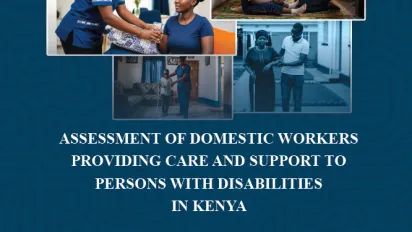
Assessment of Domestic Workers Providing Care and Support to Persons with Disabilities in Kenya
Policy Brief - Assessment of Domestic Workers Providing Care and Support to Persons with Disabilities in Kenya.png