

Sector portal
Chemicals and pharmaceuticals
Chemicals are a key part of modern societies and economies. As highlighted in the ILO Chemicals Convention, 1990 (No 170), they are also hazardous for workers and the general public, and must therefore be handled with special care.
The chemical industries have undergone considerable change in recent years. The ILO Global Dialogue Forum on Challenges for Decent and Productive Work arising from Digitalization in the Chemical and Pharmaceutical Industries adopted points of consensus that will guide the work of governments, employers and workers to ensure a just transition to a greener, safer and more productive and circular industry.
Key resources
- Technical meeting on challenges and opportunities for promoting decent work, productivity and a just transition arising from artificial intelligence in the manufacturing industry (April 2026)
- Global Dialogue Forum on Challenges for Decent and Productive Work arising from Digitalization in the Chemical and Pharmaceutical Industries (December 2018)
- Global Dialogue Forum on Initiatives to Promote Decent and Productive Work in the Chemical Industry (November 2013)
- Tripartite Meeting on Promoting Social Dialogue on Restructuring and its Effects on Employment in the Chemical and Pharmaceutical Industries (October 2011)
- Meeting of Experts to Examine Instruments, Knowledge, Advocacy, Technical Cooperation and International Collaboration as Tools with a view to Developing a Policy Framework for Hazardous Substances (December 2007)
Technical meeting on challenges and opportunities arising from AI in the manufacturing industry
The meeting will discuss AI’s impact on manufacturing, focusing on opportunities and challenges for decent work, productivity, and a just transition, aiming to adopt conclusions and recommendations.
Data and statistics
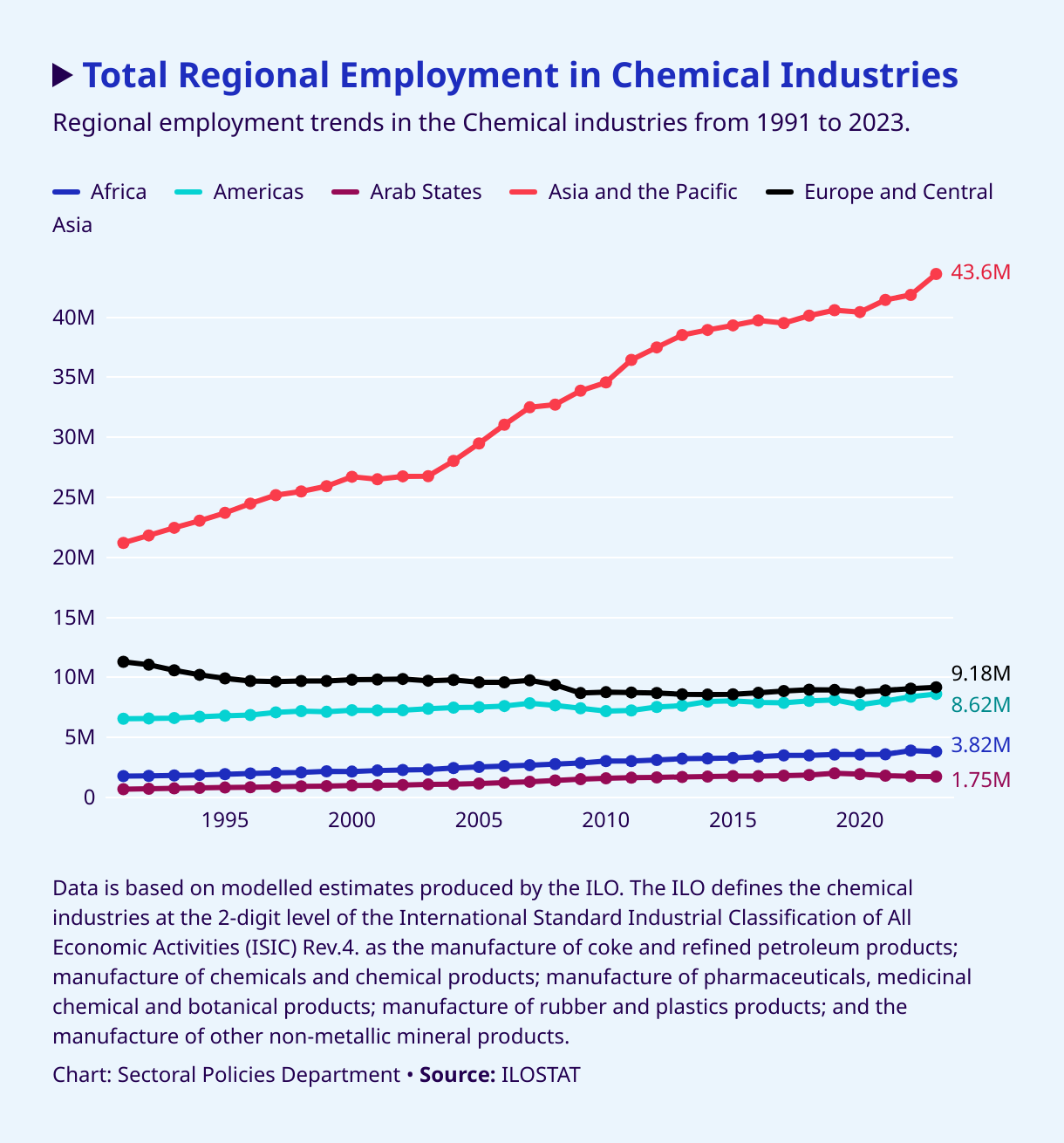
The line graphs show a time series of modelled global and regional employment estimates at the sectoral level. The ILO modelled estimates generally cover 189 countries, offering a comprehensive set of internationally comparable labour statistics. These include both reported data and imputed figures for countries with missing information. The imputations are generated using econometric models developed by the ILO.
For more detailed labour market indicators and country-level data, visit the Sectoral Employment Statistics page of the ILOSTAT database.
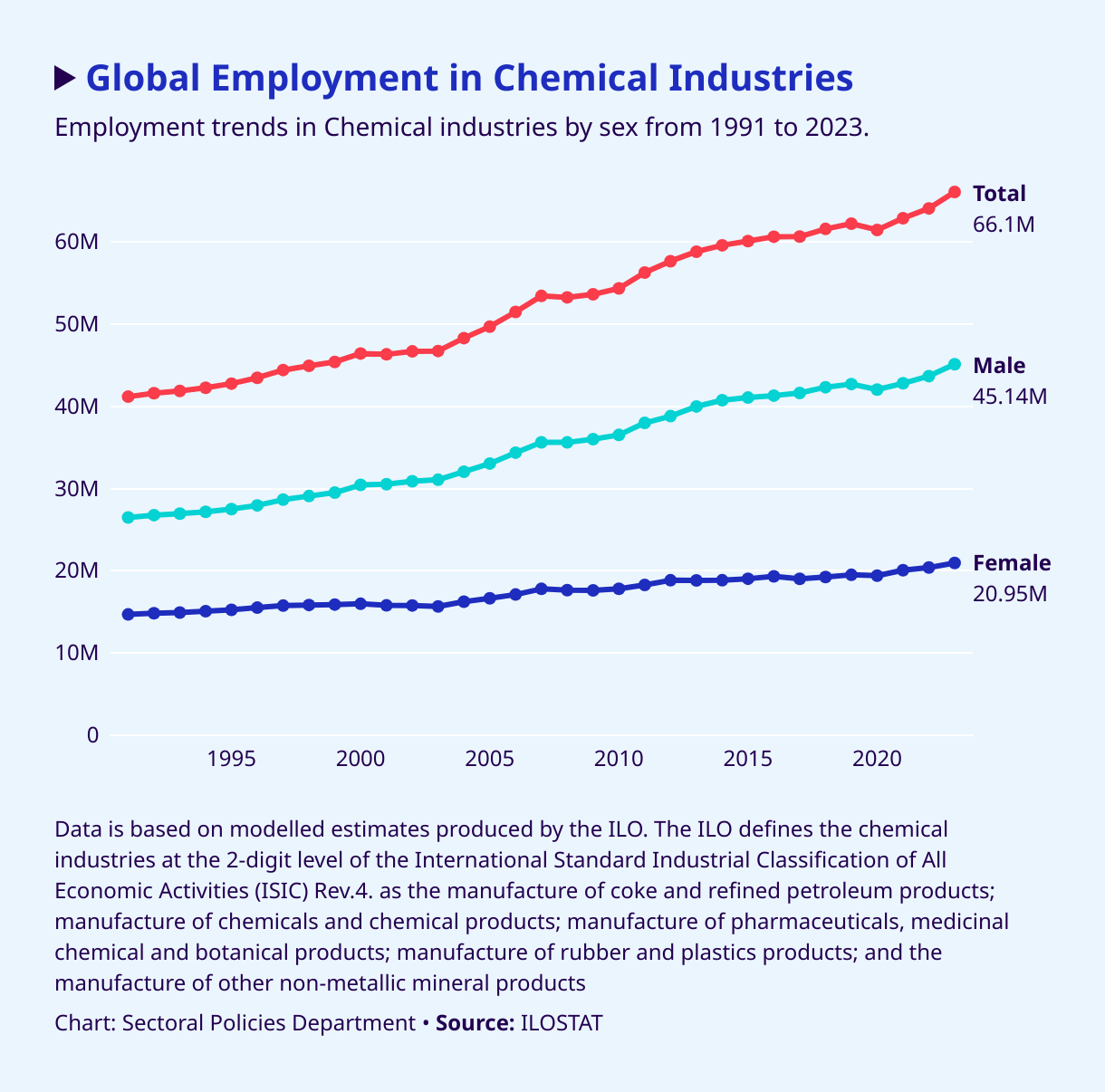
The line graphs show a time series of modelled global and regional employment estimates at the sectoral level. The ILO modelled estimates generally cover 189 countries, offering a comprehensive set of internationally comparable labour statistics. These include both reported data and imputed figures for countries with missing information. The imputations are generated using econometric models developed by the ILO.
For more detailed labour market indicators and country-level data, visit the Sectoral Employment Statistics page of the ILOSTAT database.
News

AI in the manufacturing industry
ILO adopts first-ever conclusions on AI in manufacturing work

Sectoral labour data and statistics
ILO integrates sectoral labour statistics to strengthen access to world of work data

ILO advocates for decent work and social justice in historic UN Plastics Treaty Negotiations
Publications and documents
Rapid Market Scoping of the Renewable and Solar Energy Sector in Jordan
Market Systems Analysis of Priority Sectors for Inclusive Growth in Jordan: Food Industry, Food Services, and Chemicals
Manzuma Sector Selection Study
Projects
Sound chemical management
Reducing the use and release of Chemicals of Concern (COCs), including Persistent Organic Pollutants (POPs) in the Textile Sector - ESCM
Decent work in supply chains
Advancing decent work in supply chains through sectoral social dialogue
Cambodia and Viet Nam
Occupational Safety and Health in Hazardous Work in Southeast Asia
Contact information
Sectoral Codes of Practice and Guidelines
Sectoral meetings
Conclusions and recommendations of sectoral meetings
Sign up to our newsletter!
Receive ILO news about sectoral work