

World Occupational Safety and Health Day 2025 in Türkiye
We need to come together to renew our commitment to occupational safety and health
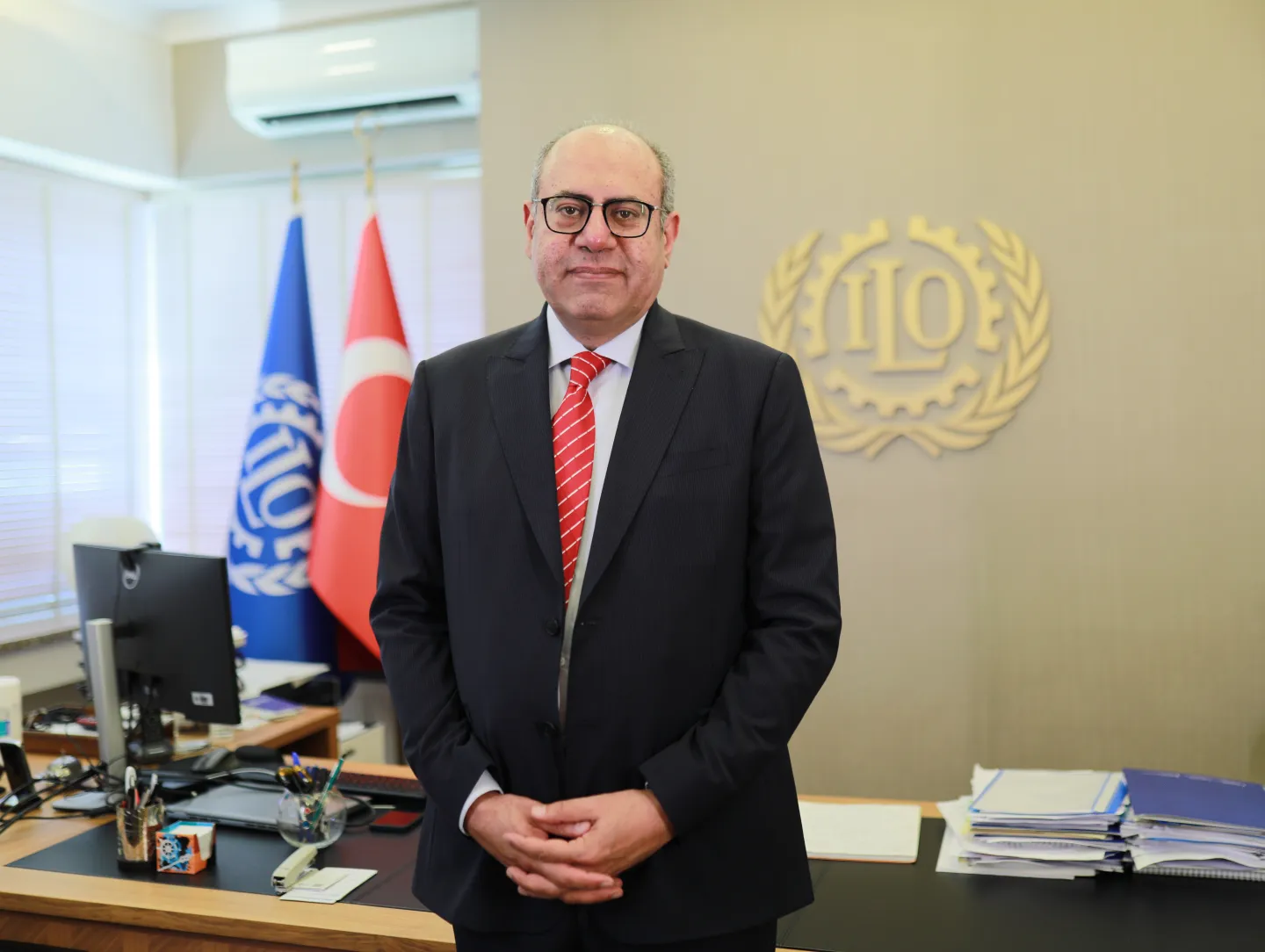
In a statement delivered for World Occupational Safety and Health Day 2025, Yasser Hassan, Director of ILO Office for Türkiye, highlights Türkiye's commitment to contribute to a national preventative culture of safety and health at work through social dialogue.
28 April 2025
Today, 28 April, we observe the World Day for Safety and Health at Work.
The International Labour Organization observes the World Day for Safety and Health at Work to promote safe, healthy and decent work. Ever since it was founded in 1919, the subject of occupational safety and health has been at the heart of the ILO’s work, including its standards-setting activities. And over the last 100 years, the ILO had developed an impressive body of standards on occupational safety and health.
Addressing the challenge requires an effort by governments, employers, and workers to create, implement, and continuously strengthen a preventive health and safety culture. In this context, ILO’s Convention No. 155, its 2002 Protocol, and Convention No. 187 provide the necessary guidance by focusing on the principle of prevention and the duty to protect workers from occupational accidents and diseases.
In 1998, the ILO Declaration on Fundamental Principles and Rights at Work was adopted. It is an expression of commitment by governments, employers' and workers' organizations to uphold basic human values - values that are vital to our social and economic lives. It affirms the obligations and commitments that are inherent in membership of the ILO, namely:
- freedom of association and the effective recognition of the right to collective bargaining;
- the elimination of all forms of forced or compulsory labour;
- the effective abolition of child labour; and
- the elimination of discrimination in respect of employment and occupation.
The Declaration provided the ILO’s response to globalization and has been a key tool to promote economic and social progress.
The fundamental principles and rights at work, including human rights in the workplace, employment policy, and human resource development, are based on the ILO Conventions and Recommendations that set International Labour Standards on a wide range of topics related to the world of work.
In 2022, at the 110th session of the International Labour Conference, ILO member States amended the Declaration to add “safe and healthy working environment” as a fifth fundamental principle.
Each of the Fundamental Principles is associated with the most relevant ILO Conventions. For OSH, the Conventions C-155 and C-187 are now considered as Fundamental Conventions.
The Occupational Safety and Health Convention (C.155) includes, in particular, the obligation for employer to ensure, so far as is reasonably practicable, the workplaces, machinery, equipment and processes under their control are safe and without risk to health. It is important to stress that ILO has always had a broad understanding of workers’ health, not merely the absence of disease or infirmity. It also includes ‘the physical and mental elements affecting health which are directly related to safety and hygiene at work’.
With the Promotional Framework for OSH Convention (C.187), ILO Members commit to promote continuous improvement of OSH to prevent occupational injuries, disease and death, by the development, in consultation with the most representative organizations of employers and workers, of a national policy, national system and national program.
The step, no doubt, created a new momentum. Governments that had ratified these two conventions are required to implement them effectively in law and practice; to report, more frequently, to the ILO Committee of Experts on the Application of Conventions and Recommendations and reply to the comments of the Committee. In addition, governments that had not yet ratified these Conventions would have a constitutional obligation, stemming from the ILO 1998 Declaration on Fundamental Principles and Rights at Work, “to respect, to promote and to realize, in good faith” the new fundamental OSH principle.
Despite this important decision and the significant progress in occupational safety and health, work-related accidents and diseases still occur too frequently, with devastating impacts on workers, enterprises and entire communities and economies. Figures tell us that:
2.93 million workers die each year as a result of work-related factors.
395 million workers worldwide sustain a non-fatal work injury each year.
2.41 billion workers are exposed to excessive heat each year.
$361 billion could be saved globally by implementing improved safety and health measures to prevent injuries from excessive heat in the workplace.
To support its members in facing these challenges and guarantee safe and healthy working environment, the ILO adopted the Global Strategy on Occupational Safety and Health (2024-2030) and an Action Plan for its implementation to accelerate progress towards the promotion, respect, and progressive realization of the fundamental right to a safe and healthy working environment worldwide and, ultimately, to contribute to a global decrease in the number of occupational fatalities, injuries and diseases, along with a reduction in the associated socio-economic costs.
The Strategy calls upon ILO constituents to accelerate action towards continuous improvement in building a preventative safety and health culture, as defined in C187, with the support of the ILO. It confirms the commitment of the ILO and its constituents to advancing social justice by protecting the health and lives of workers and promoting decent work for all.
The Strategy takes into consideration the challenges and opportunities of the changing world of work, addressing new occupational safety and health priorities, while continuing to address enduring issues in traditionally hazardous sectors, such as agriculture, construction and mining.
The Global Strategy on OSH also recognizes the evolving nature of work and workplaces, including pressing topics like climate change and just transition and the integration of new technologies and work processes. Furthermore, it aspires to foster responsive initiatives that accommodate changing working modalities, demographic shifts, and the diverse needs of a dynamic workforce. It acknowledges that inequalities in the workplace must be addressed as a requirement to effectively advance social justice for all.
The strategy is based on four transversal principles:
- International labour standards.
- Effective Social dialogue and participation.
- A human-centred, inclusive and gender-transformative approach.
- A focus on prevention throughout the life cycle.
Türkiye is a ratifying member State to the Fundamental Conventions on OSH namely C.155 and C. 187 along with technical Conventions including Occupational Health Services Convention, 1985 (No. 161), Convention No. 167 on Safety and Health in Construction and No.176 on Safety and Health in Mines and has been revising its legislation accordingly.
The government has been developing its OSH national framework in line with conventions C.155 and C187 with different interdependent components (policy, programmes and system), which are periodically assessed and updated. This is a commitment on the side of the government to contribute to the creation and maintenance of a national preventative culture, through social dialogue and the active participation of employers, and workers, in a defined system of rights, responsibilities and duties.
Employers and their organizations are aware of and do have a primary responsibility for the occupational safety and health of workers. They are responsible for conducting risk assessments and organising business operations with safety as the first priority. They are committed to engage and contribute to setting the framework to enable their enterprises to provide flexible solutions to manage workplace safety. For them, OSH performance is key to productivity, morale of their workers, reputation, and management, particularly where businesses depend on the relationship with global consumers.
Workers and their organizations are aware of and do have a significant role when it comes to the implementation of ILO standards. For the prevention of accidents and occupational diseases, and general improvement of health and safety at work, there is no better bet than a strong trade union presence. Respect for core labour standards, namely freedom of association and the right to organize, has a direct impact on the health and safety situation at work, as they provide for workers to form or join trade unions and for these unions to be able to negotiate conditions with employers. This in turn implies that trade unions really must ensure that health and safety remain at the top of their priorities.
Nevertheless, challenges remain. Data tells us that there is still a significant rate of occupational accidents and diseases. According to Social Security Institution (SSI) statistics, in 2023, the total number of fatal occupational accidents was 1.972, and the total number of occupational diseases is reported as 946. Regrettably, this falls short of our standards, remains a serious challenge to Türkiye’s development objectives, and invites all to urgently address it.
On the other hand, total number of fatal occupational diseases was reported as zero, which underlines the urgent need for improving the recording and notification systems particularly for occupational diseases. As the global estimates also demonstrate[1], the diagnosis, recording, notification and prevention of work-related diseases should be of particular attention of governments, employers’ and workers’ organizations.
ILO’s work in many countries including Türkiye inform of many lessons, such as:
- Sound evidence-based research enables improvement and resilience of the OSH framework and ensure targeted actions.
- Effective enforcement and compliance mechanisms including labour inspection are central to the implementation of national regulatory frameworks.
- Strengthened coordination, partnerships and linkages between OSH and other policies are key to realizing a national preventative safety and health culture.
As also mentioned in the ILO Global Strategy on OSH (2024-2030), there is a need for research and tools to navigate the opportunities and challenges of new technologies. We all know that continued transformations in the world of work, especially those arising from new technologies, are both offering new opportunities to improve workplace safety and creating new risks. On the one hand, new technologies are making working environments safer as advanced robotics are keeping workers out of harm’s way in some traditional (often dangerous) machine processes. On the other hand, there is a large and growing array of hazards in the new work processes.
In line with the recent developments in the evolving world of work, this year’s theme for World OSH Day is determined as “Revolutionizing health and safety: the role of AI and digitalization at work” and a report was prepared by the ILO on this theme.
The new report explores how artificial intelligence (AI), digitalization, robotics and automation are reshaping OSH in workplaces worldwide. The report, titled Revolutionizing Health and Safety: The Role of AI and Digitalization at Work, highlights how these emerging technologies are improving worker health and well-being while underscoring the need for proactive policies to address new risks. By taking on hazardous tasks, assisting in surgeries, and optimizing logistics, robots help reduce risks and improve efficiency. AI-powered systems enhance safety and health monitoring, and streamline tasks and operations, easing workloads and driving innovation—even in traditionally low-tech sectors. However, the report stresses the need for proactive policies to ensure these technologies are implemented safely and equitably.
The report highlights that advanced robotics and automation, the use of virtual and extended reality, as well as new tools such as smart wearable devices that provide real-time risk detection or environmental sensors that track air quality, are transforming safety and health by preventing accidents and reducing hazardous exposures.
Furthermore, digitalization is leading to the rise of hybrid and remote work arrangements that are creating flexibility and improving mental health. However, these advancements may also bring in new risks. While robots effectively take on hazardous tasks, workers who maintain, repair, or collaborate with these machines may face new dangers. Unpredictable robotic behaviours, system failures, or cyber threats can compromise safety. Ergonomic risks may arise from human-robot interaction, as well as from the use of wearables and exoskeletons that lack proper fit, usability, or comfort. The report also exposes safety and health risks faced by workers across the digital supply chain, from those in extraction processes to those powering AI, as well as workers handling electronic waste.
One of the good practice examples on the use of technology and AI for the prevention of occupational accidents is the project launched by the Employers Organization TİSK on “Türkiye’s Journey to Zero Accident”[2] in 2022, thanks to the artificial intelligence-supported OSH video analysis software platform through which possible occupational accidents in workplaces could be prevented. Through this project, the risks of occupational accidents can be determined in advance by integrating the software platform with existing cameras in the workplaces. It has been reported that there has been a decrease in possible work accidents for the businesses that have started to use this technology. We, at the ILO Office for Türkiye, see that such a project stands as an example for the good use of AI and digitalization to improve OSH at workplaces, and I congratulate TISK for their efforts in this regard.
A final word: Occupational accidents should never be looked at as something that comes with the job you do.
It would be highly unrealistic to pretend that accidents don’t happen or that they couldn’t or wouldn’t happen in the workplace. Unfortunately, it is a fact of life that things do go wrong on occasion, but it’s how you deal with that, that can make all the difference.
Currently, the cost is too high. And yet, public awareness of occupational safety and health tends to be low. All too frequently it does not get the priority it merits.
A national occupational safety and health culture needs to always be nurtured, one in which the right to a safe and healthy working environment is respected at all levels, where governments, employers and workers actively participate in securing a safe and healthy working environment through a system of defined rights, responsibilities and duties, and where the highest priority is accorded to the principle of prevention.
I feel pretty sure that we are all sharing a sense not only of dissatisfaction but, more importantly, of responsibility, especially when we get reminded of the cost of workplace accidents. We need to come together again to renew old commitments and maybe to make new ones for occupational safety and health. We owe a lot to those who have contributed often at great inconveniences.
At the same time, I think we have reason to conclude that, having weathered the storm of the COVID-19 pandemic, it is crucial to remain faithful to the aims and objectives of the 1998 Declaration.
As described by many delegates at the International Labour Conference of 2022, the recognition of OSH as a fundamental principle was a kind of making history. It is now our responsibility to make a difference through a collective commitment to act together – and frankly, to act better than we have in the past – to make everybody’s work safe and healthy.
The extent to which we honour that commitment will be measured in terms of accidents and diseases prevented and ultimately lives saved. What indeed could be more fundamentally important than that?
The ILO Office for Türkiye will continue to support the tripartite constituents for better and effective implementation of the ratified OSH Conventions while following the needs to ensure that OSH policies are inclusive and are designed and implemented through social dialogue. address challenges posed by digitalization, balancing technological advancements with the protection of workers' safety and health.
---------------------------------------------------------------------------------
[1] According to the latest estimates developed by ILO covering the year 2019, around 2.93 million workers died as a result of work-related factors where the large majority of these work-related deaths, 2.6 million, were attributed to work related diseases, while work accidents resulted in 330,000 deaths. A call for safer and healthier working environments.
[2] https://www.tisk.org.tr/proje/745/turkiyenin-sifir-kazaya-yolculugu-.html