

Trinidad and Tobago defining hazardous and light work for the elimination of child labour
Process includes ILO guidance on international labour standards and best practices.
18 June 2023
The Government of Trinidad and Tobago continues to take steps to end child labour in all its forms by initiating the development of lists that distinguish between light and hazardous work and are based on International Labour Organization (ILO) Conventions and Recommendations ratified by the country.
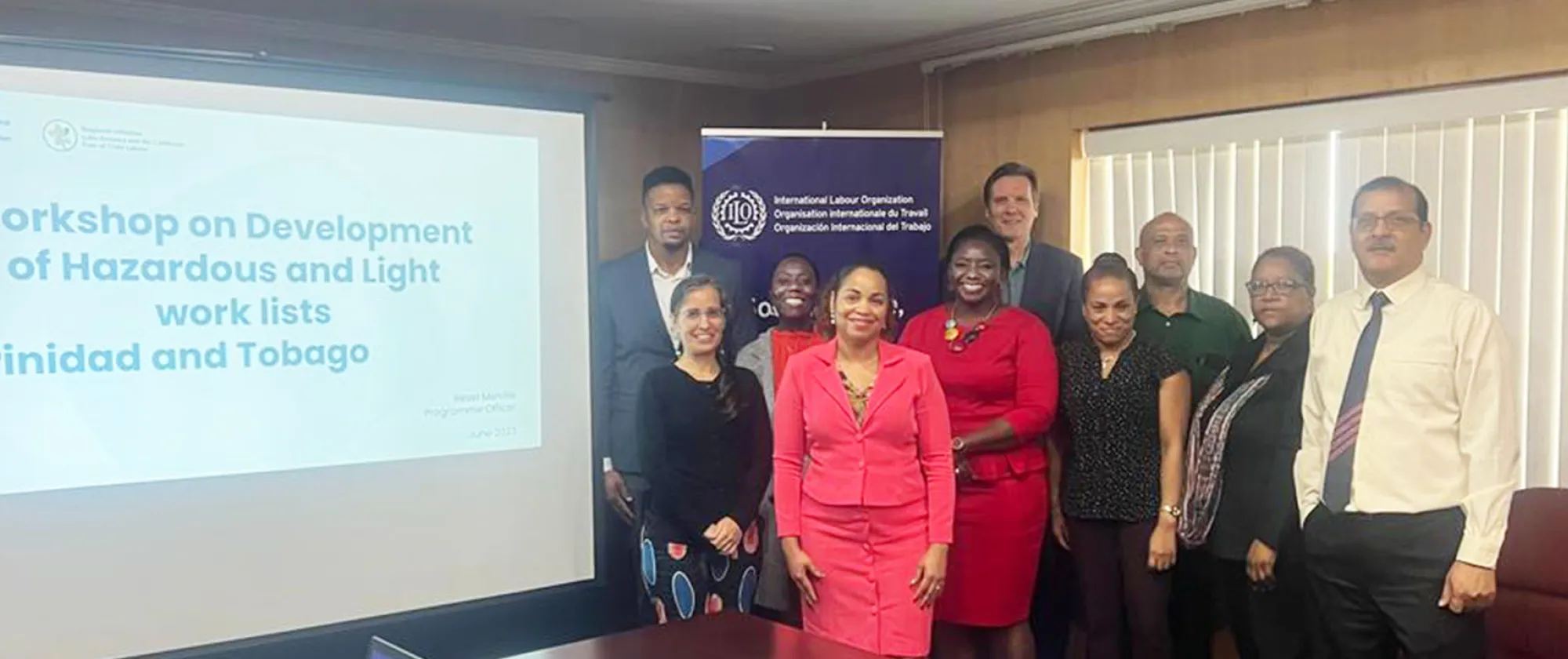
On 17 June 2023, members of the National Steering Committee for the Prevention and Elimination of Child Labour, assigned to lead the process of developing the lists, joined members of the ILO Decent Work Team and Office for the Caribbean for a workshop to review the process proposed by Trinidad and Tobago for determining the forms of labour that are likely to harm the health, safety and morals of children with an aim to prevent and eliminate the worst forms of child labour as an urgency.
“The Ministry of Labour, via the National Steering Committee for the Prevention and Elimination of Child Labour, is working assiduously towards meeting SDG Target 8.7 to ensure the Prevention and Elimination of Child Labour by 2025. In this regard, one of the Sub-Committees of the Committee has been charged with the responsibility for the development of a hazardous child labour and light work lists for Trinidad and Tobago,” said Ms. Kevar Williams, Deputy Permanent Secretary at the Ministry of Labour.
The meeting featured sessions led by ILO Caribbean staff including Resel Melville, Programme Officer for the ILO Regional Initiative on Child Labour, Shingo Miyake, Specialist for Labour Law and International Labour Standards; and Joana Borges Henriques, Specialist for Social Protection and Occupational Safety and Health.
“The ILO is proud of our ongoing collaboration with the Ministry of Labour and the National Steering Committee to sensitize officials and stakeholders on the obligations and requirements for development and institutionalization of hazardous child labour and acceptable light work lists. This process is essential for enforcement of national laws against Child Labour and supports implementation of targeted interventions that protect young children, as well as teenagers who may soon be transitioning to the world of work. Our team is providing in-depth information and best practices to support policymakers and labour inspectors. Our guidance covers critical components including occupational safety and health (OSH) as well as psychosocial assessments of children,” said Resel Melville.
At the workshop, the ILO team addressed relevant international labour standards (ILS) for the classification of types of dangerous work and working conditions endured by children, with a particular emphasis on R190 – Worst Forms of Child Labour Recommendation and C182 – Worst Forms of Child Labour Convention. They also featured a case study from Cabo Verde to demonstrate and analyze the kinds of occupations and tasks considered hazardous child labour. The ILO 6-step process for developing these lists was thoroughly reviewed as a guiding framework that could be adapted to Trinidad and Tobago.
With regards to the classification of light work, the officials reviewed R146 – the Minimum Age Recommendation and C138 – the Minimum Age Convention, to refer to national laws or regulations that could authorize employment from the age of 16 if the safety and morals of children are fully protected and the children have received adequate specific instruction or vocational training in the relevant branch of activity.
“The ILO's intervention in providing technical support via a working session with the National Steering Committee's Chair, Deputy Chair, members of the Sub-Committee and Labour Inspectors, came at a critical juncture, and has enabled the finalisation of a Plan of Action, for the development of the hazardous child labour and light work lists, which includes plans for multi-stakeholder consultations within the coming months. The Ministry once again thanks the ILO for its unwavering support in the development of robust labour policies, which will redound to Trinidad and Tobago's benefit,” said Ms. Williams.
For more information about ILO Conventions and Recommendations, please visit the NORMLEX website.
On 17 June 2023, members of the National Steering Committee for the Prevention and Elimination of Child Labour, assigned to lead the process of developing the lists, joined members of the ILO Decent Work Team and Office for the Caribbean for a workshop to review the process proposed by Trinidad and Tobago for determining the forms of labour that are likely to harm the health, safety and morals of children with an aim to prevent and eliminate the worst forms of child labour as an urgency.
“The Ministry of Labour, via the National Steering Committee for the Prevention and Elimination of Child Labour, is working assiduously towards meeting SDG Target 8.7 to ensure the Prevention and Elimination of Child Labour by 2025. In this regard, one of the Sub-Committees of the Committee has been charged with the responsibility for the development of a hazardous child labour and light work lists for Trinidad and Tobago,” said Ms. Kevar Williams, Deputy Permanent Secretary at the Ministry of Labour.
The meeting featured sessions led by ILO Caribbean staff including Resel Melville, Programme Officer for the ILO Regional Initiative on Child Labour, Shingo Miyake, Specialist for Labour Law and International Labour Standards; and Joana Borges Henriques, Specialist for Social Protection and Occupational Safety and Health.
“The ILO is proud of our ongoing collaboration with the Ministry of Labour and the National Steering Committee to sensitize officials and stakeholders on the obligations and requirements for development and institutionalization of hazardous child labour and acceptable light work lists. This process is essential for enforcement of national laws against Child Labour and supports implementation of targeted interventions that protect young children, as well as teenagers who may soon be transitioning to the world of work. Our team is providing in-depth information and best practices to support policymakers and labour inspectors. Our guidance covers critical components including occupational safety and health (OSH) as well as psychosocial assessments of children,” said Resel Melville.
At the workshop, the ILO team addressed relevant international labour standards (ILS) for the classification of types of dangerous work and working conditions endured by children, with a particular emphasis on R190 – Worst Forms of Child Labour Recommendation and C182 – Worst Forms of Child Labour Convention. They also featured a case study from Cabo Verde to demonstrate and analyze the kinds of occupations and tasks considered hazardous child labour. The ILO 6-step process for developing these lists was thoroughly reviewed as a guiding framework that could be adapted to Trinidad and Tobago.
With regards to the classification of light work, the officials reviewed R146 – the Minimum Age Recommendation and C138 – the Minimum Age Convention, to refer to national laws or regulations that could authorize employment from the age of 16 if the safety and morals of children are fully protected and the children have received adequate specific instruction or vocational training in the relevant branch of activity.
“The ILO's intervention in providing technical support via a working session with the National Steering Committee's Chair, Deputy Chair, members of the Sub-Committee and Labour Inspectors, came at a critical juncture, and has enabled the finalisation of a Plan of Action, for the development of the hazardous child labour and light work lists, which includes plans for multi-stakeholder consultations within the coming months. The Ministry once again thanks the ILO for its unwavering support in the development of robust labour policies, which will redound to Trinidad and Tobago's benefit,” said Ms. Williams.
For more information about ILO Conventions and Recommendations, please visit the NORMLEX website.