

Social dialogue
Timor-Leste advances its social dialogue mechanisms
The ILO supports Timor‑Leste in strengthening and reviewing its National Labour Council through a self‑assessment approach.
8 December 2025
DILI, Timor-Leste (ILO News) - Thirty tripartite representatives from government, employers’ and workers’ organizations across six municipalities convened in Dili, Timor-Leste to strengthen the country’s social dialogue mechanisms, with a particular focus on the National Labour Council (NLC). Held from 2-3 December, the workshop was jointly organized by the ILO in collaboration with the Secretariat of State for Vocational Training and Employment (SEFOPE), introducing the application of the Self-Assessment Method for Social Dialogue Institutions (SAM-SDI) to review and improve the functioning of the NLC.
The Government, employers and workers are not competitors. We are all part of the solution.
Carlito Cabral, Director General of Employment at SEFOPE
Carlito Cabral, Director General of Employment at SEFOPE, reaffirmed that social dialogue is essential for shaping fair, transparent and sustainable labour policies. “The Government, employers and workers are not competitors. We are all part of the solution,” he said, emphasizing the importance of strengthening national capacities so that each group can effectively carry out its role within the tripartite system. “The responsibility of the government is to create an enabling legal and institutional framework, while employers drive economic growth and workers’ organizations safeguard labour rights.”
Meanwhile, Almerio Vila-Nova, President of the Timor-Leste Trade Union Confederation (KSTL), emphasized the fundamental importance of dialogue, noting that “social dialogue is essential to resolve economic and social issues, promote good governance and ensure stability and progress.” This sentiment was echoed by the representative of the Timor-Leste Chamber of Commerce and Industry (CCI-TL).
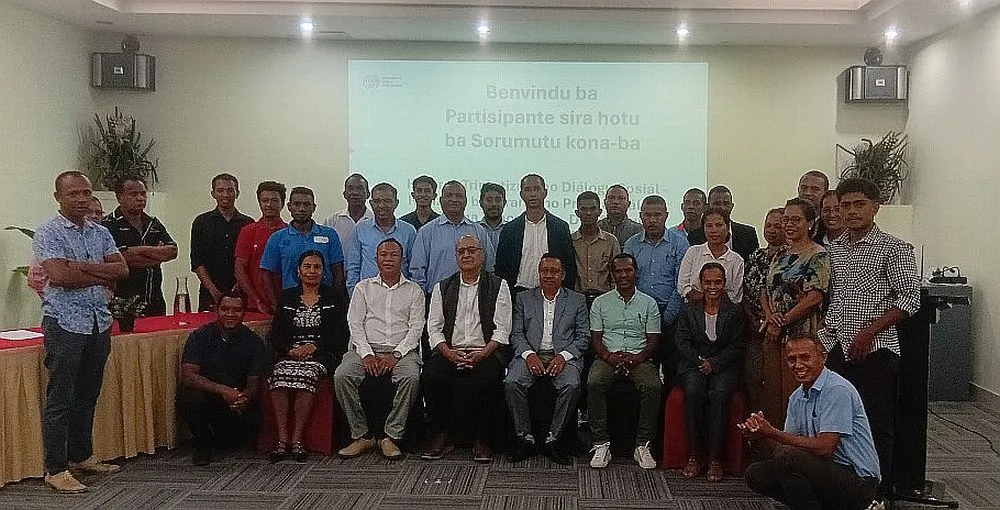
Facilitated by Arun Kumar, ILO Specialist on Collective Bargaining and Social Dialogue, the workshop introduced SAM-SDI, a tool developed by the ILO in partnership with its constituents. “SAM-SDI enables constituents to better understand the strengths and weaknesses of the social dialogue body, improve its inclusiveness and effectiveness and devise an action plan to enhance its performance and impact,” he explained.
Using the SAM-SDI assessment tools, participants conducted a focused review of the NLC’s representation, gender balance, decision-making processes, agenda relevance and methods of work. The assessment highlighted several priorities, including the need to strengthen gender inclusion, clarify membership criteria, enhance technical and research support, and improve communication and follow-up mechanisms. These insights informed the development of recommendations for strengthening the NLC.
As a follow-up, the ILO will continue to support national constituents as they move forward with the Action Plan and advance social dialogue as a foundation for decent work and sustainable development in Timor-Leste.
Arun Kumar, ILO Specialist on Collective Bargaining and Social Dialogue
Tripartite constituents subsequently outlined a set of short-, medium- and long-term actions to improve the functioning of the NLC. Short-term actions include introducing annual and monthly workplans on gender inclusion, establishing clearer representation criteria and improving communication of decisions. Medium- to long-term actions focus on enhancing the NLC Secretariat’s resources and facilities, allocating budget for research on priority labour issues, expanding constituent representation and strengthening systems for monitoring and follow-up.
In closing, participants reaffirmed their commitment to revitalizing the NLC and strengthening social dialogue in Timor-Leste. The initiative forms part of the implementation of Timor-Leste’s Decent Work Country Programme (DWCP), which aims to strengthen tripartite mechanisms and labour governance.
“As a follow-up, the ILO will continue to support national constituents as they move forward with the Action Plan and advance social dialogue as a foundation for decent work and sustainable development in Timor-Leste,” Arun concluded.