

Report
Oman advances a new regional model for rights-based social protection
A new report by the ILO and Oman’s Social Protection Fund highlights how integrated, lifecycle-based social protection aligned with international labour standards can strengthen social justice and economic resilience.
4 June 2026
GENEVA (ILO News) – The International Labour Organization (ILO) and the Social Protection Fund (SPF) of the Sultanate of Oman launched a new joint report highlighting one of the most comprehensive social protection reform processes undertaken in the Arab region in recent decades.
The report, Unlocking the transformative potential of lifecycle social protection through an integrated and multi-tiered system, documents Oman’s journey towards a unified social protection system that expands protection across the lifecycle while strengthening financial sustainability, labour market participation and social cohesion.
Launched during the high-level event Re-envisioning social security in the Sultanate of Oman for the future of work on the sidelines of the 114th International Labour Conference (ILC), the report presents Oman’s experience in reforming fragmented social protection arrangements into a more integrated, inclusive and rights-based system aligned with international labour standards.
The reforms respond to major challenges facing countries globally, including demographic change, labour market transformations, growing demands for social protection, and the need to ensure that social protection systems remain both adequate and financially sustainable.
The report highlights how Oman has expanded protection for children, older persons, persons with disabilities, women and non-national workers through a new lifecycle-based approach that combines contributory and government-financed benefits within a single coherent framework.
Among the reforms documented in the report are the introduction of universal child benefits, universal disability benefits, guaranteed income protection for older persons, expanded maternity and paternity protections, stronger unemployment and employment injury insurance, and the progressive extension of social protection to non-national workers. The reforms also include the consolidation of multiple pension schemes into a unified system and the establishment of a single Social Protection Fund responsible for administering both contributory and government-financed benefits.
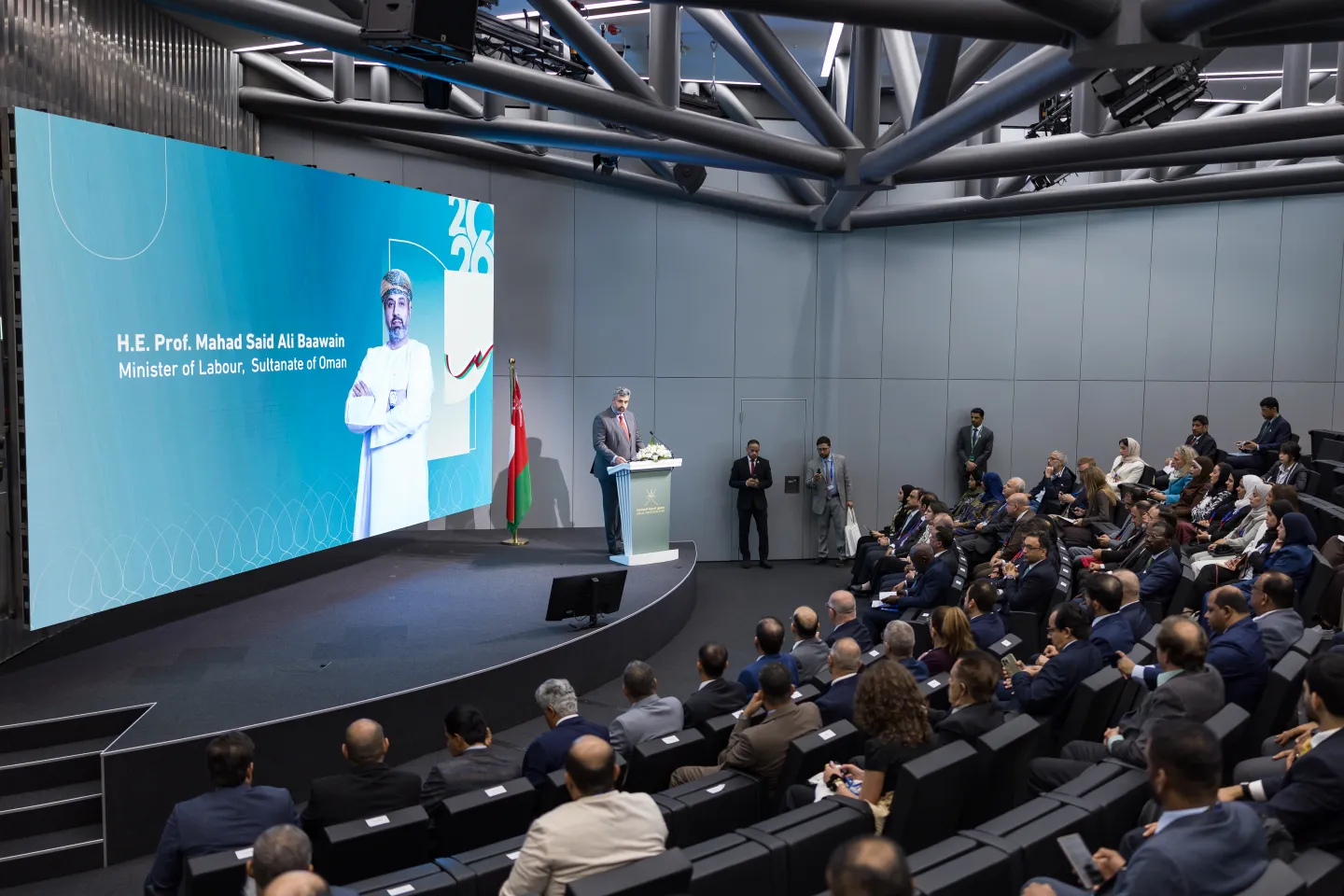
Minister of Labour and Vice-Chairman of the Social Protection Fund of the Sultanate of Oman, H.E Prof. Mahad Said Baawain, highlighted the strategic importance of social protection reform for Oman’s long-term development agenda.
"The reforms represent a strategic shift toward a more integrated, inclusive and sustainable model that is responsive to evolving socioeconomic needs and aligned with international best practices," Minister Baawain said during the opening of the event. "It constitutes a cornerstone of national development efforts that directly supports the realization of Oman Vision 2040 and contributes to the achievement of the Sustainable Development Goals."

Speaking at the launch, ILO Director-General Gilbert F. Houngbo emphasized the broader significance of Oman’s experience.
"Oman's new Social Protection Law represents a historic milestone. It is one of the most comprehensive social protection reforms undertaken in the Arab region in recent decades. Oman's experience shows that social protection reform is not only about adjusting benefits or institutions. It is about renewing the social contract. It is about how societies share risks, protect people across the lifecycle and build confidence in public institutions," Director-General Houngbo said.
Representatives of Oman’s workers and employers highlighted the importance of social dialogue in shaping the reforms and ensuring their long-term success.
"Modern labour markets need modern social protection systems,” said Chairman of the Labour Market Regulation Committee of the Oman Chamber of Commerce and Industry Mohammed bin Hassan Al-Ansi Al-Yafi'i. “The reforms create a more coherent framework that supports workforce participation, labour mobility and productivity while improving confidence in public institutions. By balancing social protection objectives with financial sustainability, Oman is helping to create the conditions for inclusive and sustainable economic growth."
"These reforms show what can be achieved when workers have a seat at the table,” said Chairman of the Board of Directors of the General Federation of Workers of the Sultanate of Oman Nabhan bin Ahmed bin Mohammed Al-Battashi. “Expanding protection for workers and their families, strengthening income security during periods of unemployment, sickness and parenthood, and extending coverage to groups that were previously left behind are important advances for social justice and decent work. Sustained social dialogue will remain essential as implementation continues."
The report argues that social protection should be viewed not as a cost, but as an investment in people, resilience, productivity and social stability. It highlights how integrated social protection systems can help societies manage economic transitions, reduce vulnerability, promote equality of opportunity and support more inclusive labour markets.
Participants at the launch event included representatives of governments, employers' and workers' organizations, international organizations, social security institutions and development partners. Discussions focused on lessons learned from Oman’s reform process and its relevance for countries seeking to strengthen social protection systems in response to changing labour markets and evolving social needs.
The report concludes that Oman’s experience provides an important example of how countries can build social protection systems that are inclusive, sustainable and fit for the future of work, while advancing universal social protection as a foundation for social justice and sustainable development.
Related content
Report
Unlocking the transformative potential of lifecycle social protection through an integrated and multi-tiered system

Project
STREAM - Extending Social Protection to migrant workers and their families in the South Asia-Gulf Corridor
Country Portal
Oman
Relevant projects
Project
STREAM - Extending Social Protection to migrant workers and their families in the South Asia-Gulf Corridor