

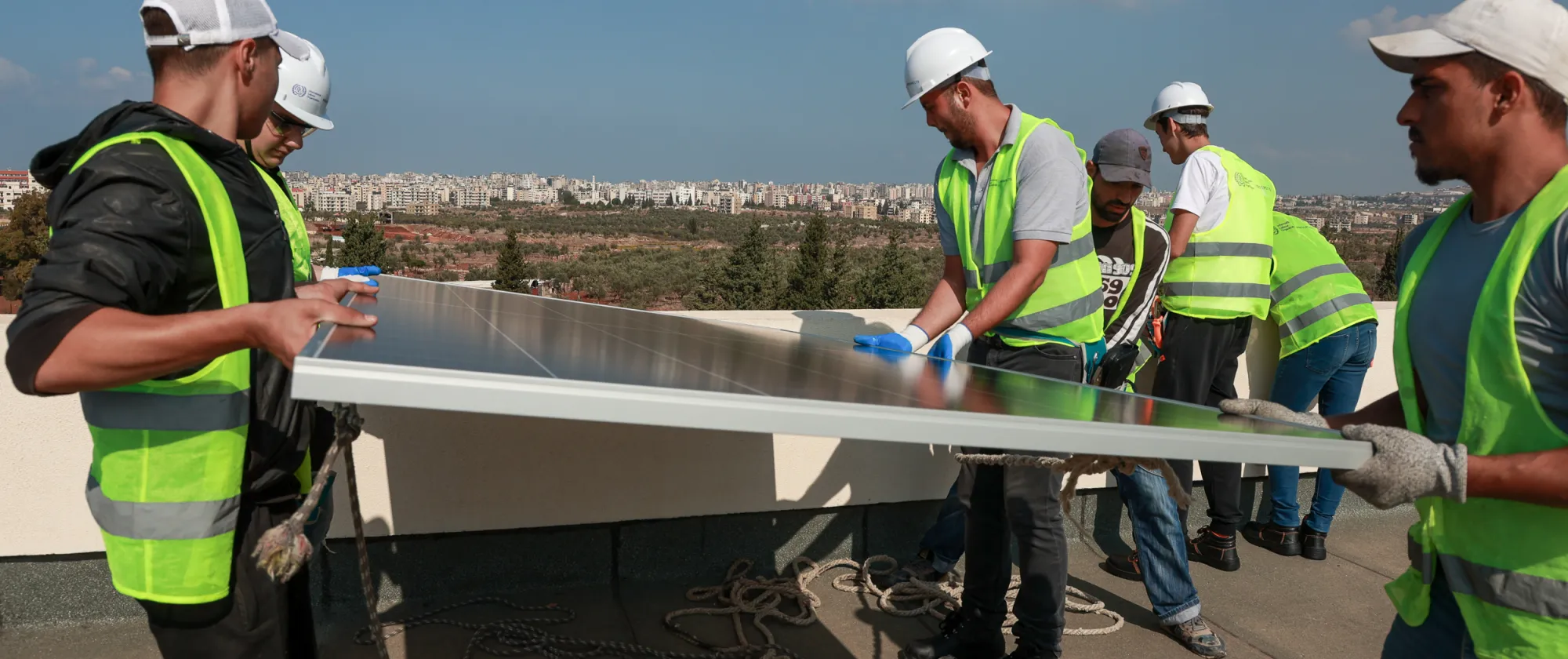
New ILO factsheets reveal linkages between climate challenges and green job opportunities in the Arab States region
New ILO country factsheets present a concise overview on key employment, environment, and climate data for the Arab States region.
24 October 2025
BEIRUT (ILO News) – Climate change is reshaping the world of work across the Arab States, altering employment patterns, threatening livelihoods in climate-sensitive sectors and creating new opportunities for green jobs and businesses, according to new data released today by the International Labour Organization (ILO) Regional Office for Arab States.
Marking International Climate Action Day, the ILO launched a landmark series of Employment, Environment and Climate Nexus Factsheets for 12 countries in the region. The factsheets present the ILO’s first regional evidence base linking labour market dynamics, environmental performance and climate vulnerability.
Key climate, environment and employment data
Across the Arab States’ region, the data shows that climate change and environmental degradation are directly impacting employment and productivity, especially in sectors such as agriculture, construction and energy. Rising temperatures, water scarcity, air pollution and extreme weather are compounding existing challenges of unemployment, informality and gender inequality in labour markets.
Yet these same pressures are also creating new opportunities for green job creation in sectors that can drive inclusive growth while protecting both people and the planet, including renewable energy, sustainable infrastructure and climate-resilient industries.
The factsheets reveal wide disparities across the region in both vulnerability to climate change and readiness to adapt to its impacts, such as extreme heat, water scarcity, desertification and increasingly frequent extreme weather events.
Some of the region’s conflict-affected countries are among the most climate-vulnerable countries in the world, suffer from extremely poor air quality or lack access to clean water and electricity. In contrast, Gulf countries demonstrate stronger institutional readiness but face high emissions.
The data shows that every country in the region exceeds WHO safe limits for air pollution. It highlights that several Arab States are among the hottest inhabited places on Earth, and that without adaptation, the region could lose jobs and working hours due to heat stress.
Green investments can drive job creation
Despite the risks, the factsheets point to significant opportunities for green and decent job creation through renewable energy and climate-resilient sectors. Jordan and Lebanon already employ thousands in solar energy. The Gulf countries are also prioritising renewable energy investments. For example, Oman and Saudi Arabia are expanding large-scale renewable projects under their 2030 strategies, targeting between 30 and 50 per cent renewable energy in electricity generation by 2050.
“The evidence is clear: climate change is not only a threat to nature, but also a labour market challenge that requires coordinated, forward-looking action,” said Mette Grangaard Lund, Just Transition Specialist at the ILO Regional Office for Arab States. “Climate action must go hand in hand with decent work and social justice, and these factsheets will assist countries in the region to develop evidence-based policies and just transition strategies that leave no one behind.”
Developed under the ILO’s regional contributions to the ILO priority action programme on just transition, the factsheets draw on national data and international sources including the ILO’s global database and portal for labour statistics ILOSTAT, the World Bank, IRENA, the Environmental Performance Index, and the Notre Dame Global Adaptation Index.
The full set of Employment, Environment and Climate Nexus Factsheets for the Arab States is now available on the ILO website.
Related content

Green Jobs and Just Transition in the Arab States

Fact sheet
Kingdom of Bahrain: The Employment, Environment, Climate Nexus Factsheet
Fact sheet
Republic of Iraq: The Employment, Environment, Climate Nexus Factsheet
Fact sheet
Hashemite Kingdom of Jordan: The Employment, Environment, Climate Nexus Factsheet
Fact sheet
State of Kuwait: The Employment, Environment, Climate Nexus Factsheet
Fact sheet
Lebanon: The Employment, Environment, Climate Nexus Factsheet

Fact sheet
State of Palestine: The Employment, Environment, Climate Nexus Factsheet

Fact sheet
Sultanate of Oman: The Employment, Environment, Climate Nexus Factsheet
Fact sheet
Qatar: The Employment, Environment, Climate Nexus Factsheet
Fact sheet
Kingdom of Saudi Arabia: The Employment, Environment, Climate Nexus Factsheet

Fact sheet
Syrian Arab Republic: The Employment, Environment, Climate Nexus Factsheet
Fact sheet
United Arab Emirates: The Employment, Environment, Climate Nexus Factsheet
Fact sheet
Republic of Yemen: The Employment, Environment, Climate Nexus Factsheet