

Refugees' access to decent work
National Tripartite Consultation addresses impact of developments in Syria on Turkish labour market
The ILO Office for Türkiye convened government, employers’ and workers’ organizations to explore the economic and labour market impacts of Syrians under Temporary Protection (SuTP) in Türkiye while promoting decent work for all at the tripartite national consultation workshop organized in Ankara.
27 May 2025
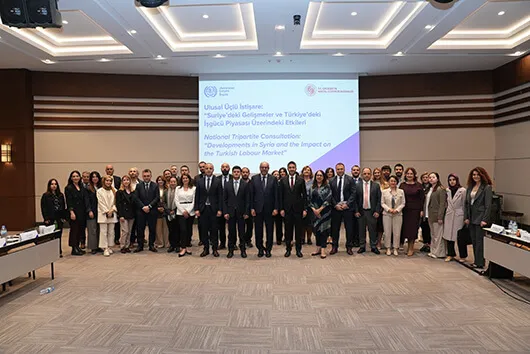
Ankara (ILO News) - Government officials, employers’ and workers’ organizations gathered on 13 May 2025 in Ankara for the National Tripartite Consultation “Developments in Syria and the Impact on the Turkish Labour Market”. The event brought together ILO constituents and key stakeholders to reflect upon the potential socio-economic effects of developments in Syria since December 2024 and the impacts on Türkiye’s labour market.
With Türkiye hosting over 2.8 million Syrians under Temporary Protection, the meeting underscored the urgency of coordinated, inclusive approaches to meet the potential economic and labour market shifts triggered by SuTP returns and the need for balancing support for voluntary returns with efforts to ensure continued social cohesion and economic stability in Türkiye.
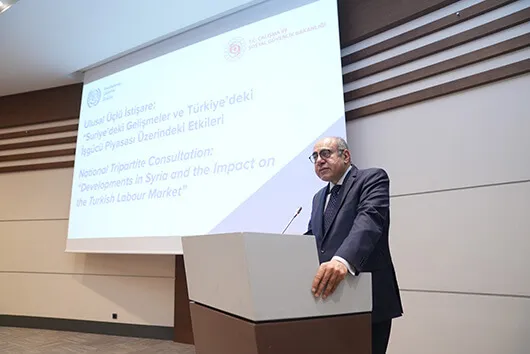
Opening the event, Yasser Hassan, Director of the ILO Office for Türkiye highlighted those policies towards refugees, of which return is a part, entails three types of consideration: humanitarian, legal, and economic. He emphasised that even with the prospect of return, “Refugees still need support where they are. They will continue to need protection in host countries and time to make informed decisions on whether to return home without undue pressure”, Hassan reaffirmed ILO’s commitment to continue its support to Türkiye Türkiye to address the refugees related labour market challenges.
Since the outbreak of the Syrian crisis in 2011, the ILO Office for Türkiye has been working closely with the government, employers' and workers' organizations as well as with municipalities and civil society entities to uphold the right to work and rights at work for all vulnerable groups, including SuTP and host communities. Through a range of programmes, the ILO has supported more than 75,000 individuals—Turkish citizens in host communities, SuTP, and other vulnerable populations—access decent employment opportunities.
In his speech, Director General of Foreign Relations and European Union of the Ministry of Labour and Social Security, Ali Aybey, emphasized Türkiye’s long-standing commitment to inclusive labour policies including for refugees referring to government’s efforts for providing comprehensive services to Syrians without discrimination in many areas from education to health, employment to social assistance, and to ensure access to the labour market and employment in decent jobs. With the recent positive developments in Syria, he reaffirmed that necessary measures are being taken to support the safe, dignified and voluntary return of Syrians who wish to return to their country while examining impact of such movements on the Turkish labour market. “We are analysing scientifically the impact of Syrians’ return to their country on Türkiye. Social dialogue is one of the most valuable tools to manage this process”, Aybey stated.
ILO social partners also shared their views how events in Syria influence Türkiye’s job market.
Representative of Confederation of Employer Association (TİSK) highlighted the importance of efficient efforts to fight with informality and made policy proposals in line with the needs of the labour market. The Confederation of Unions of Tradesmen and Craftsmen (TESK) emphasized that the current change is more than a demographic challenge as it impacts social unity, economic systems and regional stability and during such a pivotal period it is essential that all key stakeholders including local authorities, civil society and municipalities to build a unified effort to ensure decent work conditions for all.
The Confederation of Turkish Real Trade Unions (HAK-İŞ) President Mahmut Arslan stressed the importance of Türkiye’s welcoming approach to host Syrian refugees over the years and “As unions, we support human rights and equal working conditions for Syrians. We want them to be unionized, protected and part of the system, not stay outside of it”, he said.
The Confederation of Turkish Trade Unions (TÜRK-İŞ) Vice President Ramazan Ağar reminded the low unionization of Syrian workers and challenges they face in the labour market while underlining the benefits of the unionization to exercise labour rights.
The Confederation of Revolutionary Trade Unions of Türkiye (DİSK) representative referred to challenges Syrians still face in the workplace due to the high informality, and he underscored the importance of decent work and formal employment as not an ideal but a concrete objective.
Shared commitment to strengthen policy coordination
Building on an overview of the Syrian refugee feedback from people who were returning to Syria provided by Angela Li Rosi, the UNHCR Representative in Türkiye, who emphasized that return is not a fixed concept but a gradual process influenced by different considerations mostly related to situation in Syria itself, and that socio-economic data on refugees in host countries remains critical for designing targeted programs that effectively support them within national contexts, the ILO Office for Türkiye Project Manager, Frida Khan, shared good practices of integration of refugees in host country labour markets based on ILO’s work in the region. She explained how lessons could be taken to design return programmes “that are not only voluntary, safe and dignified, but also successful and sustainable”.
The consultation concluded with the need for a renewed commitment to strengthen policy coordination and explore sustainable solutions that balance social and economic development and labour market resilience in Syria and in host countries.
The workshop will also set the base for discussions planned at an upcoming Regional Tripartite Consultation Workshop to be organised, to discuss regional approaches to supporting successful, voluntary return, the impact on labour markets in the region, and best practices of labour market integration and social cohesion in host countries.